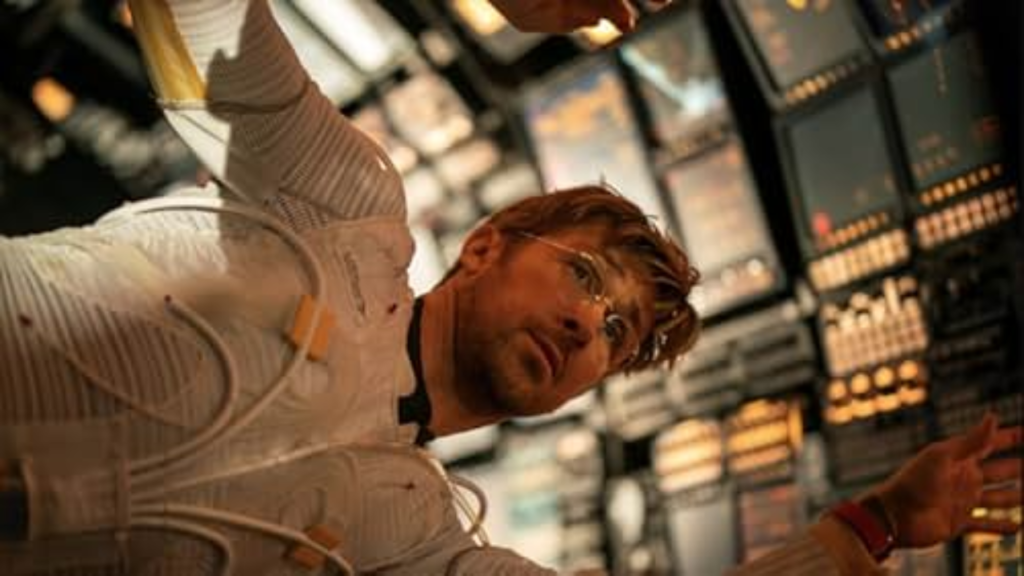
Project Hail Mary is entering its second weekend with the kind of momentum that signals more than just a strong opening, with the Project Hail Mary box office continuing to show impressive stability. After an impressive debut, the film is now eyeing a second weekend of around $45 million, with projections suggesting a drop in the range of 40–45%. That trajectory closely mirrors the hold of Dune: Part Two in 2024, a benchmark often associated with strong audience retention. In a market where big releases frequently fall by over 50% in their second weekend, this kind of stability is both notable and increasingly rare.
The film has already crossed the $100 million mark at the domestic box office within its first six days, establishing itself as one of the fastest performers of the year. Overseas, it has collected approximately $60 million so far, taking its worldwide total to over $160 million early in its run. What stands out here is not just the scale of the numbers, but the balance — the film is not relying solely on domestic strength, but is finding consistent traction across international markets as well.
This performance becomes even more significant when viewed in the context of the film’s positioning. While not an original screenplay, Project Hail Mary is a faithful adaptation of Andy Weir’s widely popular novel, carrying with it an existing fanbase that has played a crucial role in shaping its reception. Early audience scores and strong word-of-mouth suggest that fans of the book have responded positively, helping drive repeat viewings and sustained interest beyond the opening weekend.
Several factors are contributing to this strong hold, but one of the most important lies at the heart of the film itself — its emotional core. Beyond the scale and spectacle, audiences are responding strongly to the relationship between Ryland Grace and the alien engineer Rocky. That dynamic, built on trust, humor, and unexpected companionship, has emerged as a key driver of audience engagement. It’s not just the visuals that are bringing people back, but the connection between the characters, giving the film a layer of emotional resonance that extends beyond typical sci-fi storytelling.
The film’s continued presence in premium formats, including IMAX and other large-screen experiences, is also playing a significant role. A substantial portion of its revenue is coming from these higher-priced formats, reinforcing its status as a theatrical event. At the same time, rolling spring breaks across schools and colleges are helping sustain weekday footfalls, creating a strong bridge into the second weekend.
At the center of this success is Ryan Gosling, who continues to build a reputation for choosing projects that combine scale with emotional depth. With Project Hail Mary, he adds another $100 million-plus domestic performer to his filmography, following Barbie and La La Land. More importantly, the film reinforces his ability to anchor high-concept material while keeping it grounded in character-driven storytelling.
The competitive landscape further highlights the film’s strength. Over the weekend, it is successfully holding its ground against new and existing releases, including the debut of Dhurandhar: The Revenge and the second weekend of Disney/Pixar’s Hoppers. Despite these competing titles, Project Hail Mary continues to dominate premium screens and maintain audience attention, underlining the strength of its hold.
Looking ahead, the film’s trajectory suggests a strong long-run potential. Based on current trends — including its second weekend hold, premium format retention, and audience reception — early projections place it in the $400 million to $600 million worldwide range. While these estimates will ultimately depend on how the film performs in the coming weeks, the foundation for a sustained theatrical run is clearly in place.
Beyond the numbers, however, Project Hail Mary is beginning to carry broader industry significance. At a time when the box office is largely driven by sequels, reboots, and established cinematic universes, its performance reinforces the viability of concept-driven storytelling rooted in strong source material and emotional engagement.
That success naturally opens up another conversation — one centered on the film’s future. Industry chatter has already begun to suggest that Project Hail Mary could evolve beyond a single-film narrative. While no official sequel has been announced, the combination of strong box office performance, expansive world-building, and audience connection positions it as a viable candidate for franchise development.
This possibility aligns closely with the broader ambitions of Amazon MGM Studios, which has been steadily establishing itself as a major force in Hollywood. As the studio continues to invest in large-scale theatrical releases, the need for sustainable, long-term intellectual property becomes increasingly important. In today’s landscape, franchises are not just valuable — they are essential.
In that context, Project Hail Mary may represent more than a successful release. It has the potential to become a foundational property — one that could expand through sequels, spin-offs, or further exploration of its narrative universe. Whether that path is pursued will depend on both creative direction and continued audience demand, but the early indicators are clearly promising.
For now, the film’s immediate focus remains on sustaining its theatrical run. But its performance already suggests something larger — a shift from a strong opening to a stable, long-term presence at the box office.
In an industry increasingly defined by pre-existing brands, Project Hail Mary is doing something relatively rare. It is not just opening like an event film — it is holding like one. And in doing so, it may be laying the groundwork for something far bigger than a single release.
Read More: