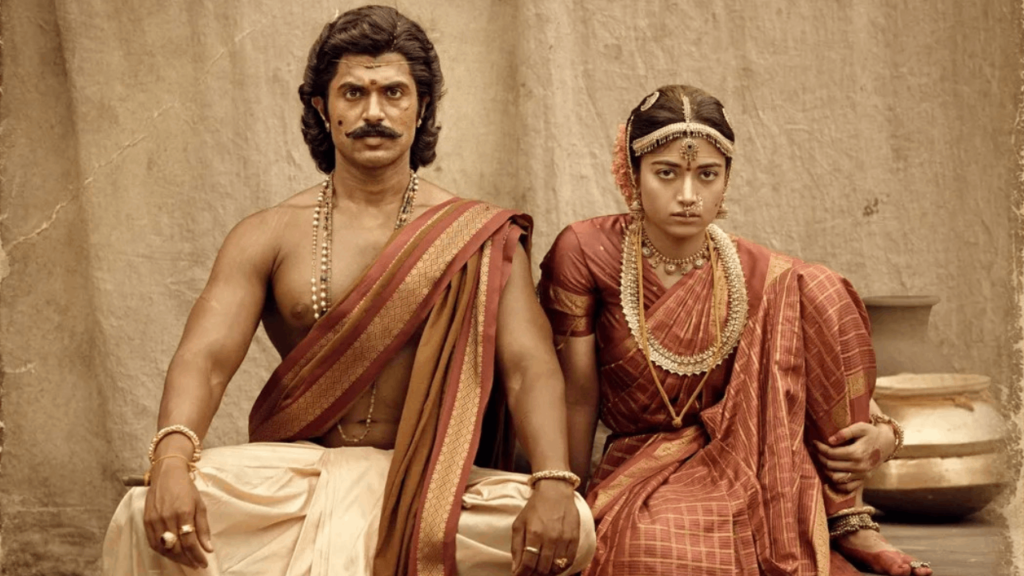
Vijay Deverakonda and Rashmika Mandanna reunite in Ranabaali, director Rahul Sankrityan’s Telugu period drama set against the Great Madras Famine of 1876–78. The film follows Singanamala Bobbili Ranabaali, a warrior who rises against British colonial exploitation as famine devastates his community. While critics acknowledge the film’s historical ambition, striking visuals and committed lead performances, many argue that excessive violence and uneven storytelling undermine its emotional impact.
Reviews from The Hollywood Reporter India, The Hindu, NDTV and The Indian Express question whether the film successfully transforms a devastating chapter of history into a compelling human drama.
Vijay Deverakonda’s commitment to the title role emerges as one of the film’s strengths, although critics differ on how effectively the screenplay develops his character. Yashaswini Sri of The Indian Express, which awarded the film 2.5 out of 5 stars, notes that Vijay convincingly captures the Rayalaseema dialect and meets the physical demands of the role. However, she feels that Ranabaali becomes increasingly defined by anger, righteousness and determination as the narrative shifts towards rebellion and warfare.
Latha Srinivasan of NDTV, which rated the film 2 out of 5, similarly acknowledges Vijay’s intensity and dedication but argues that the character’s heroism comes at the expense of deeper emotional exploration.
Rashmika Mandanna receives particular appreciation for her portrayal of Jayamma, Ranabaali’s wife. Both NDTV and The Indian Express highlight the warmth she brings to the story, with the latter finding the couple’s quieter domestic moments more compelling than much of the surrounding action. The Hollywood Reporter India also praises the chemistry between the lead actors, describing Jayamma as a welcome presence in a film that otherwise struggles to maintain its emotional balance.
The depiction of colonial exploitation and famine lies at the heart of the critical response. The Hollywood Reporter India sees considerable potential in the subject and highlights moments that convey the human cost of starvation, including scenes centred on a child’s understanding of pain and a mother’s guilt. However, the review argues that these emotionally powerful moments are frequently overwhelmed by the film’s emphasis on action and dramatic excess.
Kairam Vaashi, reviewing the film for The Hollywood Reporter India, also highlights its visual treatment of famine and its carefully constructed period setting. He praises the cinematography and art direction but believes the film relies too heavily on familiar genre conventions and predictable storytelling.
Srinivasan of NDTV is more critical of the violence, arguing that the graphic depictions of starvation and suffering, along with repeated clashes, become exhausting rather than moving. She also feels that the second half loses momentum as the narrative repeatedly returns to confrontations between Ranabaali and the British.
Sri of The Indian Express raises a similar concern, arguing that the film repeatedly prioritises violent spectacle over the emotional impact of the atrocities it depicts. She also criticises the screenplay for becoming repetitive, with scenes revisiting points the story has already established.
The production design and cinematography help establish the film’s 19th-century setting. The Indian Express praises the convincing recreation of Rayalaseema in the 1870s, while NDTV acknowledges the visual scale and bleak atmosphere created by cinematographers Nirav Shah and Jishnu Bhattacharjee.
However, these technical achievements do not fully compensate for the film’s pacing and writing problems. NDTV feels that the nearly three-hour runtime could have been shortened, while The Indian Express criticises Ajay-Atul’s background score for failing to reinforce the emotional weight of key scenes. The Hollywood Reporter India finds more effective moments in the music but argues that the film’s individual dramatic successes are often buried beneath its broader, action-driven approach.
Overall, the reviews suggest that Ranabaali has a compelling historical premise and benefits from committed performances, particularly from Vijay Deverakonda and Rashmika Mandanna. Its visual recreation of famine-era Rayalaseema also gives the film a strong sense of scale. However, critics repeatedly identify graphic violence, repetitive storytelling and underdeveloped emotional arcs as major shortcomings.
The film seeks to draw attention to a painful chapter of colonial history, but the critical response suggests that its ambition is not consistently matched by its execution. While its performances and period visuals earn appreciation, the excessive violence and uneven narrative prevent the historical drama from delivering its full emotional potential.
Watch Trailer:
Film Details: Ranabaali
- Director: Rahul Sankrityan
- Cast: Vijay Deverakonda, Rashmika Mandanna, Arnold Vosloo
- Screenplay: Rahul Sankrityan; Pramod Tammineni is also credited as a co-writer in coverage of the film
- Music: Ajay-Atul
- Cinematography: Nirav Shah and Jishnu Bhattacharjee
- Editor: Karthika Srinivas
- Production Company: Mythri Movie Makers
- Language: Telugu