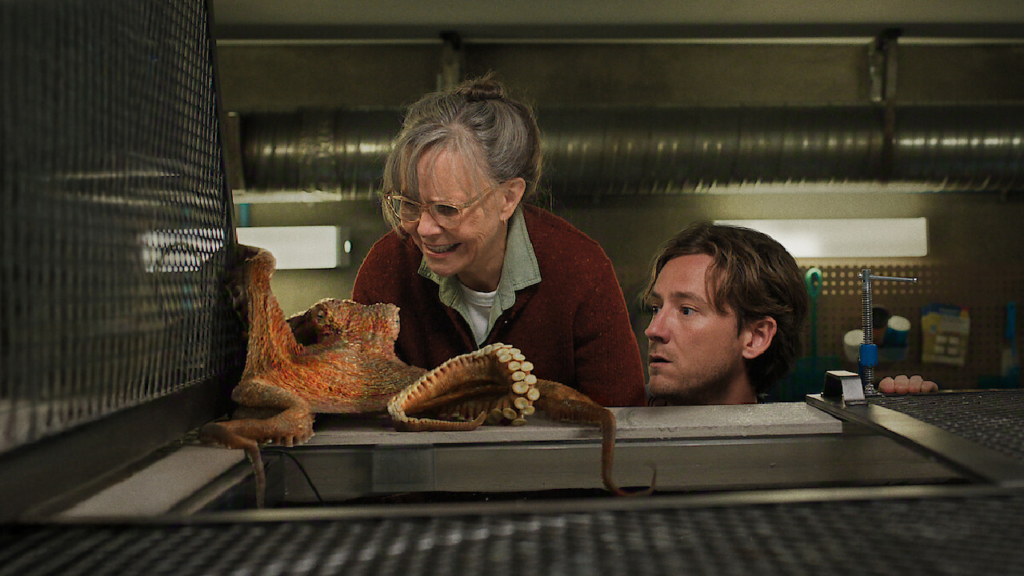
Netflix’s latest literary adaptation has arrived with an unusual emotional hook — a grieving widow, a drifting young man, and a highly intelligent octopus observing them both. The Remarkably Bright Creatures Review Roundup suggests that critics are largely won over by the film’s warmth, sincerity, and performances, even as some reviewers argue that the emotional drama becomes overly sentimental and formulaic.
Directed by Olivia Newman and adapted from Shelby Van Pelt’s bestselling novel, Remarkably Bright Creatures centers on Tova Sullivan, an elderly widow still quietly carrying the grief of losing both her husband and her son decades earlier. Working as a night cleaner at a small aquarium in the Pacific Northwest, Tova forms an unusual bond with Marcellus, a giant Pacific octopus voiced by Alfred Molina, who secretly observes the emotional struggles of the humans around him. When a drifting young man named Cameron arrives in town searching for answers about his past, the lives of all three characters begin to intertwine through themes of loneliness, healing, and second chances.
One point of near-universal agreement among critics is the strength of Sally Field’s performance. Even reviewers who were less enthusiastic about the film itself repeatedly praised Field for grounding the movie’s sentimentality with emotional honesty and warmth. Pete Hammond of Deadline describes Field as the emotional center of the film, praising her ability to balance grief, humor, vulnerability, and quiet resilience throughout the story. Hammond argues that the actress gives the film emotional credibility, elevating what could have easily become a simplistic tearjerker into something genuinely moving.
Similarly, Matt Goldberg of TheWrap says Field “shines” in the lead role, writing that her performance helps the movie avoid collapsing into Hallmark-style sentimentality. Goldberg praises the way Field plays Tova as emotionally reserved but deeply human, making the character’s loneliness feel authentic rather than exaggerated. According to him, her chemistry with Lewis Pullman becomes one of the film’s strongest emotional anchors.
That emotional dynamic between Field and Pullman also receives widespread praise across reviews. Critics repeatedly highlight how the surrogate mother-son relationship between Tova and Cameron becomes the film’s emotional backbone. Molly Freeman of ScreenRant praises the performances for making the relationship feel natural and lived-in, calling the pairing “immediately compelling” because both characters are emotionally damaged in different ways. Freeman notes that Pullman’s laid-back charm works particularly well opposite Field’s more guarded and grieving presence.
Another major talking point among critics is the film’s unusual narrator — Marcellus the octopus. While the idea initially struck some reviewers as potentially too whimsical, many ended up praising the execution. Pete Hammond calls Alfred Molina “perfectly chosen” for the role, highlighting how his narration gives the story both humor and emotional perspective. Hammond especially praises Marcellus’ cynical observations about humanity, describing the octopus as a “wise beyond his years” observer who becomes the emotional guide for the film’s characters.
Molly Freeman similarly describes Marcellus as the film’s “scene-stealer,” praising both the CGI work and Molina’s vocal performance. She argues that the character could have easily become distracting or gimmicky, but instead emerges as one of the adaptation’s most emotionally effective elements.
Much of the positive critical response also centers on the film’s comforting emotional tone. Several critics compare the movie to old-fashioned crowd-pleasing dramas that prioritize warmth and emotional connection over narrative complexity. Matt Goldberg describes the film as “comforting, uplifting, and charming,” arguing that the movie succeeds because it never pretends to be more cynical or self-aware than it actually is. He acknowledges that the story is emotionally tidy, but believes the sincerity ultimately works in its favor.
Likewise, Pete Hammond calls the film a “sweet healing story,” praising Olivia Newman’s direction for maintaining a delicate emotional balance throughout. Hammond suggests that in a cinematic landscape dominated by darker and more abrasive storytelling, Remarkably Bright Creatures stands out precisely because of its softness and optimism.
But not all critics were convinced by the film’s emotional approach. The biggest criticism across negative and mixed reviews revolves around sentimentality and narrative convenience. Guy Lodge of Variety delivers one of the harshest assessments, describing the film as “a melodrama of distinctly average intelligence.” Lodge criticizes the screenplay for relying too heavily on contrived coincidences, overly tidy emotional reveals, and what he calls “cornball coincidence.” While he praises Sally Field’s performance and acknowledges the film’s comforting intentions, he argues that the story itself often feels emotionally manipulative rather than genuinely profound.
Lodge also criticizes the film’s increasingly elaborate emotional construction, arguing that the script stretches simple revelations across nearly two hours despite the audience being able to predict most of the twists early on. He believes the adaptation leans so heavily into emotional comfort that it avoids meaningful dramatic conflict altogether.
Even some of the film’s supporters acknowledge similar weaknesses. Matt Goldberg notes that the movie occasionally edges dangerously close to Hallmark territory, though he argues the performances and craftsmanship help prevent it from becoming overly shallow. Meanwhile, Molly Freeman admits that while the film is emotionally resonant, it does not fully distinguish itself from other comforting literary adaptations beyond the novelty of its octopus narrator.
The Rotten Tomatoes reactions further reflect this divide. Sebastian Zavala Kahn of Loud and Clear Reviews praises the film’s sincerity and emotional honesty, appreciating its willingness to embrace warmth without irony. Brian Orndorf of Blu-ray.com similarly highlights the emotional themes and strong central performances. On the more negative side, Nick Schager of The Daily Beast criticizes the movie’s overwhelming corniness, while Russ Simmons of KKFI-FM argues that the predictable script is rescued primarily by the strength of the cast. Megan Lachinski of Next Best Picture also notes that while the atmosphere and emotional tone work well, the film’s thematic exploration remains somewhat surface-level.
What becomes increasingly clear across the review roundup is that critics believe Remarkably Bright Creatures succeeds far more through emotional sincerity and performance than through storytelling sophistication. The film does not attempt to reinvent literary adaptation formulas or challenge audiences structurally. Instead, it embraces straightforward emotional comfort, relying heavily on Sally Field’s performance, Alfred Molina’s narration, and the gentle emotional rhythms of the story.
For some critics, that sincerity becomes the movie’s greatest strength. For others, it becomes proof that the adaptation plays things too safely. But even many of the film’s harsher reviews acknowledge that there is something emotionally genuine underneath the sentimentality.
Ultimately, Remarkably Bright Creatures appears destined to resonate most strongly with audiences looking for warmth, healing, and emotionally accessible storytelling rather than sharp dramatic complexity. Critics may disagree on how effective the film ultimately is, but many seem to agree that its heart is unmistakably in the right place.
Film Details:
- Remarkably Bright Creatures (2026)
- Release Date: May 8, 2026
- Director: Olivia Newman
- Based on: Remarkably Bright Creatures by Shelby Van Pelt
- Cast: Sally Field, Lewis Pullman, Alfred Molina, Joan Chen, Kathy Baker
- Platform: Netflix
- Genre: Drama
- Runtime: 1h 51m
Read More Review Roundups on POF