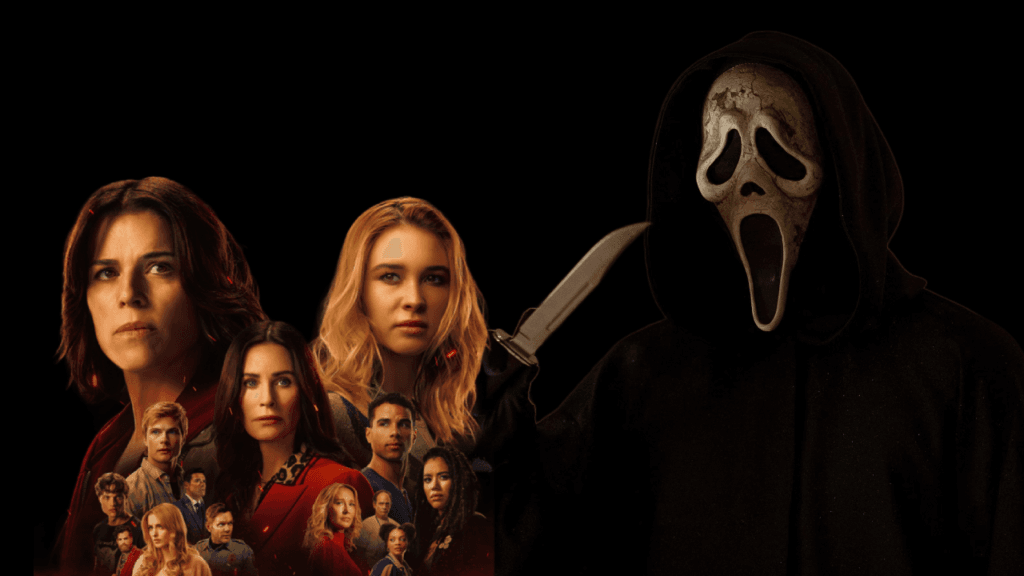
Three decades after she first outran Ghostface, Sidney Prescott is back — and so is the debate over whether this franchise still has a pulse. Scream 7 marks the first installment directed by franchise creator Kevin Williamson, positioning itself as a return to the series’ roots after the mythology-heavy sprawl of the last two entries. But now that major publications have weighed in, the critical consensus suggests a sequel caught between nostalgia and fatigue.
The numbers tell part of the story. With a Rotten Tomatoes score hovering around the high 30s and a similarly low Metacritic average, Scream 7 has emerged as one of the franchise’s most divisive — and among its lowest-rated — entries. While some critics applaud its streamlined focus and Neve Campbell’s central return, others argue that the back-to-basics approach exposes how thin the formula has become.
At Variety, Owen Gleiberman encapsulates the tension in a single line: “Williamson has gone back to basics, but… is really just… basic.” For Gleiberman, the film carries enough shocks to satisfy opening-weekend audiences, yet it lacks the clever, booby-trapped inventiveness that once defined the series. The meta-commentary — once its sharpest weapon — feels muted, almost obligatory. The franchise that once deconstructed horror tropes now seems content to recycle them.
That criticism intensifies at RogerEbert.com, where Brian Tallerico offers one of the harshest takes in the first wave of reviews. Calling the film “genuinely inept in every way… far and away the worst of the franchise,” Tallerico argues that its attempts to replicate past thrills land hollow. In a pointed metaphor, he writes that “every one of the ‘hits’… plays like a cover so lame that you wonder why you even liked the song in the first place.” For him, the film doesn’t just feel repetitive — it feels exhausted.
Not every outlet is as blunt. Benjamin Lee at The Guardian describes the sequel as “a scrappy, passably entertaining new chapter that limps to the screen with wounds on show.” His review acknowledges the turbulence surrounding the production — cast shake-ups, salary disputes, and directorial changes — and suggests that the instability lingers onscreen. Yet Lee stops short of dismissing the film outright, recognizing its entertainment value even as he questions its necessity.
On the more positive end of the spectrum, Deadline’s Pete Hammond takes a fan-forward view, writing, “It may have taken 30 years for Williamson to finally get to steer his own ship… fans will approve.” Hammond frames the film as a corrective measure — a deliberate recalibration after recent entries became too dense with lore and self-reference. Similarly, Kristy Puchko at Mashable declares, “The Scream franchise just got fun again… a return to form,” arguing that its stripped-down structure restores clarity to the narrative.
If there is one point of broad agreement, it’s Neve Campbell’s return. As Sidney Prescott — now a mother protecting her teenage daughter — Campbell anchors the film with emotional continuity. Critics repeatedly note that her presence restores gravity to a franchise increasingly adrift in meta excess. Even some negative reviews concede that Campbell brings sincerity and strength to the role, grounding the film’s generational stakes.
Courteney Cox’s Gale Weathers returns as well, though critics largely describe her arc as serviceable rather than transformative. The younger ensemble — including Isabel May and returning cast members like Jasmin Savoy Brown — fulfills franchise expectations, but few reviewers suggest they redefine the dynamic. A grisly high-school theater sequence has been singled out as one of the film’s more inventive set pieces, yet overall, critics observe that the kill design lacks the audacious creativity of earlier installments.
The central debate hinges on the “back-to-basics” promise. Supporters see a welcome return to simplicity: a tighter focus on Sidney, fewer convoluted mythology threads, and cleaner narrative stakes. Detractors argue that simplicity crosses into predictability. The revelation that Ghostface may once again be more than one person lands less like a twist and more like a procedural obligation. After seven films, the once-thrilling question — “Who’s under the mask?” — carries diminished urgency.
Several reviews point out that the franchise’s original genius lay in its cultural awareness. The 1996 film arrived as a razor-sharp critique of horror conventions, blending satire with suspense. In contrast, Scream 7 offers only scattered flashes of that self-awareness. The horror-geek commentary, once central to the series’ identity, is reduced to brief exchanges rather than driving the film’s structure. As Gleiberman implies, the series seems aware that its meta playbook has run dry — but it doesn’t quite find a replacement.
From a technical standpoint, critics describe Williamson’s direction as competent but cautious. The visual language prioritizes functionality over flair. Marco Beltrami’s score delivers familiar tonal cues, reinforcing the sense that this is a stabilizing chapter rather than a reinvention. For some viewers, that conservatism may feel reassuring. For others, it underscores a franchise unwilling — or unable — to evolve.
Ultimately, Scream 7 stands as a film defined less by shock than by reflection. It leans heavily on legacy, inviting audiences to reconnect with Sidney Prescott’s resilience. Whether that’s enough depends largely on expectations. For longtime fans, the nostalgia and Campbell’s performance may outweigh structural shortcomings. For critics seeking a revitalized franchise voice, the film feels like survival mode rather than creative rebirth.
Released by Paramount Pictures, Scream 7 is directed by Kevin Williamson and written by Williamson and Guy Busick. The cast includes Neve Campbell, Courteney Cox, Isabel May, Jasmin Savoy Brown, Mason Gooding, Matthew Lillard and others. Rated R, the film runs 114 minutes and opened in U.S. theaters on February 27, 2026.
Read More Review Roundups on POF