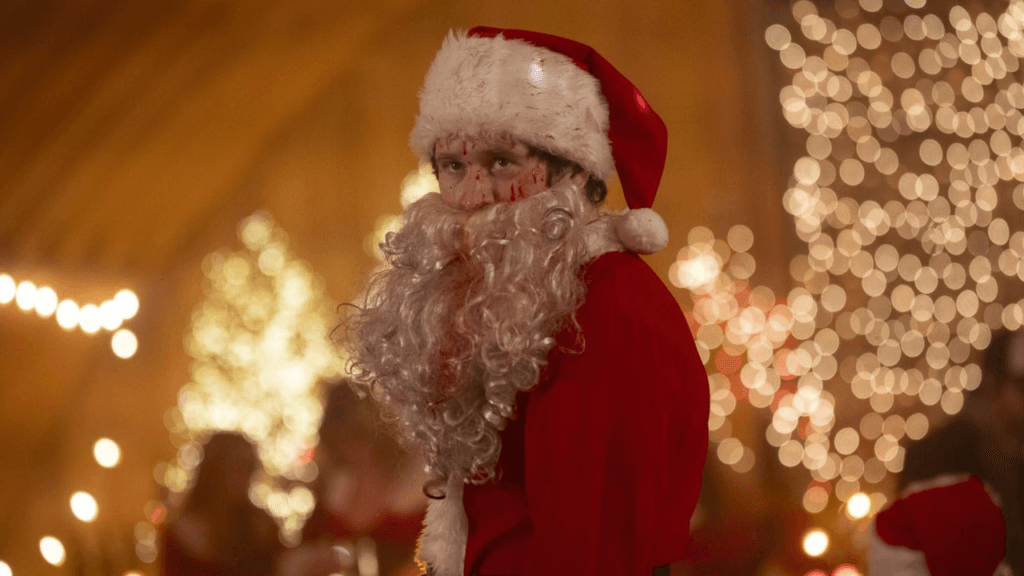
Few horror titles arrive with as much historical baggage as Silent Night, Deadly Night. First released in 1984, the original film became infamous for its killer-Santa imagery and the moral panic that followed. More than four decades later, the name still provokes strong reactions, which makes the 2025 iteration — written and directed by Mike P. Nelson — a particularly risky proposition. This version marks the second remake after 2012’s Silent Night and stands as the seventh overall entry in the franchise, arriving at a time when legacy horror properties are being re-examined, retooled, and often radically reinterpreted.
Premiering as a secret screening at Fantastic Fest before its December theatrical release, Silent Night, Deadly Night entered the conversation with a mixture of curiosity and skepticism. Could a title once synonymous with controversy find new relevance in a post-“elevated horror” landscape? Or would it remain trapped by its past, unable to justify its existence beyond nostalgia and provocation? As critics weighed in, a clear pattern began to emerge: this was not a universally embraced revival, but neither was it dismissed outright. Instead, the film sparked one of the year’s more sharply divided horror debates.
At the center of those reactions lies the film’s story. The narrative opens on Christmas Eve, when eight-year-old Billy Chapman witnesses his parents’ brutal murder by a man dressed as Santa Claus during a roadside encounter. The killer, later revealed to be Charlie, a janitor at Billy’s grandfather’s care home, leaves the boy alive after a strange physical encounter marked by an unexplained electrical surge. Years later, Billy lives a transient adult life, emotionally isolated and drifting from town to town. As Christmas approaches once more, he begins hearing a disembodied voice identifying itself as Charlie, urging him to “punish” the “naughty.” Guided by an Advent calendar ritual that demands a killing for each day leading up to Christmas, Billy embarks on a violent spree while concealing his identity behind a Santa costume. His arrival in the town of Hackett, his relationship with Pamela “Pam” Sims, a parallel investigation into missing children, and the eventual revelation of a cyclical supernatural inheritance push the film toward a bleak, morally tangled conclusion that reframes punishment as contagion rather than closure.
That ambition — both narrative and thematic — is where critics largely agree the film becomes most interesting, even when they disagree on whether it ultimately works. On Rotten Tomatoes, the film holds an 81% approval rating from 63 critics, suggesting broad but cautious support. Metacritic paints a more reserved picture, with a score of 52 based on 14 reviews, firmly in “mixed or average” territory. The gap between those numbers reflects a deeper divide in critical response.
Mainstream outlets tended to approach Silent Night, Deadly Night with restraint, acknowledging its intentions while questioning its execution. IndieWire characterized the film as ambitious but uneven, noting that Mike P. Nelson attempts to expand the mythology far beyond a conventional slasher framework. The Advent calendar structure, supernatural voice, and inherited violence intrigued the publication, but it argued that these ideas occasionally overburden the film, pulling focus away from the raw momentum that traditionally powers the genre. Rohan Campbell’s performance, however, was singled out as a major strength, grounding the chaos in emotional intensity even when the narrative sprawls.
Variety struck a similar tone, calling the film an improvement over the franchise’s reputation but ultimately labeling it a mixed bag. The trade publication appreciated the atmospheric intent and sharper craft compared to earlier entries, yet pointed to tonal inconsistency — a film caught between psychological horror, pulp slasher thrills, and social commentary. For Variety, Silent Night, Deadly Night never fully settles into a dominant mode, leaving its impact uneven.
RogerEbert.com echoed these concerns, arguing that the film frequently hesitates when it should escalate. The review suggested that while the central concept is compelling, the pacing falters, particularly in moments where emotional tension should crest. The result, in their view, is a film that gestures toward depth without always delivering the catharsis its premise promises.
If mainstream critics were cautious, traditional press outlets were more openly skeptical. The Guardian was among the film’s sharpest detractors, criticizing it as overstuffed and narratively unfocused. The review questioned whether reviving Silent Night, Deadly Night served any purpose beyond brand recognition, arguing that the film piles ideas on top of one another without allowing any to resonate fully. For the publication, the remake felt unnecessary rather than revelatory, a symptom of franchise fatigue rather than creative urgency.
Yet within genre circles, the reaction was markedly warmer. ScreenAnarchy emerged as one of the film’s strongest champions, describing it as one of the better entries in the franchise’s long and uneven history. The site praised the film’s commitment to Christmas horror iconography, its willingness to get strange, and its unapologetic embrace of blood-soaked spectacle. Rather than penalizing the film for excess, ScreenAnarchy viewed that excess as part of its appeal.
Bloody Disgusting also responded positively, framing the film as a reclamation of the title for modern horror audiences. The outlet highlighted Mike P. Nelson’s genre credentials and applauded the darker mythology woven into Billy’s arc. Rohan Campbell’s performance was again singled out, with the site emphasizing how his portrayal anchors the supernatural elements in palpable trauma. For Bloody Disgusting, the film succeeds precisely because it refuses to sand down its rough edges.
Empire occupied a middle ground but leaned favorable, acknowledging the film’s flaws while embracing its mood, gore, and seasonal specificity. The publication framed Silent Night, Deadly Night less as prestige horror and more as a solid, confidently strange Christmas slasher — a film that understands its niche and plays to it effectively.
Other outlets fell somewhere between these poles. SlashFilm appreciated the film’s attempt to explore trauma, punishment, and inherited violence but felt the final act became overly convoluted, diluting its emotional payoff. Collider described the film as better than expected, noting that fans of holiday horror would likely find plenty to enjoy, particularly when the film embraces pulp rather than solemnity.
Across these responses, a pattern emerges. Silent Night, Deadly Night is not rejected for laziness or cynicism; rather, it is debated for its ambition. Critics who value coherence and restraint tend to see a film weighed down by ideas. Those more receptive to genre maximalism view the same qualities as strengths. What unites most reactions is respect for the attempt — an acknowledgment that this is not a hollow cash-in, but a serious, if divisive, reimagining.
That divide ultimately defines the film’s place in the 2025 horror landscape. Silent Night, Deadly Night premiered as a secret screening at Fantastic Fest on September 21, 2025, before receiving a theatrical release in the United States on December 12, 2025, distributed by Cineverse. Written and directed by Mike P. Nelson, the film stars Rohan Campbell as Billy Chapman, with Ruby Modine, Mark Acheson, David Lawrence Brown, and David Tomlinson in key supporting roles. After years of stalled development and shifting creative hands, the film arrives as a late-stage revival that neither erases its past nor fully escapes it. Instead, it carves out a space as a modern cult-leaning Christmas horror film — one that may never achieve consensus, but has clearly found its audience.
Read more POF Review Roundups