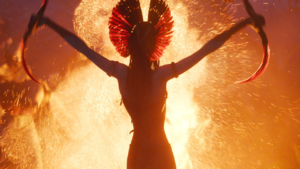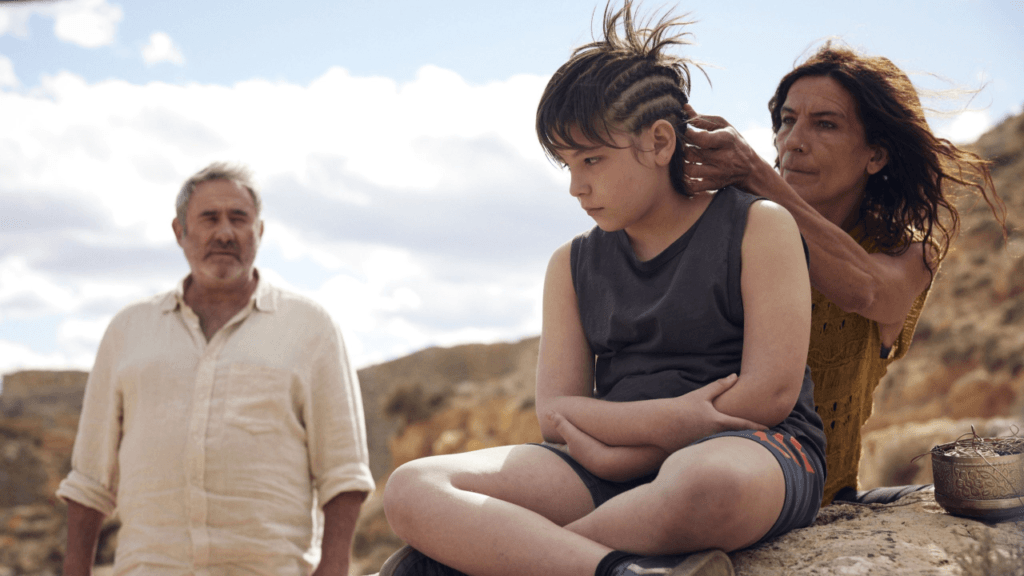
In a year crowded with spectacle and franchise cinema, Sirāt (2025) review roundup arrives as something altogether different — a film that asks for patience, physical surrender, and emotional openness rather than instant gratification. Directed by Óliver Laxe and co-written with Santiago Fillol, the film premiered in competition at the 78th Cannes Film Festival, where it was awarded the Jury Prize, sharing the honour ex aequo with Mascha Schilinski’s Sound of Falling. The recognition immediately positioned Sirāt as one of the most serious global cinema events of 2025. Since Cannes, the film has generated sustained and often intense critical discussion, praised by many as visionary while resisted by others as deliberately opaque — a divide that has come to define its broader critical conversation.
Laxe has never been a filmmaker inclined toward comfort. With earlier works such as Fire Will Come, he established a cinematic language rooted in landscape, silence, and spiritual unease. Expectations around Sirāt were therefore shaped less by narrative curiosity and more by the promise of an experiential journey. Cannes framed the film as an existential road movie — one that merges ritual, loss, and collective movement into something closer to a cinematic trance than a conventional drama. Several critics drew parallels to the grueling, high-stakes tension of William Friedkin’s Sorcerer, as well as the mythic search for a lost child in John Ford’s The Searchers, signalling early on that the film was engaging with cinema history as much as contemporary form.
The story follows Luis, a father portrayed by Sergi López, who travels with his young son Esteban (Bruno Núñez Arjona) into the southern Moroccan desert in search of his missing daughter, Mar. Their search leads them to an illicit desert rave — the last place Mar was reportedly seen before disappearing. When no clear answers emerge, Luis and Esteban join a nomadic group of ravers who continue moving deeper into the desert, guided by music, instinct, and fragile hope. This journey unfolds against the backdrop of a vaguely defined global crisis, with radio broadcasts and military movements suggesting a world quietly edging toward collapse. As the journey stretches across vast, unforgiving terrain, the desert becomes more than a setting; it turns into a moral and spiritual testing ground. The title Sirāt refers to the narrow bridge in Islamic tradition that souls must cross to reach paradise, a metaphor that frames the film’s physical journey as an emotional and existential crossing.
The Sirāt movie critics reaction reflects admiration tempered by challenge. On aggregate platforms, the film has scored solidly, though not without division. Reviewers broadly agree on its power as a sensory experience while diverging sharply on whether that experience translates into emotional clarity. The divide is less about quality than about tolerance for ambiguity — a familiar fault line in contemporary art cinema.
Among the film’s strongest champions are critics who embraced its immersive, bodily qualities. The New Yorker described the film as harrowing and exhilarating, praising Laxe’s ability to sustain visceral tension through sound, movement, and silence rather than plot mechanics. The review highlighted how trance music, wind-swept landscapes, and human vulnerability combine into a relentless forward pull. Sight & Sound similarly framed the film as radically physical cinema, arguing that movement and sound operate as moral forces rather than narrative devices, placing Óliver Laxe Sirāt within a lineage of spiritually probing works that resist psychological exposition.
Little White Lies celebrated Sirāt as a rare film that abandons narrative reassurance altogether, framing it as a phenomenological experience rather than a story meant to be decoded. For these critics, the film’s long passages of movement, ritualistic gatherings, and wordless endurance are not indulgences but deliberate acts of trust — an invitation for the audience to surrender control and accept uncertainty as part of the journey. Within this camp, Sirāt has been repeatedly cited as one of the year’s most emotionally demanding and ultimately rewarding cinematic experiences.
More measured appraisals came from outlets that admired the ambition while questioning its accessibility. IndieWire praised the film’s formal daring and its refusal to clarify motivation, particularly in the rave sequences, which it described as oscillating between communal ecstasy and existential trap. However, the publication also noted that the film tests the viewer’s endurance as much as its characters’, a challenge that may not resonate universally. Collider observed that the film’s early movements feel deceptively familiar — a search narrative anchored in parental grief — before drifting into territory that actively resists interpretation. While acknowledging the film’s growing emotional weight, the review suggested that Laxe’s refusal to guide the viewer could alienate those seeking narrative resolution.
Slant Magazine echoed this ambivalence, calling Sirāt a vivid meditation on human fragility while cautioning that its mythic scope occasionally overwhelms its intimate core. These middle-ground responses often praised individual elements — cinematography, sound design, and López’s restrained performance — while expressing hesitation about the film’s cumulative effect. The recurring question was not whether Sirāt is well made, but whether its experiential demands exceed what many viewers are willing to offer.
Resistance to the film was strongest among critics who viewed its abstraction as self-indulgent. The Guardian acknowledged the film’s striking images but argued that its later passages drift into emotional obscurity, leaving viewers stranded in what it described as an oppressive wilderness of non-meaning. From this perspective, Sirāt risks mistaking endurance for depth, testing patience without delivering proportionate insight. Such critiques frame the film less as transcendent cinema and more as an exercise in aesthetic severity.
Yet even among skeptics, outright dismissal has been rare. The Hollywood Reporter characterised the film as hypnotic and punishing in equal measure, highlighting Sergi López’s performance as a crucial anchor amid the abstraction. The Associated Press described Sirāt as mesmerising but merciless, noting that its refusal to provide catharsis is both its defining strength and its primary barrier to wider appeal. Screen Daily focused on the film’s international prospects, observing that while mainstream audiences may struggle with its severity, the film is well positioned to endure within curated festival and arthouse circuits — a trajectory often associated with films honoured by the Sirāt Cannes Jury Prize.
Across reviews, one area of near-universal agreement lies in the film’s craft. The desert cinematography, captured with a patient and unforgiving eye, transforms landscape into narrative force. The sound design and score — composed by electronic artist Kangding Ray — have been repeatedly cited as central to the film’s impact, with critics emphasising how deep techno rhythms and musique concrète textures fuse with the imagery into a single, immersive experience. The presence of non-professional performers within the raver group adds unpredictability and texture, blurring the line between fiction and documentary observation. López’s performance, understated and wounded, anchors the film’s emotional gravity without tipping into melodrama, reinforcing why Óliver Laxe Sirāt continues to dominate critical discussion.
By the time Sirāt reaches its final movements, critics broadly agree that it has fully abandoned conventional storytelling in favour of something closer to ritual. Whether that ritual feels profound or alienating depends largely on the viewer’s willingness to cross the bridge the film lays out — narrow, unstable, and uncompromising.
Directed by Óliver Laxe and co-written with Santiago Fillol, Sirāt stars Sergi López as Luis and Bruno Núñez Arjona as Esteban, with supporting performances from Richard Bellamy, Stefania Gadda, Joshua Liam Henderson, Tonin Janvier, and Jade Oukid. After premiering at the 78th Cannes Film Festival, where it won the Cannes Jury Prize for Sirāt, the film received a theatrical release in Spain on June 6, 2025, followed by releases across Europe later in the year. It has also been selected as Spain’s official submission for Best International Feature Film at the 98th Academy Awards. As critical debate continues, this Sirāt 2025 review roundup reflects a film that may never unify opinion, but has firmly secured its place in the year’s most serious conversations about what cinema can still dare to be.
Read more POF Review Roundups