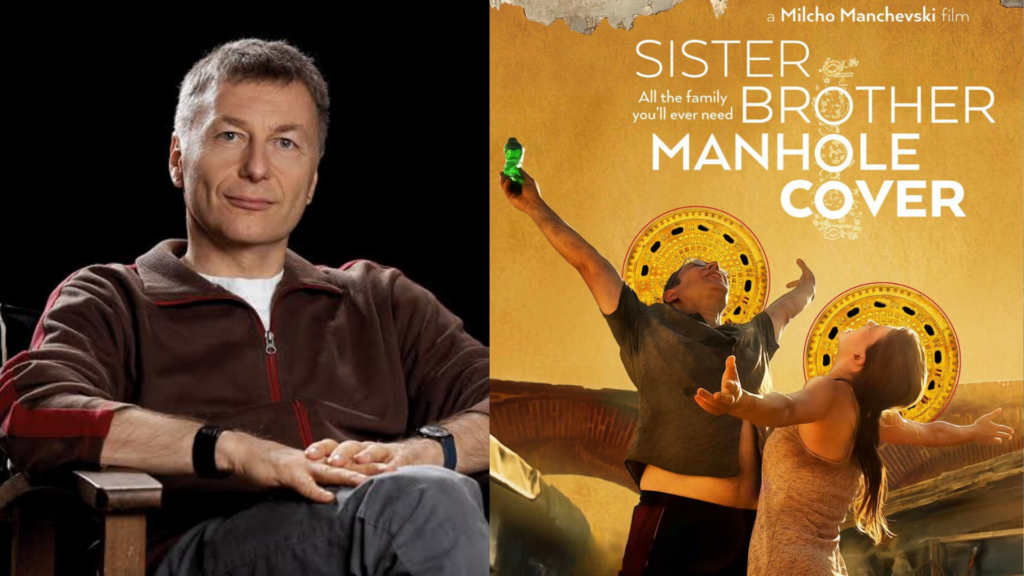
Milcho Manchevski’s Sister Brother Manhole Cover has won the Tokyo Grand Prix, the highest honour at the 39th Tokyo International Film Festival, which concluded on November 4. The dark comedy by the North Macedonian filmmaker was selected from 15 titles competing in the festival’s main Competition section. Also known as the Governor of Tokyo Award, the prize carries a cash award of JPY 3 million, approximately $19,000.
The film follows Malina and Viktor, a brother and sister who make a living by stealing bronze busts and manhole covers from the streets of Skopje, the capital of North Macedonia, before selling the metal for scrap. Their precarious routine takes an unexpected turn when a stolen bronze bust of a national hero falls on Viktor’s foot, seriously injuring him. When the siblings seek medical assistance, they encounter a doctor who demands sexual favours as payment. This incident sets them on a path into the city’s criminal underworld, taking their already difficult circumstances in a new direction.
Sara Klimoska and Filip Trajković play Malina and Viktor, the siblings at the centre of the story. The supporting cast includes Sonja Mihajlova, Petar Mirčevski, Jordan Simonov, Dejan Lilić and Jasmina Vasileva. Through the siblings’ unusual means of survival, Manchevski builds a darkly comic allegory around poverty, social inequality and the divide between those who have and those who do not. The film approaches these subjects through the lives of people struggling on the margins of society, using its central characters and their circumstances to examine the structures that shape their everyday existence.
The director has said that the story originated from an observation close to home. He had seen the empty pedestals of bronze national heroes in a park near his residence. After discovering that the missing statues had been stolen and sold for scrap, he began imagining the events from the perspective of the people responsible for taking them. That initial idea eventually developed into the story of two siblings whose attempts to survive bring them into conflict with the systems and institutions around them.
Rather than presenting its social themes as a straightforward lesson, the film focuses on the characters and the choices they make under difficult circumstances. Alongside poverty and inequality, it also explores the idea of family as something people can create beyond traditional relationships and inherited ties. The siblings’ relationship and their position within the city’s criminal underworld provide the framework through which the film examines these concerns.
The Competition jury, headed by Australian filmmaker Rolf de Heer, recognised the film for the way it treats its characters. De Heer praised the “humanity and compassion shown towards its characters”, describing it as a complex work that manages to be both touching and playful. The jury’s recognition places particular emphasis on the film’s approach to its characters, whose difficult circumstances are presented alongside the humour and human relationships that shape their story.
Manchevski had already left Tokyo by the time of the closing ceremony. Producer Jane Kortoshev and the film’s lead actors, Klimoska and Trajković, accepted the award on behalf of the team, while the director appeared through a video message. In his message, Manchevski described the win as a vindication for a film that “almost did not happen”. He also spoke about the story’s focus on unusual families and the divide between the haves and have-nots, themes that run through the film’s depiction of life on the edges of society.
The award marks another connection between Manchevski and the Tokyo International Film Festival. His previous fiction feature, Kaymak, also premiered in the festival’s Competition section in 2022. He first achieved international recognition with Before the Rain (1994), which won the Golden Lion at the Venice Film Festival and received an Academy Award nomination. Sister Brother Manhole Cover is his first fiction feature since Kaymak, making its recognition at Tokyo a significant moment in the filmmaker’s return to feature filmmaking.
Sister Brother Manhole Cover is a six-country co-production involving North Macedonia, Bulgaria, Serbia, Albania, Italy and the United Kingdom. The film had its world premiere in the Competition section on October 30, with Coccinelle Film Sales handling international sales. Its production structure brings together partners from across Europe, reflecting the international scope of the project while keeping its story rooted in the streets and social realities of Skopje.
The Tokyo International Film Festival’s Competition jury also presented the Special Jury Prize to Sun Xun’s animated feature Magic Atlas. Lisandro Alonso received the Best Director award for Double Freedom, while Hu Ling won Best Actress for The Night That Binds Us. Narita Ryo received Best Actor for Two Cigarettes, Three Nights. Jelena Maksimović’s Until the Day Ends was recognised with the Best Artistic Contribution Award, and Teodora Ana Mihai’s Heysel 85 won the Audience Award.
With the Tokyo Grand Prix, Sister Brother Manhole Cover emerged as the leading title of this year’s Competition, bringing renewed international attention to Manchevski’s work. Its recognition also highlights a film that uses an unusual premise—the theft of bronze statues and manhole covers—to tell a story about economic hardship, social divisions and the different forms that family can take. For Manchevski, the award adds another major festival achievement to a career that began attracting international attention with Before the Rain and continued through Kaymak.