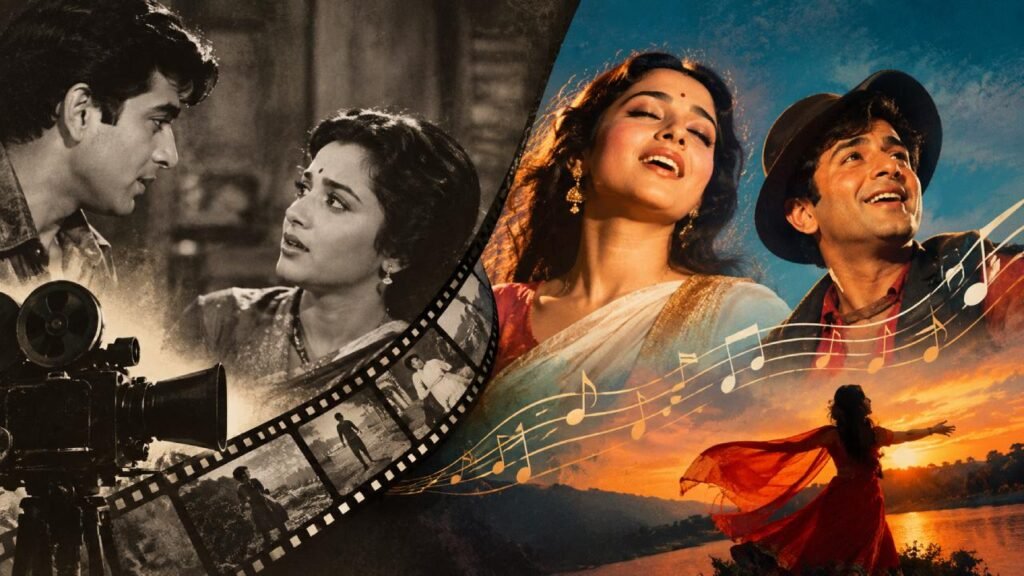
A song begins in the middle of a film out of nowhere. The characters who were speaking a moment ago are now seen singing. The location changes, the choreography begins, and for the next few minutes, the story is told through music and movement instead of dialogue.
For an audience unfamiliar with Indian cinema, this can seem unusual. Why does a film need to stop its story for songs? Why does a character need to sing what could have been said in a few lines?
The interesting thing is that Indian cinema has never really treated the song as something that sits outside the film. Whereas in much of world cinema, music usually exists around the story, as a background score, a soundtrack or, in the case of musicals, as a deliberate part of the form. In Indian cinema, the song became something much closer to the language of the film itself.
That difference did not appear suddenly. It came from a much older relationship between music and storytelling.
Long before cinema existed, Indian stories were being told through poetry, music and performance. The Ramayana, Mahabharata, and the Vedas were all composed in verse and were traditionally passed down through oral recitation before being committed to writing. The Natya Shastra, one of the earliest major texts on performing arts, brought together theatre, music, dance, and acting as parts of the same artistic experience.
This meant that music was already associated with storytelling in a way that was deeply familiar to Indian audiences.
A story did not have to be spoken from beginning to end. It could be sung. It could be performed through dance and gesture. Emotion could be expressed through music rather than explained through dialogue.
This is an important difference when cinema enters the picture.
When sound films began developing around the world, different film industries had different traditions to draw from. Hollywood, for example, developed the musical as a distinct genre, where singing and dancing were consciously built into the form of the film. But a drama, thriller or romance did not automatically need to become a musical.
Indian cinema took a different path.
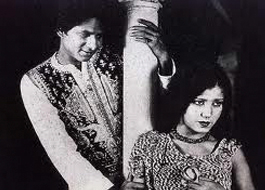
When Alam Ara, India’s first sound film, was released in 1931, it contained seven songs. The arrival of sound did not just introduce spoken dialogue into Indian films. It gave filmmakers a way to bring an existing musical storytelling tradition directly into cinema.
The films that followed often went much further. During the early years of Indian sound cinema, films could contain ten or more songs, sometimes even more. At a time when other film industries were increasingly developing cinema around dialogue, editing, and visual storytelling, Indian films were developing a form in which music could exist alongside all of these things.
The song did not have to mean that the film had become a musical. It could simply be part of the film.
That is why the question of why Indian cinema has songs cannot be answered only by saying that Indian audiences enjoy music. Music was already connected to the way stories were told, long before audiences had cinema halls to go to.
It also fitted naturally into everyday life.
Music accompanies weddings, festivals, religious ceremonies, celebrations, and other important moments across India. Different regions have their own folk songs and musical traditions, many of which are connected to particular occasions. So, when a film moved from a conversation into a wedding song or a festival dance, it was not creating an entirely unfamiliar reality.
Cinema was reflecting something audiences already knew.
This helped create another difference between Indian films and many films from elsewhere. In a lot of world cinema, a song has to be motivated by the story or belong to a particular genre. In Indian cinema, audiences gradually became comfortable with a song simply being part of the experience.
A romance could have songs. An action film could have songs. A family drama could have songs. A historical film could have songs.
The song did not necessarily define the genre. It became one of the things audiences expected from cinema itself.
The length of Indian films also played a role. For decades, films could run for three hours or more, and going to the cinema was often a larger family outing. A film was expected to offer a complete evening of entertainment, with romance, comedy, drama, action, and music all fitting into the same experience.
The song could help create that variety. But its importance did not end when the film ended.
This is where the history of Indian film music takes another turn. Before television and streaming platforms, songs travelled through radio and records. Later, cassettes made film soundtracks easier to access. People could buy the music, play it again and again, and share it without watching the film.
This was not quite the same relationship audiences had with film music in many other parts of the world.
A film could now become known through its songs before people had even seen it.
The music began to create anticipation for the film. People could know the melody, remember the lyrics, and associate a song with an actor long before they entered a theatre. The soundtrack was becoming a separate part of the film’s identity. It was no longer simply something that accompanied the finished product. It had become something that could be sold, heard, and enjoyed independently.
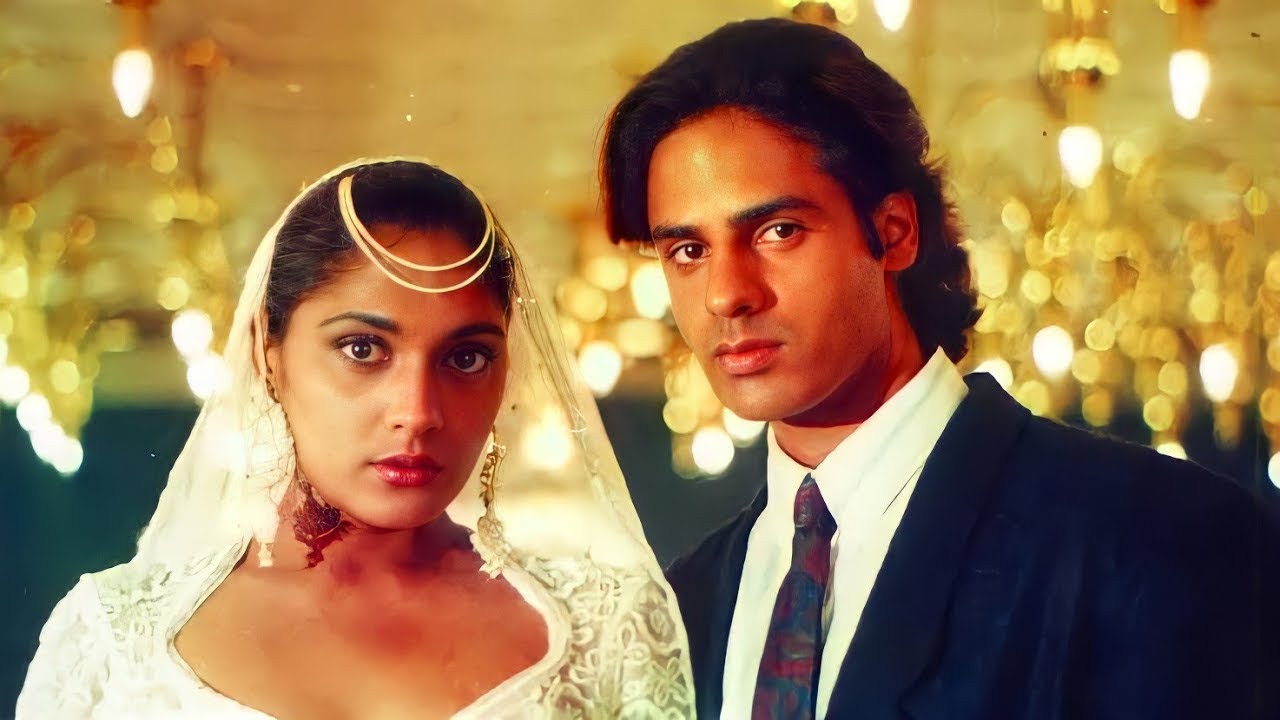
The film Aashiqui (1990), directed by Mahesh Bhatt, proved that a movie could be built entirely around pre-existing music. Because the songs were recorded first, the soundtrack didn’t just accompany the film; it served as the foundation for the script itself. Ultimately, the music didn’t just shape what audiences expected from the movie; it literally allowed the director to construct the entire film out of the public’s imagination of those songs.
This is where the Indian model began to look increasingly different from the way songs functioned in much of world cinema.
In Hollywood, a song could become famous outside a film, and musicals could build entire films around music. But most films did not need a collection of songs to establish themselves before release. A film’s trailer, poster or star cast could do that work.
Indian cinema had another powerful promotional tool already built into its system: the soundtrack.
A song could be released before the film, played on radio, bought as an album, and later shown as a music video. The audience could encounter the film through its music before encountering the film itself.
Today, this relationship has become even stronger.
A song can be released weeks or months before a film and spread through YouTube, Instagram, and streaming platforms. A dance step can become popular on social media. A hook from a song can become familiar even to people who have no intention of watching the film.
The song has, in many cases, become a trailer of its own. But this has also changed what songs do inside Indian films.
Earlier, a song could reveal a character’s emotions, move a relationship forward, or take the story through a passage of time. Today, those functions still exist, but a song can also be designed primarily as a promotional moment.
This is why some contemporary songs can feel almost separate from the films they come from.
They may not tell us anything necessary about the story. They may exist because they can be played on music platforms, circulated online or give the film a moment that audiences will remember.
That is a significant change.
The song that once helped tell the story can now help sell the story. And yet, the fact that songs have changed their purpose does not explain why they continue to remain so common in Indian cinema while most other film industries do not have the same expectation.
For that, maybe the history matters.
Indian cinema did not have to teach its audiences to accept music as part of storytelling. That relationship already existed. It inherited centuries of traditions in which stories were sung, performed and remembered through music. When sound cinema arrived, the song therefore fitted into the form almost naturally.
In other film traditions, songs could become important, even hugely popular, without becoming a standard part of almost every kind of film.
That is the real distinction.
It is not that Indian cinema is the only cinema that uses songs. It is that Indian cinema made them normal.
A song does not necessarily signal that an Indian film has entered a different genre. It can simply mean that the film has chosen another way to express what is happening. A character can speak about love, or sing about it. A family can talk about a celebration, or the celebration can become a song. A character can remain silent, while the music says what they cannot.
The audience understands the language because it has existed for much longer than cinema itself.
That is also why some of the strongest memories people carry from Indian films are not always scenes of dialogue. They are melodies.
The role of the song may have changed from storytelling to entertainment, from entertainment to a separate music industry, and from there to one of the most effective promotional tools for a film.
But the reason it stayed is much older than all of these changes.
Indian cinema did not invent the relationship between music and storytelling. It inherited it, built an industry around it, and eventually made it one of the things that audiences recognise as Indian cinema.
That is why the difference between Indian cinema and much of world cinema is not simply that one has songs and the other does not.
It is that, in Indian cinema, the song became part of what a film could be. And once audiences, filmmakers, and the industry had grown around that idea, it became very difficult to imagine Indian cinema without it.