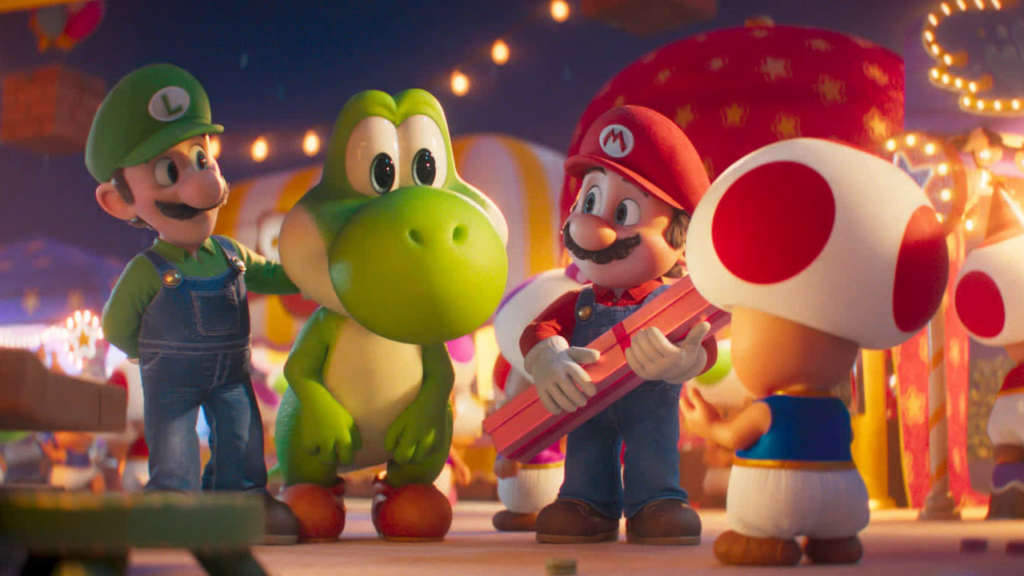
Super Mario Galaxy Movie review reactions have arrived with a clear sense of division, as critics weigh in on Nintendo and Illumination’s ambitious sequel. Following the massive commercial success of The Super Mario Bros. Movie, expectations were naturally high for a follow-up that expands the franchise into a larger, more imaginative space. Instead, early reviews suggest a film caught between scale and substance — one that dazzles visually but struggles to deliver the same emotional or narrative impact. With early Rotten Tomatoes reactions hovering around the mid-range, the film is being positioned as a spectacle-driven sequel that leans heavily on familiarity, even as critics question whether it truly evolves the franchise.
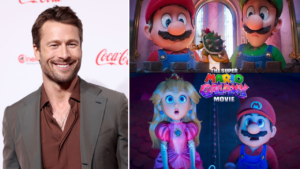
Directed by Aaron Horvath and Michael Jelenic, and written by Matthew Fogel, The Super Mario Galaxy Movie reunites its core voice cast including Chris Pratt as Mario, Anya Taylor-Joy as Princess Peach, Charlie Day as Luigi, and Jack Black as Bowser, while introducing new characters such as Rosalina, voiced by Brie Larson, and Yoshi, brought to life with a playful, childlike energy. The story shifts away from the grounded world of the Mushroom Kingdom into a sprawling cosmic setting, where Mario and his allies encounter a race of glowing star-like creatures known as Lumas, under the care of Rosalina. When Rosalina is abducted and taken deep into space, the narrative unfolds across a series of rapidly shifting cosmic environments, with Bowser Jr. emerging as a central antagonist manipulating events from behind the scenes. Meanwhile, Bowser himself undergoes an unusual arc, initially diminished in power before reasserting his presence alongside his son, as the film builds toward a large-scale, universe-spanning confrontation. The film’s setting rarely settles into a single location, instead moving quickly from one visually vibrant space to another, creating a sense of constant motion that defines much of its storytelling approach.
Across major publications, the critical consensus is clear — The Super Mario Galaxy Movie is a visually impressive but narratively thin sequel. Critics widely acknowledge the film’s technical strengths, from its animation quality to its fast-paced energy, but many argue that these elements come at the expense of storytelling depth. With early reactions indicating a roughly split critical response, the film is being described as entertaining on the surface, yet lacking the emotional grounding that made its predecessor resonate more strongly with audiences.
Where the film finds its strongest support is in its spectacle and fan appeal. Critics point to its vibrant animation and relentless pacing as key strengths, with IGN noting that the film “has more Easter eggs than you can count,” underscoring its appeal to longtime fans of the franchise. Similarly, reactions highlighted by Screen Daily emphasize the film’s energetic tone and its ability to deliver large-scale, visually engaging sequences. For audiences familiar with the games, these elements provide a sense of recognition and excitement, reinforcing the film’s identity as a celebration of the Mario universe.
However, much of the critical conversation centers on where the film falls short, particularly in its storytelling. Several major outlets have been notably harsh in their assessment. The Guardian described the film as “a bland screensaver of a movie that’s actually worse than AI,” a strikingly blunt critique that reflects frustration with its lack of narrative substance. Variety similarly called it “frenetic and disappointing,” pointing to a film that prioritizes motion and spectacle over meaningful progression. Meanwhile, The Independent argued that the sequel “doubles down on its own blandness,” suggesting that rather than expanding creatively, the film reinforces the limitations of its predecessor.
This criticism extends into the film’s overall structure and pacing, which many reviewers feel leaves little room for emotional engagement. The rapid movement between settings, while visually impressive, contributes to a sense that the film never fully establishes stakes or allows its characters to develop. Slashfilm encapsulates this sentiment by describing the film as “cute, flashy, and mostly empty,” a phrase that has become central to the film’s critical identity. The emphasis on constant motion and visual stimulation creates an experience that is engaging in the moment but lacks lasting impact.
Another key point raised by critics is the film’s reliance on fan service. While references and callbacks are expected in a franchise adaptation, many reviewers argue that The Super Mario Galaxy Movie leans too heavily on these elements, using them as a substitute for narrative depth. The abundance of Easter eggs, while enjoyable for dedicated fans, reinforces the perception that the film is designed more as a series of recognisable moments than a cohesive story. Social media reactions echo this sentiment, with viewers noting that the film is “a good time” but “one-dimensional from a story and character perspective,” highlighting a disconnect between immediate entertainment and lasting resonance.
Character development is another area where the film has drawn criticism. Despite the introduction of new figures like Rosalina, critics feel that the film does not fully explore their potential. Rosalina’s role, while central to the plot, lacks the emotional depth needed to anchor the story, while Bowser’s arc — shifting between diminished villainy and renewed threat — is seen as inconsistent. Even returning characters, including Mario and Luigi, are given limited room to evolve, reinforcing the idea that the film prioritizes spectacle over character-driven storytelling.
In the end, The Super Mario Galaxy Movie stands as a sequel that expands the scale of its world but not necessarily its substance. It is a film defined by its contrasts — visually dynamic yet narratively shallow, entertaining yet ultimately fleeting. For fans of the franchise, it offers a colorful, fast-paced adventure filled with familiar elements and playful references. For critics, however, it represents a missed opportunity to build on the foundation of its predecessor with greater depth and ambition.
Whether the film resonates will largely depend on what audiences are looking for. Those seeking pure spectacle and nostalgia may find plenty to enjoy, while viewers expecting a more layered or emotionally engaging story may come away disappointed. What is clear from early reactions is that The Super Mario Galaxy Movie has sparked a conversation — not about whether it succeeds outright, but about what audiences expect from blockbuster animation in an era increasingly defined by scale over substance.
Film: The Super Mario Galaxy Movie
Director: Aaron Horvath, Michael Jelenic
Writer: Matthew Fogel
Cast: Chris Pratt, Anya Taylor-Joy, Charlie Day, Jack Black, Brie Larson, Donald Glover, Keegan-Michael Key
Production: Illumination, Nintendo
Runtime: ~98 minutes
Release: April 1, 2026
Read More Review Roundups on POF