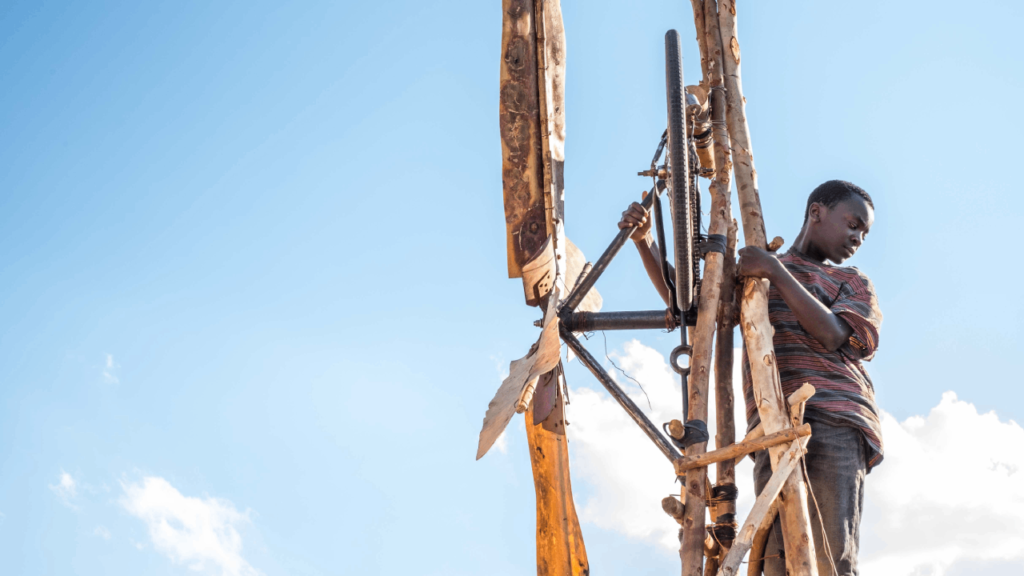
Imagine an engineer, a developer, or anyone whose work involves constructing a windmill. For them, building one might seem like a regular task. They are trained for it. They have spent years learning about it. Their studies, exams, projects, practices, everything has in some way prepared them for that moment. But the background matters.
Now imagine that same windmill being built in the middle of a drought. Where the only means of producing food and earning a living is farming, and the fields have gone dry. Where there is barely enough food left for a family to eat, let alone enough to plant another crop. And now imagine that the person building it is not an engineer. He is a thirteen-year-old boy.
That is what the film The Boy Who Harnessed the Wind (2019), directed by Chiwetel Ejiofor, is about.
Based on the true story of William Kamkwamba, the film follows a young boy in Malawi who, during a devastating famine, finds a way to build a windmill from whatever materials he can find. His idea is simple. If he can produce electricity, he can use it to pump water into the fields. If there is water, there can be crops. And if there are crops, his family and his village might have food again.
On the surface, or even on paper, it is a simple story. A boy builds a windmill.
It only remains simple if you look at the protagonist and the thing he accomplishes. But the moment you look at the circumstances in which he accomplishes it, everything changes.
What William does is simple. What he does under the circumstances, and with the very limited resources available to him, is what makes it extraordinary.
William is not someone who has spent years studying engineering. He is not working with advanced equipment or in a place where every material he needs is available to him. He is a child trying to understand something through whatever education he can get his hands on.
And this is where one of the things I found most compelling about the film comes in. William sneaks into school to study.
There is something about that which feels so foreign when you think about our own experience with education, as we sit with our laptops and our constant supply of coffee, discussing how fun or annoying school life was. We talk about the subjects we used to bunk, the classes we did not want to attend, and how we wished we could get away from school for a while.
But William is doing the opposite. He is sneaking to get education, not to run away from it.
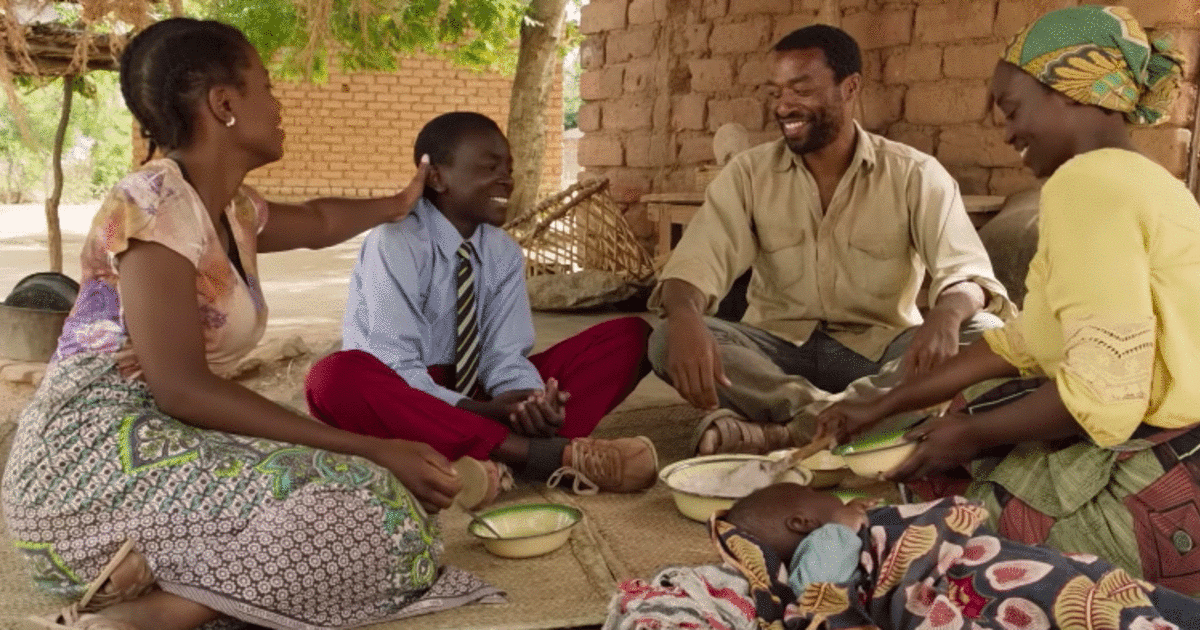
His family can no longer afford his school fees, and he is forced to leave school. But he still finds a way to use the school library, where he comes across a science book that teaches him about windmills. And there is something strange and painful about seeing education become something that a child has to sneak into. For us, education can become a routine. Something we complain about because it is always there. But for William, it is not simply something he is supposed to do because he is a child. It is something he needs.
And what he does with that education is even more striking.
A child who has education readily available, with teachers, equipment, laboratories, computers, and everything else around them, may learn how a windmill works because it is part of a lesson. William learns it because he needs to find a way to save his family.
That difference changes everything.
The entire village is experiencing a drought. Farming is not just their occupation. It is their food, their income, and their way of living. When the crops fail, there is nothing else to fall back on. The little grain that the family has managed to store is eventually stolen. There is less and less food, and people begin thinking about leaving because there is no longer much left for them there.
And in the middle of all this, William has an idea.
He thinks that if he can build a windmill, he can generate electricity. That electricity can power a water pump. The water can reach the fields. The fields can grow vegetables. It sounds like an enormous solution coming from a child. But William does not begin by building the enormous windmill.
He starts small.
Using scraps and whatever he can find, he builds a miniature windmill. It works. He manages to produce enough electricity to power a small radio. It is a tiny thing in comparison to the problem facing the village. But it proves something. The idea is not only an idea anymore. It is an idea that might work.
So William and his friends decide to build a much larger windmill, one that can generate enough electricity to power the pump and bring water to the fields. But there is a problem.
They need parts from a bicycle. And that bicycle belongs to William’s father. This is where the film’s conflict becomes more than a boy trying to prove that his invention works.

William goes to his father and tries to convince him. Like any child trying to convince their parent, he begins with logic. He shows him the small windmill he has already built. He demonstrates that it is producing electricity without a battery. He tries to make his father see what he has seen. But his father’s reaction is almost nothing.
Because his father is not looking at a windmill. He is looking at a drought. He is looking at the fields. He is looking at the very real possibility of his family going hungry.
So when William tells him that he needs his bicycle to build a bigger windmill, his father thinks that his son is being unserious about the situation they are facing. Everyone around them is struggling to find food, and here is his son asking for a bicycle to build what looks to him like another toy.
His father refuses. And in a way, you understand why.
William is looking at the problem through the education he has managed to receive. His father is looking at it through years of farming and the reality of the land in front of him.
One sees a possibility. The other sees what is left.
William comes back with his friends and tries again to convince his father again. But he still refuses. His friends have begun to think about leaving the village. If there is no food left, maybe going somewhere else is the only chance they have. They ask William to come with them. But he refuses. He cannot leave his family behind. And his father hears him say that.
It is a small moment, but it changes the way the windmill feels. And in a different setting, William’s mother asking his father how much more loss she will have to bear adds to the moment.

Until then, William’s father sees his idea as something a child is doing while the real problem continues around him. But William staying behind tells him something else. This is not about a toy. It is not about a boy wanting to prove that he can build something. He is also trying to save his family. And when there is finally no other path left, when there is no solution his father can see that might help them survive, he turns back to his son. He asks William about the plan again. And this time, he gives him the bicycle.
Together, they build the windmill.
There is something lovely about that moment because the windmill is no longer just William’s achievement. It becomes something between a father and a son. The father who knows the land but cannot make it produce anything without water, and the son who has learnt from a book that there might still be a way to bring that water back.
And then, the windmill works.
The wind turns the blades. Electricity is produced. The pump brings water to the fields. And the fields can live again.
What makes that moment powerful is not really the windmill. A windmill, after all, can be built. An engineer can build one. Someone with the right education and the right equipment can build one. There is nothing inherently miraculous about the machine itself.
What is extraordinary is who is building it, why he has to build it, and what he has to build it with.
William is thirteen. He has limited education because he has been forced out of school. He has limited resources because his family has almost nothing left. He does not have the equipment that would make the process easy. And yet he takes whatever is available to him and tries to make something out of it. A book becomes knowledge. Scraps become parts. A bicycle becomes the missing piece. The wind becomes electricity. And electricity becomes water.
The film makes you think about how much the circumstances around an achievement can change the way we see the achievement itself. Building a windmill may be simple. Building one when your family is starving is not. Learning about science in a classroom is one thing. Sneaking into that classroom because you cannot afford to be there is another.
And maybe that is why William’s windmill feels so much larger than the machine he builds.
It carries everything that came before it. The drought. The hunger. The school he could no longer attend. The book he found. The bicycle his father did not want to give him. The friends who left. The family he refused to leave behind.
By the time the windmill turns, it is no longer just producing electricity. It is carrying the weight of everything William was trying not to lose.
And maybe that is what makes the story so moving. Not that a boy built something an engineer could build. But that when almost everything around him had become a reason to give up, he found a possibility where there seemed to be none.