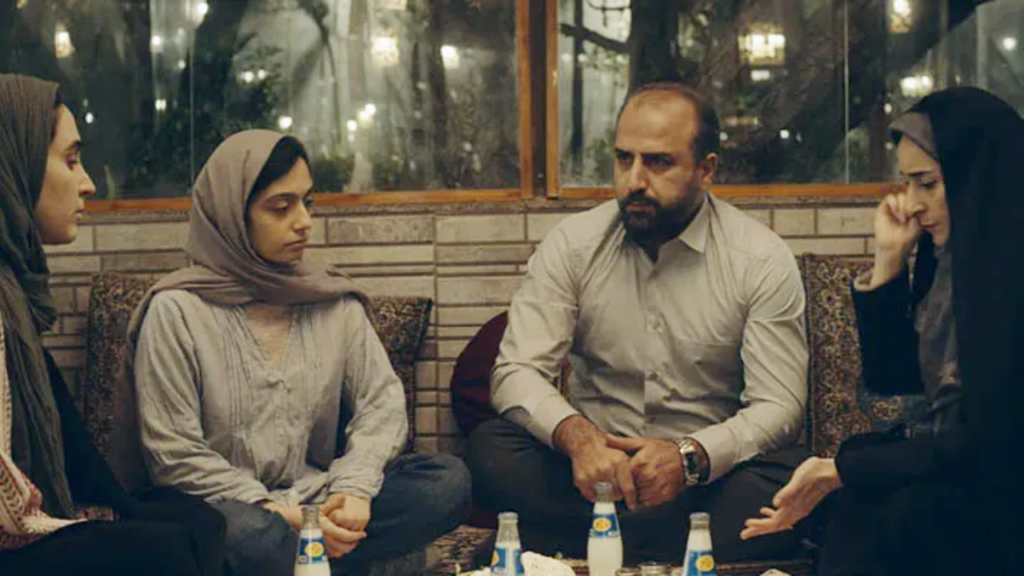
A family is sitting together at home. There is nothing unusual about the moment. A father comes home from work, his wife worries about him, and his daughters are busy with their own lives. It could be any family.
But in The Seed of the Sacred Fig, the outside world slowly begins to enter this home.
To understand what is happening outside, we have to go back to Iran in September 2022. A 22 year old Iranian-Kurdish woman, Mahsa Jina Amini, died in custody after being arrested by Iran’s morality police over allegations that she was not complying with the country’s compulsory veiling laws. Her death sparked nationwide protests that came to be known as the “Woman, Life, Freedom” movement. What began with anger over the treatment of women soon grew into a much wider protest against repression, restrictions on freedom and the government’s control over everyday life. The authorities responded with a violent crackdown, arresting thousands and using lethal force against protesters.
This is the Iran that The Seed of the Sacred Fig places its family inside.
Directed by Mohammad Rasoulof, the film follows Iman, an investigating judge in Tehran’s Revolutionary Court, a judicial system closely associated with cases involving political dissent and national security. His new position puts him much closer to the machinery of the state. He is expected to process cases that can carry serious consequences, including death sentences, and to follow decisions coming from his superiors. This is important because Iman is not simply watching the protests from a distance. He is becoming part of the system responding to them.
His daughters, Rezvan and Sana, meanwhile, are watching what is happening on the streets through their phones. They see the protests, the violence and the anger of people their age. Their father is being asked to trust the system. His daughters are beginning to question it.
So the conflict inside this family is not just between a father and his children. It is between two completely different ways of seeing the country they live in.
At first, it is only a difference of opinion.
Then Iman’s gun disappears. It sounds almost like the beginning of a thriller. A government official loses his weapon, and suddenly everyone around him becomes a suspect. But the missing gun is not really the most important mystery in the film.
The important question is what the disappearance does to Iman.
The gun represents his authority. It is connected to his position, his power and the world he has chosen to serve. Without it, his confidence begins to disappear. He becomes suspicious. Then paranoid. And eventually, he starts looking at his own family as if they are his enemies.
The man who is supposed to protect his family begins to frighten them. This is where the film becomes genuinely powerful. Because the political conflict outside the house slowly becomes a family conflict inside it.
Iman wants obedience. His daughters want answers.
He believes that following the system will keep them safe. They are beginning to realise that the system itself may be the thing they should be afraid of. And the more Iman tries to control his family, the more he loses them.
There is something painfully familiar about watching this happen. Political arguments often begin outside our personal lives. We talk about governments, protests, laws and institutions as if they belong to another world. But eventually, politics can enter the dinner table. It can change friendships. It can create arguments between parents and children. It can make people question the people they have trusted all their lives.
That is what The Seed of the Sacred Fig understands very well. The family becomes a smaller version of the country around it.
But the film is not always as subtle as this idea.
At times, Rasoulof seems so determined to make sure we understand his metaphor that he explains it more than once. The tension is stretched, the symbolism becomes increasingly obvious, and some moments feel designed to tell us exactly how seriously we should take them.
And that can make the film feel a little pretentious.
There is a difference between a film trusting its audience and a film constantly reminding its audience what it wants them to think. The Seed of the Sacred Fig occasionally crosses that line.
Its strongest moments are often the simplest ones.
A daughter looking at something on her phone. A mother becoming uncomfortable with what is happening inside her own home. A father asking a question and not believing the answer. A family sitting together but no longer feeling like a family.
These moments are enough.
Because the real horror of the film is not the violence outside. It is watching trust disappear inside the house.
Iman is not introduced as a monster. He is a father. He loves his wife. He cares about his daughters. He wants to provide for them. That is what makes his transformation disturbing.
He does not suddenly become a different person. Fear slowly changes him. And perhaps that is the film’s most interesting observation. Authoritarian systems do not survive only because of the people at the top. They survive when fear travels downwards and becomes part of everyday life. When people begin policing one another. When obedience becomes more important than trust. When suspicion becomes easier than love.
By the final act, the family is no longer simply trying to survive the political situation around them. They are trying to survive each other.
The film eventually moves away from the home and into a much more dramatic, almost nightmarish landscape. It becomes larger, more symbolic and more intense. Some of this works beautifully. Some of it feels like the film is pushing too hard for a grand finale.
But by then, the emotional damage has already been done. The father has lost the trust of his wife and daughters. The daughters have lost their sense of safety. And the home, which should have been the one place where they could escape everything happening outside, has become another battlefield.
The title The seed of the sacred fig can also be read as a metaphor for the way fear and power spread. Like roots extending beyond where a tree first takes hold, they move from institutions into homes, relationships and families.
That is what stays with you after the film ends.
Not the missing gun. Not even the protests. But the sight of a family slowly losing the ability to trust one another.
The Seed of the Sacred Fig may sometimes be too eager to show us how important it is. It can be heavy-handed and, at times, undeniably pretentious. But underneath all of that is a simple and deeply unsettling idea, a country can change a family.
And sometimes, the most frightening thing about political fear is not what it does to the streets. It is what it does to the people sitting beside you at home.
Watch The Seed Of The Sacred Fig Trailer:
Read More: