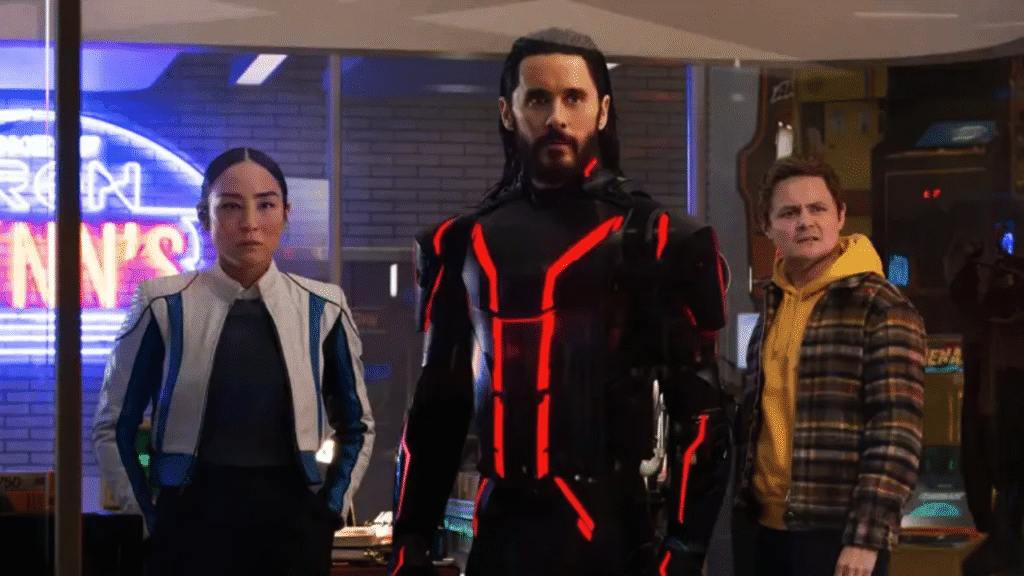
When Disney released Tron: Ares, it seemed poised to reignite one of sci-fi’s most visually iconic franchises. With Jared Leto taking the lead and Greta Lee joining the cast, the film promised neon-soaked light cycles, high-tech spectacle, and a modern revival of a legacy story. But after a worldwide box office of roughly $103 million, the film is projected to lose $132.7 million — a sobering reality for a franchise once considered a cult favorite.
Tron Ares demonstrates a clear lesson: even dazzling visuals, brand recognition, and marquee names cannot guarantee audience engagement without a compelling story and strategic execution.
The Numbers Behind the Glow
Reports indicate that production costs for Tron: Ares reached $220 million, with marketing, residuals, and ancillary expenses pushing the total to approximately $347.5 million. While home entertainment and global television licensing may recoup some losses, the gap between costs and revenue remains massive.
From a financial perspective, Disney’s gamble was enormous. The studio invested in elaborate premiere events, touring light cycles, and high-profile stunts, yet these investments could not offset the steep domestic and international decline.
Why the Story Didn’t Connect
While Tron: Ares is visually spectacular, its narrative shortcomings are glaring. The screenplay underwent multiple revisions, with director Joachim Rønning initially seeking a different approach than the one greenlit by Disney. Late-stage rewrites by Billy Ray aimed to patch inconsistencies, but the core story lacked the emotional depth to anchor its technical brilliance.
The original Tron achieved cult status partly because of its imaginative premise and immersive world-building, but even that was limited by narrative constraints. Tron: Ares repeats the same mistake — relying heavily on nostalgia and visual spectacle without creating stakes that feel immediate or characters audiences care about.
Jared Leto and the Star Factor
Jared Leto’s presence in Tron: Ares initially seemed like a strategic draw, combining critical acclaim with mainstream recognition. Yet, Leto’s career trajectory reflects a broader challenge: actors who excel in smaller, character-driven projects do not always translate into tentpole reliability. While Leto brings gravitas and a distinct energy to his roles, Ares shows that star power alone cannot compensate for structural flaws in the film.
Greta Lee, in contrast, delivers a nuanced performance that hints at her potential as a breakout talent. However, the film’s weak screenplay and scattered pacing prevent her contributions from making a lasting impact. This dichotomy highlights the importance of narrative as the true engine of audience engagement, even when high-profile actors are involved.
Production Ambition and Its Costs
Tron: Ares was built to impress. Production included elaborate light cycle stunts, touring activations, and a laser-light concert at the Los Angeles premiere. While these moments are visually memorable, they also significantly inflated the budget, turning the film into one of Disney’s costliest projects in recent memory.
Our analysis suggests that the film’s production ambition may have inadvertently undermined its storytelling. When resources are heavily allocated to spectacle, the narrative can become secondary, which is precisely what happened here. In today’s cinematic landscape, audiences increasingly expect high-quality storytelling alongside technical wizardry; films that neglect this balance risk underperforming.



The Challenge of Reviving a Legacy Franchise
The Tron franchise has always faced a narrow audience window. The original 1982 film underperformed at the box office, only later achieving cult status through home video. Tron: Legacy (2010) improved on this with a global gross of around $400 million, but it did not generate the broad appeal Disney hoped to capitalize on with a third installment.
As Kroll from Vulture notes, “It’s hard to peg exactly where the mass appeal for a third ‘Tron’ film was going to come from” . The reliance on nostalgia and visual spectacle could not attract a broad new audience, a critical shortfall for a franchise attempting to reestablish itself.
Disney misjudged the contemporary audience’s appetite. Nostalgia can attract die-hard fans, but it cannot expand the base of viewers significantly. Unlike Marvel or Star Wars properties, which have multi-generational and mainstream recognition, Tron occupies a niche that limits the scope of box office success. Reviving such a franchise requires both a compelling story and a strategy for broader accessibility — something Ares struggled to achieve.
Industry Context: Lessons for Mid-Tier Sci-Fi
The film’s underperformance is not unique in today’s post-pandemic environment. Mid-budget science fiction and fantasy films increasingly face steep financial risks, especially those outside established mega-franchises. According to TheWrap, studios are reconsidering how they allocate resources to reviving dormant IP, weighing the cost of production against the uncertain returns.
Tron: Ares exemplifies this risk. It illustrates how high production value and elaborate stunts cannot automatically secure audience loyalty or justify massive budgets. For Disney and other studios, the lesson is clear: careful script development, audience alignment, and sustainable budgeting are crucial when reviving legacy franchises.
Looking Forward: What’s Next for Tron and Its Stars
The projected loss for Tron: Ares raises questions about the franchise’s future. Industry insiders predict that Disney may pause immediate plans for sequels, opting instead to evaluate whether the world of Tron can be reimagined in a more cost-effective and narrative-driven format.
For Jared Leto, the film’s reception may shift his focus back toward smaller, character-driven projects where his talents can shine without the pressure of tentpole performance. Greta Lee, meanwhile, emerges with increased visibility and the opportunity to leverage her nuanced performance into higher-profile projects.
Lessons from a Neon Misfire
Tron: Ares serves as a striking example of how modern audiences weigh story and spectacle. While the neon-lit world and advanced effects are visually compelling, they cannot substitute for coherent storytelling or meaningful character development.
In the end, Tron: Ares is more than a box office disappointment; it is a roadmap for studios on what to avoid when attempting a high-stakes franchise revival. Spectacle alone is no longer enough — audiences demand story, stakes, and characters they can connect with, and future entries in the franchise must prioritize these elements if they hope to succeed.
Read More: