
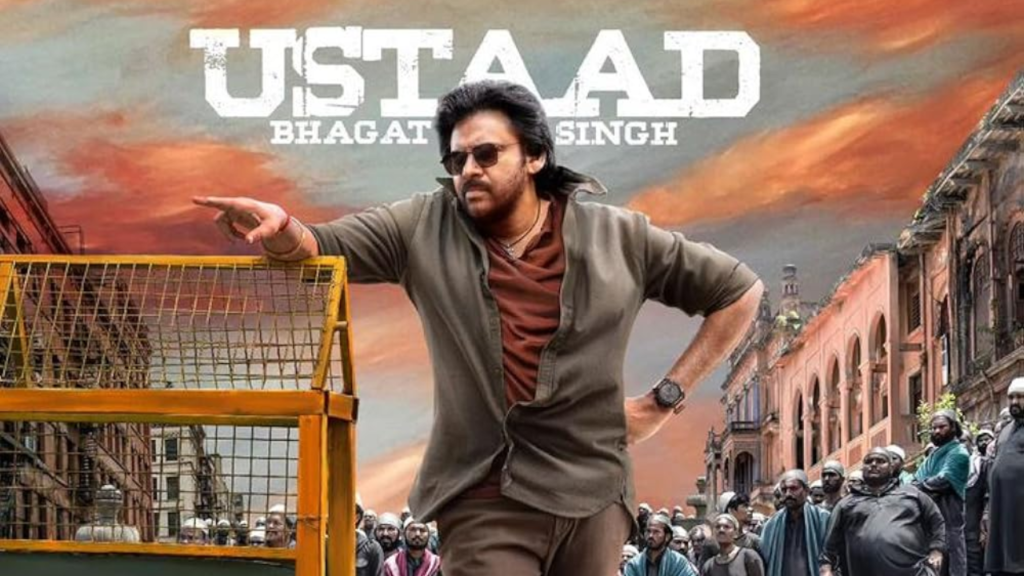
Ustaad Bhagat Singh has arrived in theatres amid massive expectations, bringing together Pawan Kalyan and director Harish Shankar for what was positioned as a high-voltage commercial entertainer. The reunion, carrying the legacy of Gabbar Singh, promised a blend of mass appeal, political undertones, and crowd-pleasing moments. But as early reactions and Ustaad Bhagat Singh reviews begin to pour in, the film finds itself at the center of a familiar debate — one where star power commands attention, even as storytelling struggles to keep up.
Across reviews, one point of consensus is clear: Pawan Kalyan remains the film’s biggest strength. Critics repeatedly highlight his screen presence, with The Times of India noting that he “dominates with a powerful one-man show.” His charisma, dialogue delivery, and larger-than-life aura seem to drive the film’s most engaging moments, particularly in sequences designed for theatrical whistles and applause. Similarly, 123Telugu describes the film as “a mixed bag with fan appeal,” underlining how strongly it caters to his core fanbase. Even more neutral takes, like those reflected in India Today, suggest that the film leans heavily on familiar strengths associated with the star, reinforcing his connection with audiences who come in expecting a full-fledged mass outing.
However, beyond its central performance, the film begins to lose momentum — and this is where critics converge sharply. The screenplay and writing have drawn significant criticism, with many calling out its reliance on outdated tropes and predictable structuring. The Indian Express delivers one of the harshest verdicts, stating that “Pawan Kalyan cannot save this dated 2026 mass entertainer.” The criticism isn’t just about familiarity but about a lack of reinvention, especially in an industry where audience expectations are rapidly evolving. Echoing this sentiment, The Hindu labels the film “an incoherent bore,” pointing toward issues in narrative cohesion and engagement. Meanwhile, Great Andhra reduces the film’s core to a “cliched cop” template, reinforcing the idea that the story fails to rise above its genre conventions.
The direction by Harish Shankar, once celebrated for revitalizing mass cinema, also comes under scrutiny this time. Critics argue that while the filmmaker attempts to recreate the energy and tonality of his earlier successes, the execution feels stuck in a different era. M9 News observes that the director appears “stuck in past, lost in present,” a critique that captures the film’s broader struggle to balance nostalgia with contemporary storytelling. Similarly, The Hollywood Reporter India points out that the film is “propped up by Pawan Kalyan, undone by” its weaker narrative choices — a telling line that encapsulates the imbalance between performance and writing.
Audience reactions, as reflected in early online chatter and media coverage, mirror this divide. Platforms tracking public sentiment highlight a split response, with fans celebrating the film’s mass elements while general viewers express disappointment. Moneycontrol notes that the film has received “mixed reviews” from netizens, while iDiva calls it “a decent commercial entertainer,” suggesting that its appeal largely depends on what viewers are seeking. For fans, the film delivers moments worth cheering for; for others, it struggles to justify its runtime with compelling storytelling.
At the box office, the film has opened on a strong note, collecting around ₹31.5 crore on its first day, as reported by The Indian Express. While this reflects the undeniable pull of Pawan Kalyan’s stardom, the numbers also come with context — expectations were significantly higher, and competition in the market appears to have tempered its overall impact. The coming days will likely depend on word-of-mouth, which, at least for now, remains mixed.
In the end, Ustaad Bhagat Singh stands as a classic example of a film carried by its leading star but held back by its inability to evolve. It works best when it embraces its identity as a fan-driven spectacle, delivering moments tailored for mass audiences. But as a cinematic experience aimed at a broader viewership, it falls short of the freshness and narrative strength that today’s audiences increasingly demand. The film ultimately raises a question that continues to define mainstream cinema today — in an era of changing tastes, is star power alone still enough?
Film Details:
Film: Ustaad Bhagat Singh
Director: Harish Shankar
Cast: Pawan Kalyan, Sreeleela
Release: March 2026
Genre: Action / Commercial Drama
Read More Review Roundups on POF