SS Rajamouli has never treated cinema as a regional product. His films may emerge from Telugu culture, but his ambition has always been to speak in a global cinematic language. With Varanasi — promoted internationally as Globe Trotter — the intention is clearer than ever: this is a film engineered to travel. And the rollout proves it.
Over the past week, media houses that typically track major Hollywood launches — from trade-focused portals to global entertainment wires — covered the Varanasi event with the same tone they use for franchise announcements in Los Angeles or promotional showcases in London. Not because of mythology, not because of location, but because the presentation was unmistakably cinematic in its design. Rajamouli didn’t unveil a film; he unveiled a world.
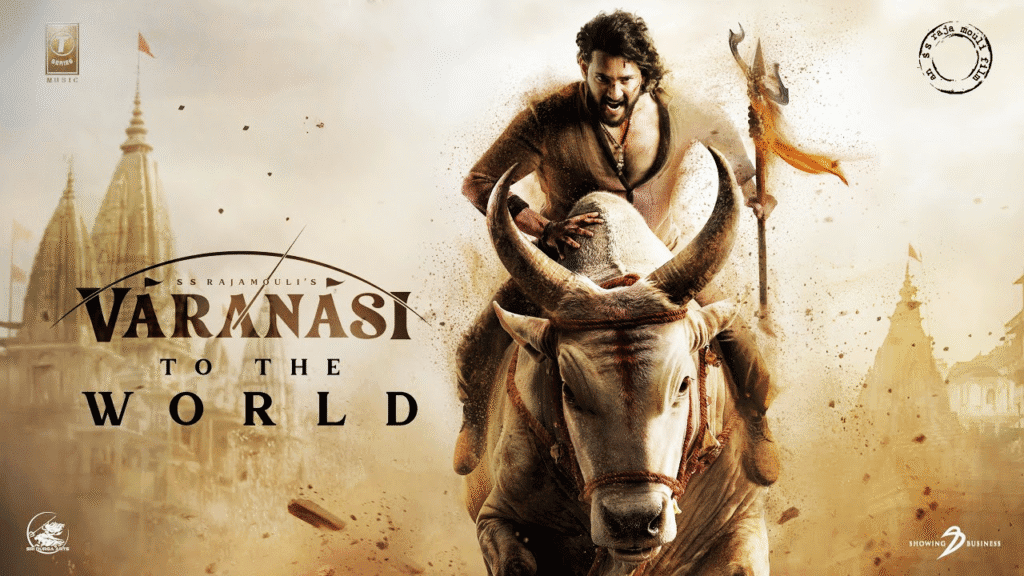
The motion poster for Varanasi—formerly teased as GlobeTrotter—is a masterclass in visual ambition. Mahesh Babu, cast as “Rudhra,” rides a charging bull while wielding a trident, set against dusty, saturated hues that feel both raw and iconic. This isn’t just symbolism — it’s a design choice that telegraphs real production muscle: tailored costumes, sculpted animal forms, layered lighting, and the promise of large-scale environments.
Rajamouli’s art is turning that one frame into a mission statement: this is a world built to be felt, not just observed. And every technical department is going to matter. This distinction matters. India has often exported stories, but rarely filmmaking. Rajamouli is reversing that equation. He is presenting cinema first, mythology second, and geography last.
The event itself reflected this shift. The tone wasn’t devotional or historical; it was industrial. The reveal resembled a concept-art showcase for a large-scale fantasy or a global franchise starter — mood boards, textures, light palettes, visual logic. Posters were designed not as marketing material but as production statements: a promise of scale, a window into the film’s internal physics, a mapping of the visual dialect Rajamouli plans to explore.
Varanasi is being shot for 1.43:1 IMAX, the tallest and most demanding film format in contemporary cinema. Only a select few directors, including Nolan, Cameron, and Villeneuve, regularly work in this frame. Shooting in IMAX is not just aesthetic — it demands technical mastery across; Set design and height, Camera rig configuration, Choreography and blocking, VFX pipelines, Lighting and editorial rhythm, Sound design and spatialization
Choosing this format signals that Rajamouli is creating a global theatrical experience, not a film tailored to domestic multiplexes. For the first time, an Indian epic is being constructed with international premium screens in mind from the outset.
Where Hollywood talks about “world-building,” Rajamouli talks about “world-design.” Where Western media examines craft — composition, motion, silhouette, choreography — Indian coverage often gets stuck on character origins or mythological references. Yet international reactions show what truly stands out: the filmmaking. The ambition. The confidence in form.
The casting of Mahesh Babu and Priyanka Chopra is deliberate. Mahesh Babu ensures South Asian and diaspora draw, while Priyanka Chopra brings Western familiarity and Hollywood visibility. Together, they create a dual-market engine, blending regional, pan-Indian, and international audiences. Festival presence, streaming leverage, and global theatrical appeal are baked into the casting strategy.
If the film delivers on its promise, Varanasi may mark a new era for Indian blockbusters. It’s not just about myth or spectacle — it’s about format-first filmmaking, where every department (VFX, sound, cinematography, design) is orchestrated to create a cinematic experience, not just a movie you watch. This is Rajamouli not just as a storyteller, but as a craft curator. He’s building a film that demands a large screen, careful technical design, and engaged audiences who want more than just a narrative—they want to be immersed.
With RRR, Rajamouli entered global consciousness. With Varanasi, he is attempting something more decisive — stepping into the space where filmmakers build not just films, but global events. The creative choices visible so far indicate a director looking outward, not inward. The mythology is incidental; the cinematic infrastructure is the real story.
Rajamouli’s international ambition isn’t abstract. It’s visible in how the project is positioned, how the material is unveiled, and how global media instinctively recognises it. They’re covering Varanasi the same way they cover a Denis Villeneuve sandworm reveal or a Christopher Nolan first-look drop: as a filmmaking moment.
At its core, Varanasi is shaping up not as a mythological spectacle, but as a cinematic manifesto — a statement about where Indian filmmaking can go when it stops explaining itself to the world and simply belongs in the room. Rajamouli isn’t asking for a seat at the global table; he’s building a new table and inviting the world to look at what an Indian production pipeline can architect when it aims beyond borders.
Read More: