There’s a strange familiarity to most biopics. Not just in what they show, but in how they make you feel. You walk in expecting a life, but what you often get is something smoother, safer, already resolved. The struggle is there, the fall is there, the rise is definitely there, but it all feels… arranged. As if the film isn’t discovering a person, but carefully presenting one.
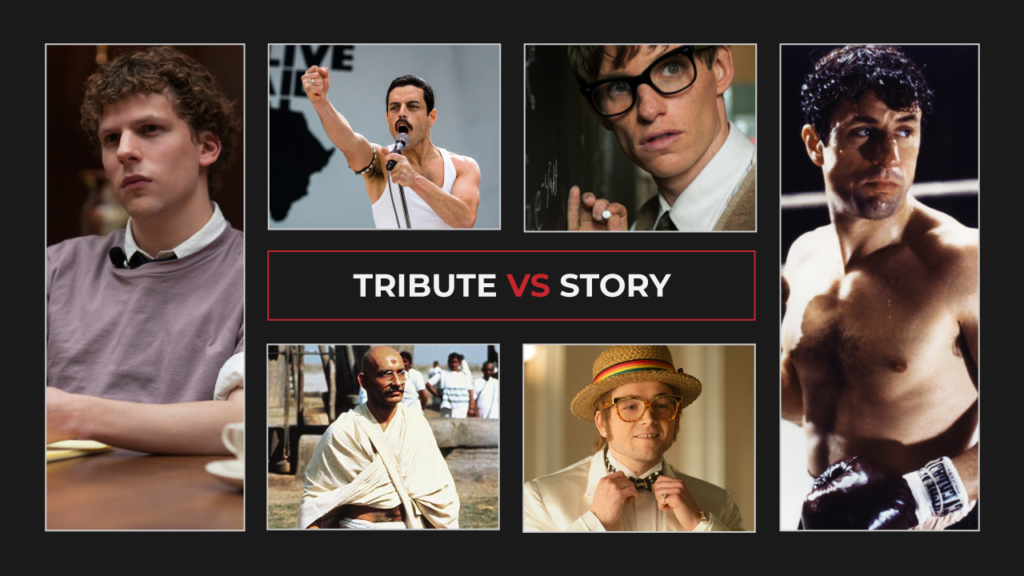
Take Bohemian Rhapsody, it’s energetic, emotional, and widely loved. But it rarely feels like it’s exploring Freddie Mercury. Instead, it feels like it’s protecting him. The rough edges are touched, but never allowed to linger. Conflicts appear, but they resolve just in time. The film moves like a tribute concert, building toward moments we already admire, rather than questioning the man behind them.
And maybe that’s the point. Because most biopics are not really designed as stories. They are designed as acts of remembrance.
This becomes clearer when you place them next to something like The Social Network.
It’s based on a real person, Mark Zuckerberg, but it doesn’t behave like a tribute. It doesn’t try to make him likeable, or even fully understandable. It allows distance. It allows discomfort. More importantly, it allows contradiction. The film is less interested in honouring a life and more interested in examining a personality. And that shift changes everything. Because the moment a film decides to honour, it also decides to limit.
You can see that limitation in The Theory of Everything. It’s sincere, moving, and respectful in its portrayal of Stephen Hawking. But it stays within a certain emotional boundary. It shows struggle, but in a way that inspires. It shows love, but in a way that reassures. The film never feels like it might lose control of its subject. And because of that, it never fully reveals him either.
Even something as monumental as Gandhi carries that same tone. Directed by Richard Attenborough, it presents Mahatma Gandhi with immense respect and scale. But that respect creates a kind of distance. You watch him, you admire him, but you rarely feel like you’re inside his contradictions. The man becomes a symbol, and the symbol becomes untouchable. And that’s where biopics often begin to drift away from storytelling.
Because stories thrive on uncertainty. On mess. On the possibility that a character might not be who we want them to be. That’s why something like Raging Bull feels so different.
It doesn’t ask you to admire Jake LaMotta. It barely asks you to like him. Instead, it forces you to sit with his anger, his insecurity, his self-destruction. There is no attempt to “protect” his image. And in that refusal, the film finds something rare, truth without decoration.
Similarly, Rocketman doesn’t try to be a clean retelling of Elton John’s life. It embraces subjectivity. It bends reality. It turns memory into spectacle. And strangely, that stylization makes it feel more honest, because it acknowledges that a life is not a sequence of facts, but a collection of emotions.
So the question isn’t whether biopics are accurate. The question is what are they afraid of?
Because most of them are afraid of losing approval. Approval from audiences. From fans. From history itself. And so, they choose admiration over exploration. Clarity over complexity. Legacy over truth.
A life, when turned into a film, becomes something else. It gets edited, not just for time, but for perception. Certain moments are highlighted, others quietly disappear. Flaws are framed as obstacles. Conflicts are shaped into lessons. By the end, the person feels complete. Understood. Almost finished.
But no life is ever that clean. Maybe that’s why the most memorable biopics are the ones that feel slightly uncomfortable. The ones that don’t fully resolve. The ones that leave you with questions instead of conclusions. Because a biopic stops being a story the moment it becomes afraid of its own subject. And perhaps the real challenge is not to capture a life as it was,
but to have the courage to show it as it might have felt.
Read More:
- Top 10 Sequels That Elevated Cinema: When Hollywood Got Better the Second Time
- How much does responsibility seep into filmmaking? Or does it at all?
- Beyond Hype: The 10 Indian Films Defining Anticipation in 2026