We spend thousands of hours watching films throughout our lives. We remember dialogues better than history lessons, characters better than politicians, and fictional places better than real ones. Yet we rarely stop to ask ourselves one simple question, why does cinema matter so much?
Might seem like a simple question, but it assuredly isn’t.
Why are we so obsessed with it? Why is every person, if not obsessed, at least aware of it?
Often, people are more aware of cinema than they are about current news, the state their country is in, or sometimes even about their own family. Every few years, a film becomes more than just another release. Whether it is Titanic, Avatar, Oppenheimer, or The Odyssey, cinema has a way of creating cultural moments that extend far beyond its regular audience.
That’s the thing about cinema. It reaches far beyond the people who actively follow it. It becomes a part of popular consciousness in a way very few other art forms do. Even if you don’t participate in it, you’re aware of it. It exists around you.
Cinema is a spectacle. But that’s only one part of it.
The definition of cinema is different for everyone. It’s a source of entertainment for some. It’s a medium to relax for others. It’s something to be distracted by. It’s an avenue through which one self-reflects. For some, it’s simply about spending time. For others, it’s about understanding time. And somehow, all of these definitions are true.
The very same way, cinema halls are important. They’re essential for many reasons. They provide employment, yes. They keep an industry alive. But I don’t think that’s why people feel so strongly about them.
It’s really the scale they provide.
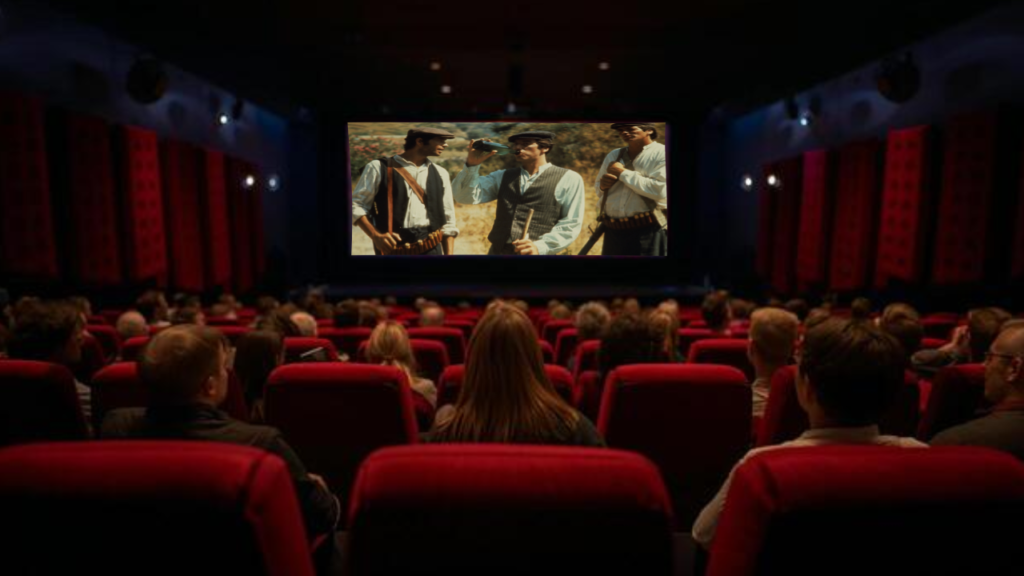
The feeling of sitting in a dark theatre, surrounded by strangers, all waiting for the same thing to begin. Watching cinema in a hall is entirely different from watching it at home. The screen is bigger, yes. The sound is louder, yes. But more than that, there’s a certain commitment that comes with it. For those two or three hours, you’re completely present. The world outside disappears. There’s something almost irreplaceable about that.
Perhaps that is because cinema is unlike any other art form we have ever created.
For the first time in human history, one art form managed to bring together so many others without diminishing any of them. A novel could move people through words, a painting through colour, a symphony through sound, and a play through performance. Cinema inherited all of these languages at once. It borrowed the narrative of literature, the rhythm of music, the visual composition of painting, the immediacy of theatre, the precision of photography, the grace of dance, and even the emotional influence of architecture through the spaces it created. Yet, it was never merely a collection of these arts. It transformed them into something entirely new. That is perhaps why cinema became the defining art form of the twentieth century. It spoke a universal language that crossed borders, cultures, and even literacy. A film could be understood by someone thousands of miles away, regardless of the language they spoke, because emotion itself became its vocabulary.
Perhaps the greatest power of cinema lies in the fact that it doesn’t simply entertain us, it quietly alters the way we see the world. A film rarely changes our mind in the moment we are watching it. Instead, it plants a thought, a question, an emotion that lingers with us. Slowly, it begins to influence how we look at people, relationships, places, history, even ourselves. Some films make us more empathetic. Some challenge our prejudices. Some inspire us to dream bigger, while others force us to confront uncomfortable truths we had been avoiding. Few art forms possess this ability to become part of a society’s collective memory. We quote films, borrow their ideas, revisit their characters, and often understand entire generations through the stories they chose to tell. In that sense, cinema is not merely a mirror held up to society. Sometimes, it is the force that changes the reflection itself.
Maybe that’s why it’s so difficult to define its importance.
Iranian film director, screenwriter, poet, photographer, and film producer Abbas Kiarostami once said, “In my mind, dreams are windows in our lives, and the significance of cinema is in its similarity to this window. Dreaming is like being in a stuffy room and opening a window… You let the air in and then you breathe.”
Though the thought here is metaphorical, it somehow feels literally true as well. At least it does to me.
Sometimes, and I don’t know if it’s true for every writer, you get ideas for stories from your dreams. I have seen that be true in my case. Not every idea. Not every time. Not every dream. But often. Sometimes it’s just an image. Sometimes it’s a feeling. Sometimes it’s a conversation that never happened. You wake up, and before you know it, you’re trying to hold onto it before it disappears. Most of it does disappear. But every now and then, something stays. And that something slowly becomes an idea. And that idea makes you feel closer to breathing, to living life in its truest form. It feels away from your routine life. It feels like you’re amidst beauty.
Maybe that’s another reason cinema feels so close to dreams. Not because dreams are films. But because both leave you with something that you can’t quite explain.
American actress, screenwriter, and film director Greta Gerwig also said something else that’s quite an interesting thought to introspect about, “Whatever the negotiation of time and art is, it’s absurd to have a timed art form. But it’s also beautiful to have a timed art form because we’re all on a timer.”
I think there’s something incredibly moving about that. Every film asks for your time. Two hours. Maybe three. Often even four. And that’s all it gets. Within that limited time, it has to make you laugh, question, reflect, understand, or simply feel.
Maybe that’s what makes cinema so special. It exists within the same limitation that we do. Same limitation that life does.
English screenwriter, producer, director, and former actor Mike Leigh once said, “It’s an impulse to tell stories. To make things up. To get people doing things. To put on shows. All of it is in your DNA.” I like that thought. Because storytelling has never really felt like a profession to me. It feels more like an instinct. An urge. A need. Something that keeps returning no matter how much you ignore it. Some people express that through novels. Some through music. Some through paintings. Some through films.
And perhaps that’s also why cinema stays with us, and why it feels so essential.
My belief is that the importance comes from the fact that it has the power to move you. And I’m not talking about feeling something in the moment of watching the film. I mean after. After you’ve watched it and it’s still there. Inside of you. Festering and growing. Staying with you. Becoming a part of you. Making a home within you.
That, to me, is what makes cinema imperative. A simple, yet perhaps the most powerful, medium of storytelling.
Where the stories slowly become your own. Regardless of who made them. Regardless of what country they’re from. Regardless of what corner of the world they belong to. Sometimes, a city you’ve never heard of. Sometimes, a life you’ve never lived. And yet, somehow, it all feels familiar. When your ideas match. When your beliefs align. The distance between you and the film disappears.
American filmmaker Martin Scorsese once said, “Cinema is necessary. I know the business has changed and everything changes all the time. While the art, of course, can’t survive without the business, I have to say that in the end, the business certainly isn’t gonna survive without the art, which is made by people with something to say. We can’t have a future of our art form without knowing its past.”
I think about that often. Everything changes. The business changes. Technology changes. The way we watch films changes. Our choices and interests change. But people with something to say will always exist. And as long as they do, cinema will continue to stay relevant and significant.
When something makes you feel like it’s the reason for your breathing fresh air. The why of living. The answer to all questions. Somewhat similar to what love makes you feel. The wholeness. The breath of freedom. The release from confinement. And so, cinema is love. And love, however small and simple a word, the meaning is anything but.
While knowing the importance of cinema, you also feel its importance. And it feels profoundly significant.
Read More: