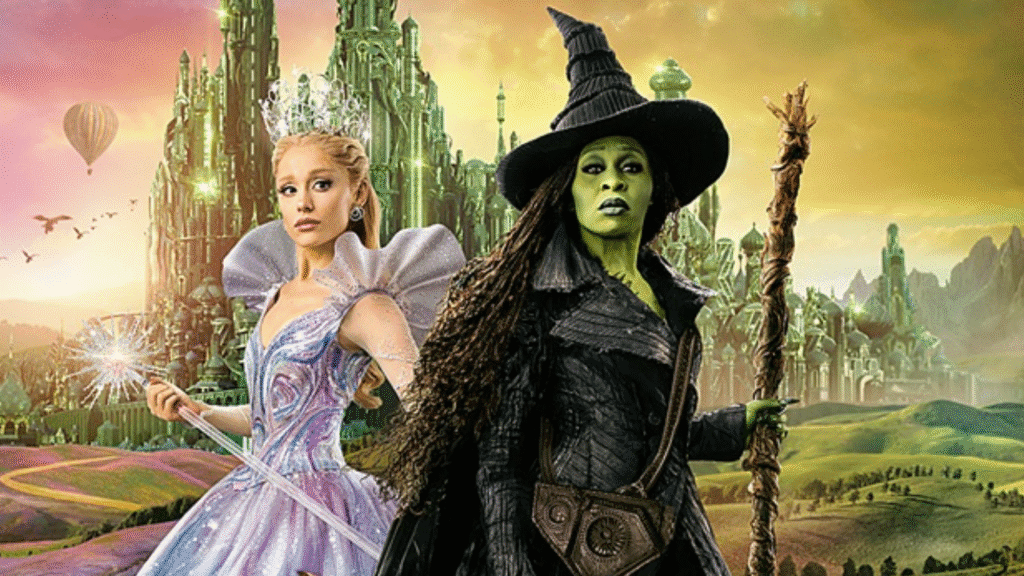
Wicked: For Good has finally arrived for audiences and critics alike, and the verdict is deeply mixed, yet emotionally resonant. As the grand second chapter of Jon M. Chu’s cinematic adaptation of the celebrated stage musical, this sequel shifts its focus from sheer spectacle to the intimate emotional stakes between its two leads — and many reviewers say that gamble pays off, even if not everything lands perfectly.
From Variety, Peter Debruge argues that the film underscores Glinda’s redemption in a way the first film could not, writing that while the original was about Elphaba’s empowerment, this sequel centers on Glinda’s personal evolution. He praises the richly detailed world-building — particularly the ornate Art Nouveau sets — but notes the film leans more heavily into virtual effects than its predecessor. The Hollywood Reporter’s David Rooney sees the casting of Cynthia Erivo and Ariana Grande as “a masterstroke,” pointing out the “lovely symmetry” created by shifting more of the emotional weight to Glinda, while still giving Elphaba room to shine. Rooney lauds Erivo’s performance as a powerhouse, saying her voice “shakes the heavens,” and also applauds Grande for revealing “tender depths” in her quieter, introspective moments.
Over at BBC, critic Caryn James reflects on the film’s glossy visuals — “as slick and shiny as Glinda’s lip gloss” — and admits that for fans, exactly that kind of visual spectacle may be precisely what they hoped to see. She also highlights the emotional impact of extended musical set-pieces, noting how director Chu uses close-up shots on Erivo and Grande while they sing, creating some of the film’s most powerful moments. RogerEbert.com’s Christy Lemire echoes this emotional take: she describes the darker tone of the sequel as balanced with genuine wonder, calling the number “No Good Deed” a showstopper that perfectly showcases Erivo’s vocal strength. She also praises one of the two newly written songs, “The Girl in the Bubble,” as a moment for Grande to dive deeper into Glinda’s psyche with real dramatic weight.
Yet not all reactions are glowing. Vulture’s Bilge Ebiri feels that although Wicked: For Good is emotionally richer than the first chapter, it makes a trade-off by scaling back spectacle. His audience “was audibly sobbing by the end,” a testament to the emotional pull, but he questions whether the sequel quite recaptures the magic of Part One. Collider’s Therese Lacson, meanwhile, marvels at director Chu’s flair for grand, cinematic moments — she even suggests he deserves “some kind of special award” for orchestrating a magical onscreen wedding — but she also points to structural weaknesses and moments where the narrative feels rushed.
Slant Magazine’s Dan Rubins is more critical of the adaptation’s ambition, calling “No Good Deed” a “cinematic sensation” but arguing that certain detours delay the story without fundamentally reimagining it. AwardsWatch’s Sophia Ciminello notes that much of what works musically comes from what was carried over from the stage show, rather than from the two new songs written for this film, though she acknowledges Grande’s charm helps balance the musical’s darker second act.
What Audiences Think of Wicked: For Good — Rotten Tomatoes and IMDb Scores
Early audience sentiment for Wicked: For Good skews overwhelmingly positive, suggesting that viewers may be more forgiving than critics. On Rotten Tomatoes, the critic score currently hovers around 74%, earning the film a “Fresh” status, even as it registers below the first film’s critical reception. But on the same platform, the audience seems spellbound: the verified user rating sits at an astonishing 98%, indicating widespread fan love. Meanwhile, the early critical consensus summarized by sites like World of Reel points to a 61/100 on Metacritic, reflecting a notably polite critical reception. On IMDb (7.4/10), while the score is still settling given the film’s recent release, initial user reviews largely echo the theatrical, emotional, and musical strengths that critics have highlighted.
What the Critics Agree On — and Disagree About
Most critics converge on a few key highlights. The emotional heart of Wicked: For Good — the evolving friendship and tension between Elphaba and Glinda — is widely praised. Erivo is consistently celebrated for her powerhouse vocal performances, and Grande is recognized for bringing surprising depth and vulnerability to Glinda. Chu’s direction, while visually ambitious, is also commended for creating moments of genuine intimacy.
Yet, critics diverge sharply when it comes to pacing and structure. For some, the film’s darker tone and dense narrative make it feel slower and less focused than the first installment. Others point to the new songs as underwhelming: while “No Good Deed” is almost universally singled out as a highlight, additional compositions like “The Girl in the Bubble” and “No Place Like Home” receive more mixed responses. The increased reliance on CGI is also a sticking point for those who preferred the more grounded feel of the predecessor.
Wicked: For Good in Focus — Key Details About the Film
Wicked: For Good is directed by Jon M. Chu and reunites Cynthia Erivo as Elphaba and Ariana Grande as Glinda in a richly textured, emotionally charged conclusion to their Oz journey. Supported by a cast including Jeff Goldblum, Jonathan Bailey, and more, the film explores the political upheaval brewing in Oz, the fractured loyalties of its central characters, and the redemptive power of friendship and truth. Based on the beloved Wicked stage musical by Winnie Holzman and Stephen Schwartz, the film blends sweeping visual design, complex choreography, and a score that mixes iconic numbers from the original with newly written material. With a theatrical release in November 2025, the sequel has raised both expectations and eyebrows — delivering a finale that some critics say is breathtaking, while others agree it may be a risk that doesn’t entirely pay off.
Read More: