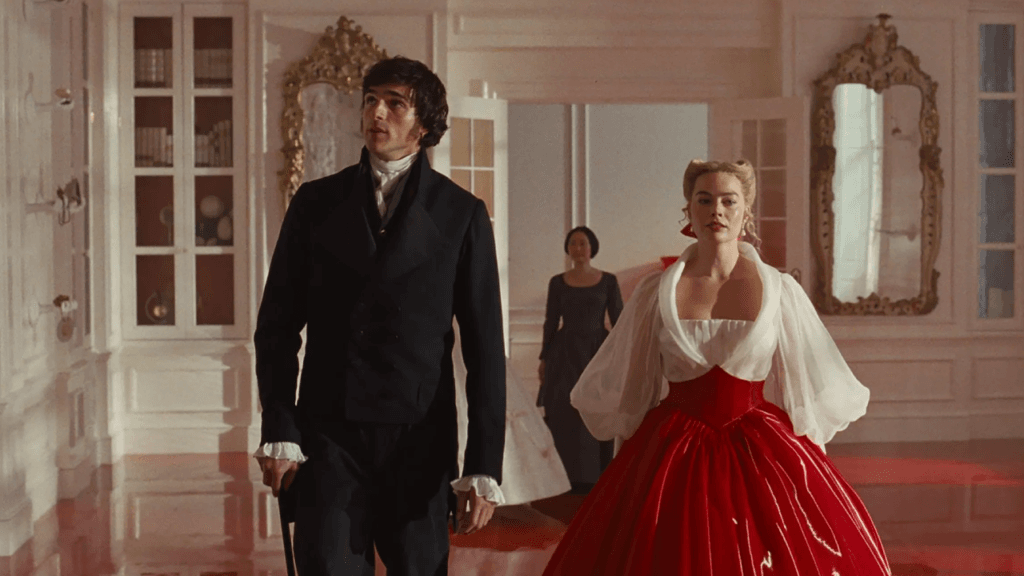
Wuthering Heights arrives with the kind of baggage few literary adaptations can avoid and fewer filmmakers choose to provoke. Directed by Emerald Fennell, the film follows Saltburn with an operatic, erotic reimagining of Emily Brontë’s novel—one that critics across major global publications agree is impossible to ignore, even when it frustrates. The response, taken as a whole, is sharply divided: praise for audacity, performances, and atmosphere collides with concerns about emotional depth and excess.
At its core, Fennell’s Wuthering Heights announces itself as a decisive escalation from prior screen versions. Where earlier adaptations softened Brontë’s ferocity, this one leans into carnality and power. Variety’s Peter Debruge sets the tone by calling the film “bold and engaging, even when indulgent,” noting that Fennell understands the value of withholding gratification as much as delivering it. That sense of calculated excess—pushing the material to the edge and then pulling back—defines much of the critical conversation.
The adaptation reframes Brontë’s romantic tragedy as an erotic gothic drama. Critics note the R rating as a statement of intent, a break from the “polite, repressive” lineage of earlier versions. Screen Daily describes a “fiercely stylised gothic romance that privileges sensation over subtlety,” while The Guardian argues that the provocation sometimes substitutes for profundity. The question critics keep asking is not whether Fennell’s version is faithful—it isn’t—but whether its sensual reorientation reveals something new or merely amplifies surface thrills.
On the matter of performances, consensus is notably warmer. Margot Robbie’s Catherine is widely described as emboldened and complicit, granted more agency in the story’s destructive passions. Jacob Elordi’s Heathcliff, by contrast, is read as wounded rather than demonic—less a brute than a vessel for obsession and revenge. Variety highlights the “intense” chemistry between the two, and USA Today calls the film “lavish, provocative, and impossible to ignore,” crediting the leads for sustaining its fevered pitch even when the narrative strains.
Fennell’s directorial stamp is unmistakable and divisive. IndieWire characterises the film as a “lurid, operatic reimagining” that will “either intoxicate or repel,” arguing that the director doubles down on excess and trusts style to carry meaning. The Hollywood Reporter acknowledges the approach as “visually arresting,” but finds the emotional trajectory uneven, suggesting that the tragedy at the heart of Brontë’s novel is oddly muted by the film’s fixation on sensation. For supporters, this is a deliberate reframing; for detractors, it’s a dilution.
Visually, the film earns near-universal attention. Critics dwell on the stark contrast between spaces—the ominous Earnshaw estate and the lurid opulence of Thrushcross Grange—as symbolic extensions of desire and decay. Screen Daily praises the commitment to atmosphere, while the Associated Press describes the film as “visually daring but emotionally thin,” encapsulating a refrain heard elsewhere: the craft is undeniable, the feeling less so. Music choices, including contributions by Charli xcx, reinforce the sadomasochistic subtext and the film’s appetite for extreme sensation.
Where critics push back most forcefully is on emotional resonance. The Guardian calls the film “all atmosphere and attitude, with little of the novel’s emotional ache,” arguing that the erotic emphasis crowds out Brontë’s fury and sorrow. The New Yorker echoes this concern, writing that Fennell’s film “never quite plumbs the depths” of the source’s rage and grief. The Daily Beast is blunter still, dubbing it “the year’s horniest literary adaptation” and one of its most exhausting—an assessment that captures how some viewers experience the relentless intensity as numbing rather than cathartic.
That division extends to broader cultural positioning. Rotten Tomatoes’ early consensus frames Wuthering Heights as a boldly stylised take that divides critics with its erotic excess and uneven emotional payoff. For audiences attuned to the aesthetic maximalism of A24 and Neon releases, this may be a feature rather than a flaw. IndieWire suggests the film speaks directly to viewers who crave sensation and authorship over reverence, even if it risks alienating purists.
Taken together, the reviews converge on a clear picture. Wuthering Heights is not a definitive adaptation meant to replace what came before; it is an argument—about desire, about power, about how far a classic can be bent before it breaks. Variety’s appraisal captures the balance many critics strike: indulgent yet intentional, excessive yet controlled. The Hollywood Reporter’s reservations underline the cost of that approach, while The Guardian and The New Yorker articulate what may be lost in the translation.
In the end, Fennell’s film leaves critics—and likely audiences—wanting in different ways. Some will want less provocation and more feeling; others will want even more audacity. What few deny is the film’s force. It shocks less by what it shows than by how unapologetically it reframes a familiar story, insisting that Wuthering Heights be experienced as an erotic fever rather than a restrained lament. Love it or resist it, the film provokes a reaction—and in the crowded field of literary adaptations, that may be its most decisive achievement.
Wuthering Heights is directed by Emerald Fennell, stars Margot Robbie and Jacob Elordi, is released by Warner Bros. Pictures, runs 136 minutes, and is rated R.
Read More Review Roundups on POF