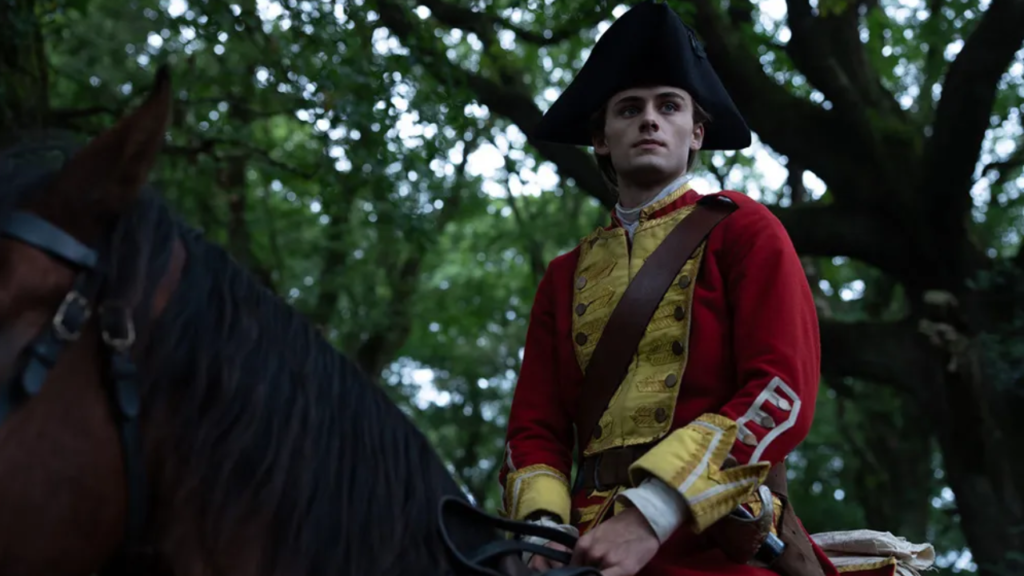
Young Washington reviews reveal one of the year’s most polarized critical responses. Released by Angel Studios during America’s 250th anniversary celebrations, Jon Erwin’s historical drama explores George Washington’s formative years long before he became the first President of the United States. Critics have largely agreed on the film’s technical strengths, praising William Franklyn-Miller’s lead performance, the sweeping battle sequences, and Kristopher Kimlin’s striking cinematography. However, opinions sharply diverge over whether Young Washington succeeds as an inspiring coming-of-age story or settles for a simplified, patriotic retelling that avoids the more complicated aspects of Washington’s legacy.
Set during the French and Indian War in the mid-1750s, the film follows a 23-year-old George Washington as he struggles to rise above his modest social standing in colonial Virginia. Working first as a surveyor before joining the Virginia militia, Washington earns the attention of influential figures such as Lord Fairfax and Lieutenant Governor Robert Dinwiddie, eventually finding himself at the center of dangerous military expeditions into the Ohio Territory. Alongside his growing feelings for Sally Cary and his increasingly difficult battlefield experiences, the young officer begins developing the qualities that would later define one of history’s most influential leaders. Rather than focusing on the Revolutionary War or the presidency, the film examines the setbacks, failures, and difficult decisions that shaped Washington’s character.
One of the strongest themes running through the reviews is that Young Washington works best when it presents Washington not as a national icon but as a young man still searching for purpose. Several critics praise the film for resisting the temptation to portray him as instantly heroic. Instead, they appreciate watching an ambitious but inexperienced officer learning painful lessons about leadership, responsibility, and sacrifice. Even reviewers who disagreed about the film’s overall success acknowledged that this coming-of-age approach gives the story its strongest emotional foundation.
Writing for Deadline, Pete Hammond describes Young Washington as an overdue look at America’s first president before history turned him into a legend. Hammond praises Jon Erwin’s staging of the Battle of Fort Necessity and the Battle of Fort Duquesne, arguing that these sequences provide the film with its most exciting moments. He also singles out cinematographer Kristopher Kimlin for giving the battlefield scenes scale and realism. At the same time, Hammond believes the film often feels closer to a polished History Channel production than a major summer theatrical release. Despite that reservation, he argues its patriotic tone makes it an appropriate release for the Fourth of July holiday.
One of the film’s strongest supporters is Matt Zoller Seitz of RogerEbert.com, who calls Young Washington “a well-crafted but accessible biopic” about the making of a national leader. Seitz praises Jon Erwin’s economical storytelling, arguing that the film successfully balances historical context with engaging drama. He particularly appreciates the way William Franklyn-Miller portrays Washington as determined but still uncertain, allowing audiences to witness his gradual transformation into a capable leader rather than presenting him as a flawless hero from the outset. Seitz also highlights the film’s impressive landscapes and frontier sequences, noting that Kristopher Kimlin’s cinematography captures both the beauty and harshness of colonial America. While acknowledging Angel Studios’ ideological identity, he believes Young Washington represents one of the studio’s strongest historical dramas to date.
Variety’s Owen Gleiberman offers a more measured assessment, comparing Young Washington to the inspirational biographies many readers encountered in school. He appreciates the film’s sincerity and its portrayal of Washington earning greatness through perseverance rather than destiny. Gleiberman praises William Franklyn-Miller’s restrained performance, particularly his portrayal of Washington’s temper, determination, and sense of fairness. He also enjoys the depiction of the colonial militia and the emergence of unconventional fighting tactics that would later influence the American Revolution. However, Variety cautions that the film’s feel-good patriotism should not be mistaken for historical complexity, describing it as an old-fashioned historical biography that remains more inspirational than intellectually challenging.
If there is one point on which critics almost universally agree, it is William Franklyn-Miller’s performance. Reviews from RogerEbert.com, Variety, Deadline, Hollywood in Toto, and even several of the film’s harshest critics consistently praise the young actor’s portrayal of Washington. Rather than presenting him as an untouchable historical icon, Franklyn-Miller plays him as ambitious, vulnerable, occasionally impulsive, and constantly learning from failure. That humanity allows audiences to connect with a figure often reduced to myth.
The battle sequences emerge as the film’s most celebrated technical achievement. Across the review spectrum, critics repeatedly highlight Jon Erwin’s staging of military action, Kristopher Kimlin’s cinematography, and David de Vos’ editing. Deadline, RogerEbert.com, The Film Verdict, Rick Bentley, and even William Bibbiani’s otherwise negative review for TheWrap all acknowledge that the battlefield sequences possess an authenticity and scale rarely seen in modestly budgeted historical dramas. The contrast between traditional British military tactics and the rougher frontier style of combat also receives praise for illustrating the military evolution that would later define the American Revolution.
Where critics begin to disagree is in the storytelling itself. Frank Scheck, writing for The Hollywood Reporter, argues that Young Washington suffers from the stiff and stodgy qualities that have long plagued historical dramas, suggesting that its two-hour runtime feels considerably longer. Josh Parham of Next Best Picture describes the filmmaking as dull and the storytelling as hollow, while reviewers from The Wall Street Journal and Flickering Myth criticize the flat supporting characters and conventional narrative. Several reviewers compare the experience to watching a classroom history lesson or a television historical drama rather than a cinematic event. This recurring criticism becomes one of the defining themes of the film’s mixed reception.
The strongest criticism comes from William Bibbiani of TheWrap, whose review questions not only the film’s storytelling but also its historical perspective. While acknowledging the competent direction, impressive production design, and William Franklyn-Miller’s committed performance, Bibbiani argues that the screenplay presents an overly sanitized version of George Washington. He criticizes the film for largely avoiding the contradictions surrounding Washington’s ownership of enslaved people while increasingly portraying him as an almost mythic action hero during the climactic battle sequences. Bibbiani also questions Angel Studios’ “pay it forward” ticket campaign, arguing that it undermines the patriotic message the film attempts to celebrate. His review represents the sharpest example of critics who believe Young Washington sacrifices historical complexity in favor of inspirational mythmaking.
Not every critic viewed the film’s patriotic tone as a weakness. Christian Toto of Hollywood in Toto calls Young Washington the George Washington film audiences deserved, praising its respectful treatment of the historical figure, energetic battle scenes, and strong performances. Cody Benjamin of Christianity Today similarly argues that the film succeeds because it portrays Washington as a resilient young man shaped by failure rather than instant greatness. Reviews from Parade, Aisle Seat, and several other publications also embrace the film’s inspirational approach, suggesting that its emphasis on perseverance and leadership is precisely what makes it effective as a historical drama.
Ultimately, Young Washington reveals a fascinating divide among critics. Nearly everyone agrees that Jon Erwin has assembled an impressive cast, staged compelling battle sequences, and found an engaging lead performance in William Franklyn-Miller. The disagreement lies in what audiences expect from a historical biopic. Viewers looking for an uplifting origin story about America’s first president may find much to admire, while those seeking a deeper examination of Washington’s contradictions and the complexities of early American history are more likely to leave disappointed.
The most interesting aspect of Young Washington isn’t whether it succeeds as patriotic cinema—it is why critics disagree about it. The film is strongest when it strips away the legend and presents George Washington as a determined but inexperienced young man whose failures shaped his future greatness. At the same time, the criticism surrounding its simplified historical perspective is difficult to ignore. Whether audiences ultimately embrace Young Washington will likely depend on whether they view it as an inspirational coming-of-age drama or expect a more probing historical portrait. Either way, critics largely agree that William Franklyn-Miller and the film’s impressive battle sequences give this ambitious biopic a solid foundation.
Film Details: Young Washington
Genre: Historical Drama, WarDirector: Jon Erwin
Writers: Jon Erwin, Tom Provost, Diederik Hoogstraten
Cast: William Franklyn-Miller, Ben Kingsley, Andy Serkis, Kelsey Grammer, Mary-Louise Parker, Mia Rodgers
Runtime: 122 Minutes
Rating: PG-13
Studio: Angel Studios
Release Date: July 2, 2026
Read More Review Roundups on POF