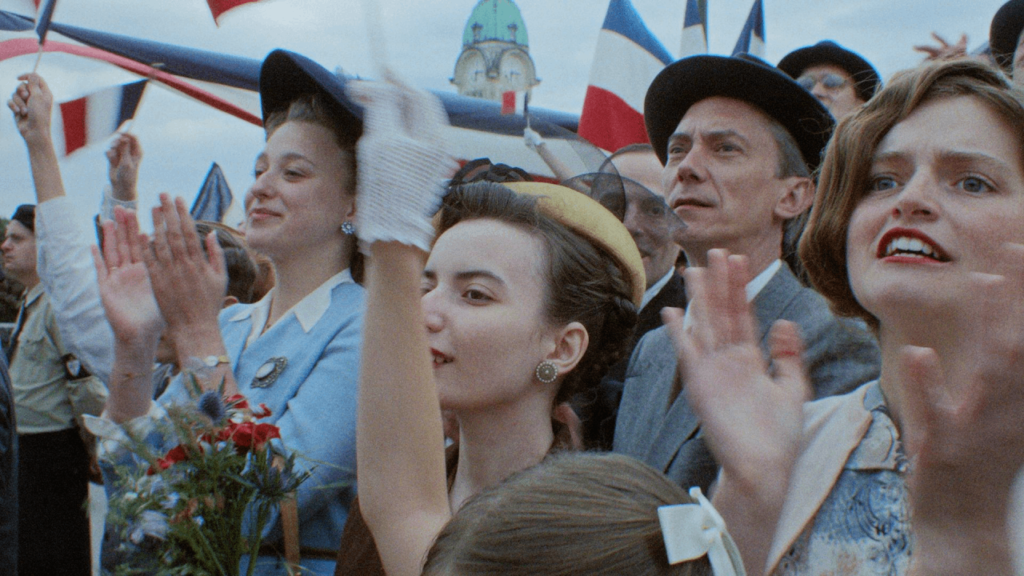
A film about political collaboration, personal ambition and the banality of evil is finding an unexpectedly large audience in France. Emmanuel Marre’s A Man of His Time, released in French cinemas on September 30 under its original title, Notre Salut, recorded 215,000 admissions in its first week and nearly 500,000 within 15 days. Starring Swann Arlaud as a bureaucrat working under France’s Vichy regime during the Second World War, the film has emerged as a notable box-office success despite running for more than two and a half hours and rejecting many conventions of mainstream cinema. Its performance has been particularly striking in Paris, where it has outperformed other releases.
There is little in A Man of His Time that resembles a conventional commercial attraction. The film has no action sequences, spectacular effects or romantic subplot to make its historical setting more accessible to a mainstream audience. Instead, Emmanuel Marre follows a man attempting to establish himself within an authoritarian administration, finding opportunities for advancement as France undergoes a political transformation.
The film runs for 155 minutes, according to the official Cannes Film Festival listing. Its opening 15-minute sequence unfolds in a confined setting, while its handheld camerawork and unconventional narrative demand patience from viewers. Rather than building towards familiar dramatic payoffs, the film finds tension in conversations, routine work and the decisions through which its central character becomes complicit in a destructive political system.
Swann Arlaud is central to the film’s approach, appearing in almost every scene as Henri Marre, an ambitious official who sees the Vichy administration as an opportunity to rebuild his life and advance his ideas. His performance avoids the familiar portrayal of a historical villain as an openly threatening figure. Henri’s danger lies in his ability to treat his work as ordinary administration, separating his professional ambitions from the consequences of the system he serves.
The filmmaking follows a similarly understated approach. Dialogue was developed through substantial improvisation, while the camera remains close to the characters rather than transforming the period setting into an elaborate historical spectacle. These choices give the film an immediacy that contrasts with the distance often associated with wartime dramas.
The approach also earned recognition at Cannes, where Emmanuel Marre received the Best Screenplay award in 2026. The film’s achievement lies in making an unsettling historical subject feel immediate without reducing it to a straightforward moral lesson.
The response to A Man of His Time is particularly noteworthy given its subject. The Vichy regime collaborated with Nazi Germany, and the film examines how ordinary officials contributed to its functioning. At its centre is the question of the banality of evil: how ambition, convenience and the desire to remain useful can make participation in an oppressive system appear routine.
The film has attracted favourable attention across France’s politically diverse media landscape, including Le Monde, Libération and Le Figaro. That broad reception is unusual for a politically charged film, particularly one whose questions extend beyond the historical period it depicts. Rather than presenting audiences with an uncomplicated villain, Emmanuel Marre offers a character whose everyday decisions raise uncomfortable questions about individual responsibility.
The story also has a personal foundation. The director drew inspiration from correspondence involving his great-grandparents, including the history of his great-grandfather’s work under the Vichy administration. This connection gives the film a historical starting point while allowing its central questions to reach beyond one family’s past.
The next challenge is expanding the film’s audience. Its strong opening and continued growth during its second week suggest that word of mouth is working. Its performance beyond major urban centres will help determine how far its theatrical run can extend.
For now, A Man of His Time offers a reminder that audiences do not always need spectacle to find a reason to visit cinemas. Sometimes, a film can draw viewers by asking them to spend time with an uncomfortable character and examine the choices that shape his world. For a historical drama built around quiet complicity rather than grand gestures, nearly half a million admissions in two weeks is a notable box-office result.