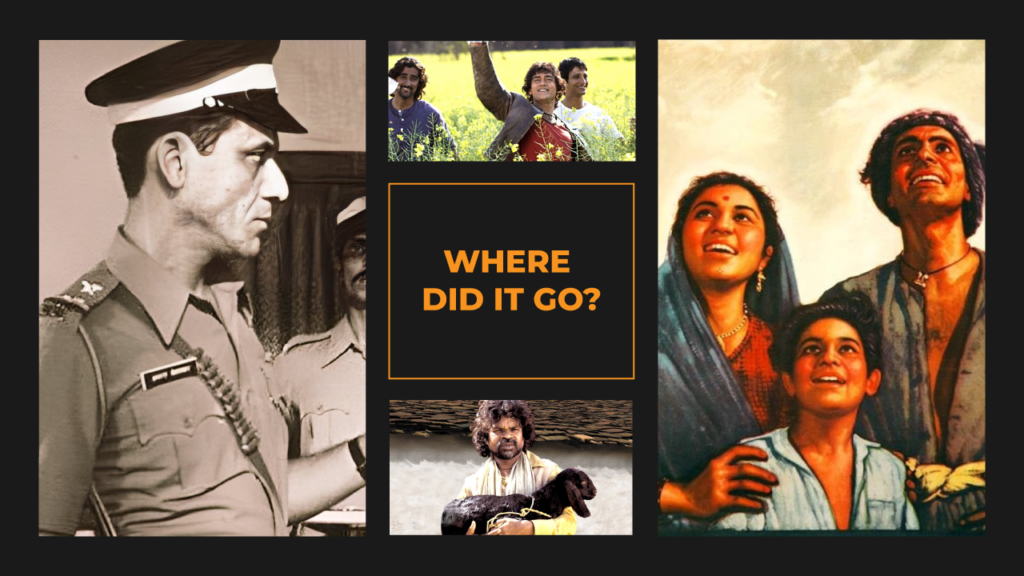
There was a time when Hindi cinema did more than entertain; it confronted power. It questioned authority, exposed systemic failures, and gave voice to a public simmering with frustration. What we now describe as “anti-establishment cinema” wasn’t a fringe movement in Bollywood. It was, for a significant period, almost a defining tone of mainstream storytelling.
In the 1970s and 80s, this impulse found its most potent expression through the “angry young man,” immortalized by Amitabh Bachchan. Films like Deewaar and Zanjeer were not merely popular successes, they were cultural reactions. The establishment, whether in the form of corrupt institutions, failing law enforcement, or economic inequality, became the central antagonist. The hero did not exist above the system; he was born out of its failures.
These films resonated because they mirrored a larger social reality. India of that era was marked by political instability, unemployment, and a growing sense of disillusionment. Cinema became a site of emotional release, a place where the audience could witness resistance, even if they could not enact it in real life. The defiance on screen was not aspirational in a conventional sense, it was cathartic.
Importantly, this engagement with the establishment was not confined to one kind of storytelling. Parallel cinema and socially conscious mainstream films consistently tackled pressing issues, agrarian distress, police brutality, corruption, and institutional decay. Works like Do Bigha Zamin and Ardh Satya approached these themes with stark realism, while commercial cinema translated similar anxieties into more dramatic narratives.
Even in the 2000s, there were moments when this tradition resurfaced. Rang De Basanti captured the disillusionment of a younger generation and its confrontation with political apathy, while Peepli Live used satire to critique media sensationalism and governmental indifference toward rural distress. These films indicated that the anti-establishment impulse had not entirely vanished, but they also now appear as some of the last widely embraced examples of it.
So what changed? The decline of anti-establishment cinema in mainstream Bollywood cannot be attributed to a single cause. Rather, it reflects a convergence of industrial, cultural, and psychological shifts. First, the economics of filmmaking have transformed significantly. The rise of high-budget productions, corporate studios, and global distribution models has made risk management central to the filmmaking process. Anti-establishment narratives, by their very nature, invite controversy. They challenge power structures, provoke debate, and can alienate certain sections of the audience or stakeholders. In an environment where financial stakes are higher than ever, such risks are often avoided in favor of safer, more universally palatable content.
Second, audience expectations have evolved. Contemporary viewers are navigating an increasingly complex and demanding reality, marked by economic pressures, information overload, and the constant presence of digital media. In such a context, cinema often functions as an escape rather than a confrontation. Stories that offer relief, fantasy, or personal drama tend to find wider acceptance than those that demand critical engagement with uncomfortable truths.
Third, the relationship between cinema and power has itself become more intricate. The boundaries between storytelling, public sentiment, and institutional influence are less clearly defined. This makes overt critique more complicated not only for filmmakers, who must navigate these dynamics carefully, but also for audiences, who may interpret such narratives through increasingly polarized lenses.
The result is a noticeable shift in the nature of conflict within mainstream Hindi cinema. Where earlier films placed the individual against the system, many contemporary narratives focus on personal struggles, interpersonal relationships, or internal dilemmas. The antagonist is no longer the establishment, it is often circumstance, fate, or individual psychology. While these are valid and meaningful areas of exploration, they mark a departure from a tradition that once placed systemic critique at the heart of popular storytelling.
What has been lost in this transition is not merely a genre, but a certain cinematic courage. Anti-establishment cinema was never just about politics in a narrow sense. It was about asking fundamental questions, Who holds power? Who is marginalized? What happens when systems designed to protect begin to fail?
By raising these questions, such films created a space for reflection and, at times, discomfort. They reminded audiences that cinema could do more than entertain, it could challenge, provoke, and even unsettle.
Today, that unsettling quality is rare in mainstream Bollywood. The absence is not absolute, independent films and certain streaming content occasionally revisit these themes, but within the larger commercial landscape, the voice of dissent has grown quieter.
This raises an important question. Has anti-establishment cinema truly disappeared, or has the ecosystem around it changed in ways that make it less visible, less viable, or less desired?
The answer likely lies somewhere in between. The stories still exist, as they always will, because the tensions they arise from between individuals and systems are inherent to society itself. What has shifted is the willingness, both from filmmakers and audiences, to engage with them in the same way.
And perhaps that is where the real absence lies, not on the screen, but in the space between what cinema dares to say and what we are willing to hear.
Read More:
- Why India Still Doesn’t Have Its Own Pixar
- Roger Corman: The King of Cult Cinema and His Enduring Legacy
- From Water to Fire: How Avatar’s Visual Language Is Evolving