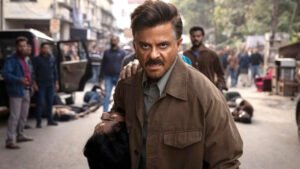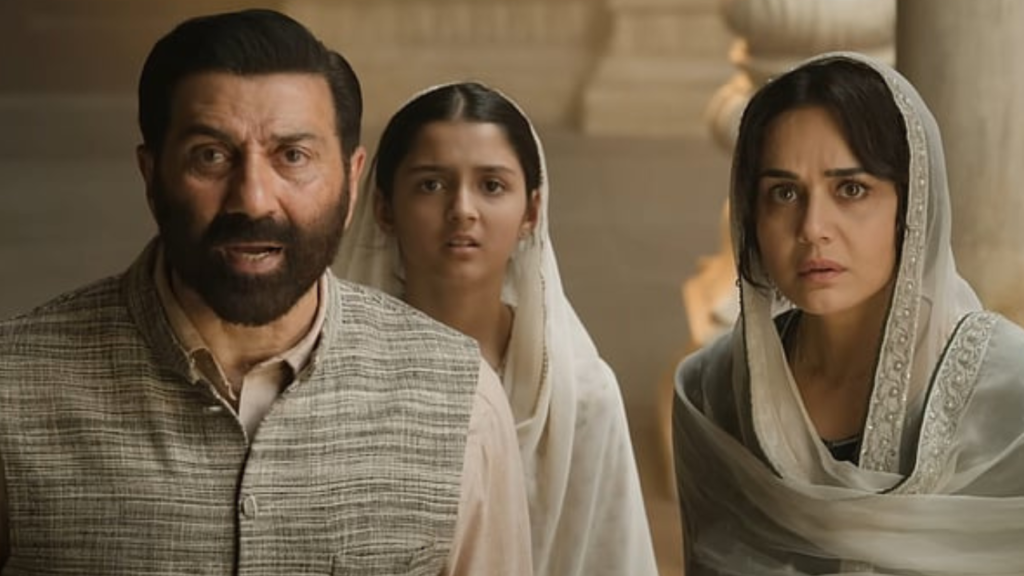
Batwara 1947 released on August 14, India’s Independence Day, and the timing is entirely deliberate. Directed by Rajkumar Santoshi and produced by Aamir Khan, the film is an adaptation of Asghar Wajahat’s acclaimed Urdu play Jis Lahore Nai Vekhya, O Jamya E Nai, and stars Sunny Deol, Preity Zinta, Shabana Azmi and Ali Fazal. It arrives as part of a quiet wave of Bollywood films alongside Ikkis and Main Vaapas Aaunga that have made the case for shared humanity across the subcontinent’s divisions. The critical response is largely warm in intent but honest about execution, a film worth seeing, critics say, whose courage consistently outpaces its craft.
A prosperous Muslim family from Meerut, led by patriarch Sikandar Mirza, played by Sunny Deol, is forced to flee to Lahore on a blood-soaked Partition night. After months of displacement, they are allotted a haveli. When they arrive, they discover the original Hindu owner, Durgavati, known to all as Maai and played by Shabana Azmi, still lives upstairs, refusing to leave and waiting for a son who will never return. Mirza and his family choose compassion over resentment.
They shelter her, celebrate her festivals and cook her food. This secular warmth draws the fury of fundamentalist neighbours, who begin to pressure and eventually threaten the Mirza family. When all else fails, Mirza must decide whether peace can survive in a world still learning how to divide by faith.
Every review of Batwara 1947 begins from roughly the same place: a genuine respect for what the film is trying to do and a candid assessment of how far the execution falls short. The Hollywood Reporter India’s Rahul Desai described what he calls “the heart-is-in-the-right-place syndrome”, the phenomenon where a film’s moral courage becomes a kind of shortcut that substitutes for filmmaking. He acknowledged that the film says important things but argued that the courage of the film is ultimately more moving than the film itself.
Bollywood Hungama described it as a well-intentioned and moving tale of humanity that benefits immensely from strong performances but is prevented from being a hard-hitting entertainer by a lengthy second half and too few mass moments. The Quint’s Arunabh Saikia noted that the film’s intentions are honourable but that things move along predictable routes, with every conflict veering toward its foreseeable resolution without genuine surprise. Rotten Tomatoes’ collected critical consensus echoed the same note, calling it thought-provoking when it finds its balance but acknowledging that the 145-minute runtime works against it.
One name appears in every positive notice without reservation: Shabana Azmi. The Hollywood Reporter India singled out her performance as the film’s one genuinely deep and registering element, the only performance that captures the full weight of displacement, stubbornness and grief without ever tipping into melodrama. Bollywood Hungama called her performance strong and central to the film’s emotional credibility. The Quint pointed out that Durgavati’s resolve drives the entire conflict of the film, even as the screenplay ultimately makes her fate dependent on whether Mirza arrives in time to save her, which it describes as a telling structural limitation.
The Hollywood Reporter India made the most insightful observation about Sunny Deol’s performance, describing Mirza as a character split between two versions of the actor himself. The first is the measured, reasoning man who tries to use words, kindness and monologues about the teachings of the Quran. The second is the single-screen superstar who did Gadar: when all else fails, the two-and-a-half-kilogram hand wreaks havoc, the vocal cords set records, and handpumps are in danger.
The battle between these two personas, critics noted, is part of the film’s conceit. To Sunny Deol’s credit, he allows his trademark volume to eventually be defeated by the hush of altruism. Bollywood Hungama acknowledged that those expecting relentless action will be disappointed but that Deol’s quieter moments carry genuine conviction.
Ali Fazal, as a liberal poet, was praised across reviews as a welcome and grounded presence. Preity Zinta, returning to the big screen in a significant role, received respectful notices. Bollywood Hungama described her performance as noteworthy. Karan Deol, as Javed, the son who is radicalised by trauma, was described by The Quint as very callow. The film’s antagonists drew sharper criticism: The Hollywood Reporter India pointed to pantomime-villain henchmen who sport fake moles, beards, lipstick and contact lenses, a visual shorthand that reduces the film’s sense of authentic danger.
Batwara 1947 was shot by veteran cinematographer Santosh Sivan and features music by A.R. Rahman. Despite that pedigree, The Hollywood Reporter India argued that the film looks and sounds like a school play blessed with a Bollywood-sized budget, with Lahore described as looking like a parody of itself. The screenplay’s dialogue, while occasionally sharp — “Don’t mix politics and religion, it destroys everything” and “nothing is more dangerous than the silence of good people” — is also prone to moments where characters seem to be addressing the camera rather than each other. A little girl innocently asking why India and Pakistan can’t coexist in peace is identified across reviews as the kind of moment that reflects the film’s tendency to state its themes directly rather than earning them through drama.
The most interesting shared observation across reviews is about the film’s contemporary resonance. The Hollywood Reporter India noted that Mirza could be Mishra in the 2020s, the hatred he faces is frightfully familiar, and the partitions persist, making the film’s 1947 setting feel almost incidental. The Quint described this as a story about partition within religion, not just partition between countries. Rotten Tomatoes’ aggregated response included the observation that the film arrives when audiences desperately need to be reminded that the people on the other side of a border are not abstractions. That weight, the sense that this story is about now, not just then, is the film’s most powerful attribute. It is also, critics suggest, what makes its imperfect execution feel like such a missed opportunity.
Batwara 1947 is the kind of film that a healthier film industry would have no trouble making: a plea for humanity told through accessible melodrama, with a star who embodies that contradiction. In 2026, that act of making it is itself significant. Bollywood Hungama concluded that strong positive word of mouth will be crucial for the film to grow beyond its below-expectations opening. The Hollywood Reporter India, despite its reservations, acknowledged that the film’s singular climax almost makes the preachy climb worth it. Almost. The film is like a leader who vows to thrash anyone who disrupts their peaceful protest. The irony is contemporary. And so is the prayer underneath it.
Film Details: Batwara 1947
Film: Batwara 1947
Director: Rajkumar Santoshi
Writers: Rajkumar Santoshi, Asghar Wajahat
Based on: Jis Lahore Nai Vekhya, O Jamya E Nai by Asghar Wajahat
Cast: Sunny Deol, Shabana Azmi, Preity Zinta, Ali Fazal, Karan Deol, Abhimanyu Singh, Kanikka Kapur
Cinematography: Santosh Sivan
Music: A.R. Rahman
Producer: Aamir Khan
Production: Aamir Khan Productions
Distributor: Reliance Entertainment
Language: Hindi
Release Date: August 14, 2026
Read More Review Roundups on POF