When you are truly hungry, and suddenly there is food in front of you, any food, regardless of the taste, that feeling becomes indescribable. At that moment, food is not a preference, luxury, or choice. It becomes survival. It becomes priceless. Hunger strips human beings down to their most basic reality. It changes the way a person thinks, behaves, moves, and even sees the world around them.
And yet, despite hunger being one of the gravest crises in the world even today, cinema rarely speaks about it honestly anymore.
But long before statistics, surveys, and global reports dominated conversations around hunger, one man transformed hunger into performance. And that man was Charlie Chaplin.
His films were never blind comedies made just for entertainment. Behind every joke, every fall, and every expression was a painful understanding of survival. Hunger in Chaplin’s cinema was not treated as background information. It was an embodiment of that life, of that world. He performed hunger through movement, rhythm, silences, gestures, timing, and expression.
In, The Immigrant (1917), Chaplin explored migration, poverty, and hunger through incredibly small but powerful moments. One of the most significant scenes in the film is inside a restaurant, where the Tramp is desperately hungry and, in that desperation, walks into the restaurant without first confirming whether he has the means to pay for a meal, only to later realize that he might not. Chaplin performs the anxiety of poverty physically. While eating, he constantly watches the waiter, checks his pockets repeatedly, and tries to maintain dignity despite panic slowly taking over him. The comedy comes from the Tramp trying hard to act normal while clearly panicking inside. Chaplin turns something as ordinary as eating at a restaurant into a performance of poverty and fear. Hunger here is shown not through loud tragedy, but through nervousness, shame, and the constant worry of not having enough money to afford what might seem like a basic meal.
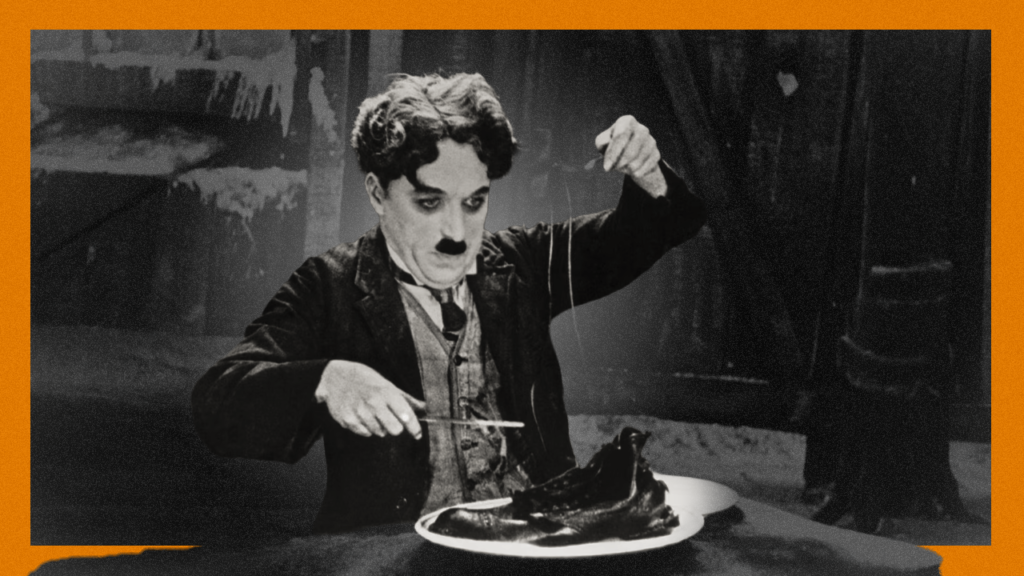
But perhaps no Chaplin film captures the literal performance of hunger more brilliantly than The Gold Rush (1925), in my opinion anyway. Set during the Klondike Gold Rush in Alaska, the film follows the Tramp trapped inside a cabin during a brutal snowstorm with almost nothing left to eat. What follows is one of the most iconic portrayals of starvation in cinema history. There is the unforgettable scene where Chaplin cooks and eats his own shoe after having eaten a candle just before. And somehow, he transforms this horrifying situation into comedy without ever disrespecting the suffering behind it. He boils the shoe carefully, twirls the shoelaces like spaghetti, and eats with the manners of somebody dining in a luxurious restaurant. The performance is funny, absurd, and deeply tragic all at once. Chaplin does not simply tell the audience that the character is hungry. He makes the audience feel the psychological desperation of starvation through performance.
Another moment to reflect in The Gold Rush is when Big Jim hallucinates from hunger, imagining Chaplin as a giant chicken. It is ridiculous and hilarious on the surface, yet underneath the comedy lies a terrifying reality: hunger slowly drives people towards madness. This was Chaplin’s genius. He could perform suffering while making audiences giggle at the same time. It’s as though making someone laugh until they end up crying once they discover what’s beneath the surface.
As Chanakya once said, “There is no wealth more dear than food grain.” The quote feels deeply connected to Chaplin’s cinema because in his films, food is never treated casually. A loaf of bread, a meal, or even scraps of food become symbols of life itself. Food represents survival in different shapes and forms.
In Modern Times (1936), where Chaplin shifted his attention towards industrialization, the film critiques a society where workers are treated less like human beings and more like parts of a machine.
One of the film’s most famous sequences involves an automatic feeding machine. The machine is tested on Chaplin’s character. At first, the invention seems impressive, but everything quickly goes wrong. The machine starts forcefully pushing food into the character’s mouth, spinning corn wildly into his face, and feeding him so aggressively that he completely loses control. The scene is funny because of Chaplin’s physical performance and reactions, but it also shows something disturbing, that even eating is treated like part of factory production. Eating almost feels mechanical. Food is no longer about comfort, or even survival, it becomes another way to increase efficiency. Hunger is not shown only as lack of food. It becomes hunger for rest, individuality, and basic humanity in a world increasingly controlled by machines.
Way ahead of his time, wasn’t he? And what makes all of this even more astonishing is that Chaplin achieved it during the silent film era. Without long monologues or dramatic speeches, he communicated suffering through expression and movement alone. Every gesture mattered. Every pause mattered. Silence itself became part of the performance. Chaplin proved that cinema did not need words to express pain. The body could speak a language of its own.
What he taught an entire generation and more to come is that when you have a story to tell with restrictions facing you, you make do with what you have, you mould your craft in ways it needs, and out comes magic. That is why his work still feels timeless.
Today, hunger continues to exist everywhere around the world, but modern cinema rarely performs it with the honesty and creativity that Chaplin once did. Films may mention poverty, but very few embody it the way he did. He understood that cinema should not only entertain audiences. It should remind people of each other. And that is exactly what he accomplished.
When Charlie Chaplin performed hunger, he was not simply portraying starving characters on screen. He was translating human suffering into movement, comedy, silence, and emotion. He made audiences laugh, but somewhere within that laughter, he quietly placed discomfort, empathy, and truth.
That was the power of Charlie Chaplin. And that is the power of the performance of hunger.
Read More: