Let’s visit history a bit. History of perhaps one of the darkest chapters of Cambodia. A history long forgotten by many. A history that would shift you in your seats. A history ever-so present in the hearts and nightmares of Cambodians.
The Khmer Rouge, led by Pol Pot, came to power in April 1975 after years of civil war. Between 1975 and 1979, an estimated 1.5 to 2 million Cambodians lost their lives through executions, starvation, forced labour, and disease. The period would later come to be known as the Cambodian genocide, but no phrase truly captures the scale of what happened. It was not only lives that were taken. Families disappeared. Childhoods disappeared. Homes disappeared. An entire generation was left carrying memories that words often fail to hold.
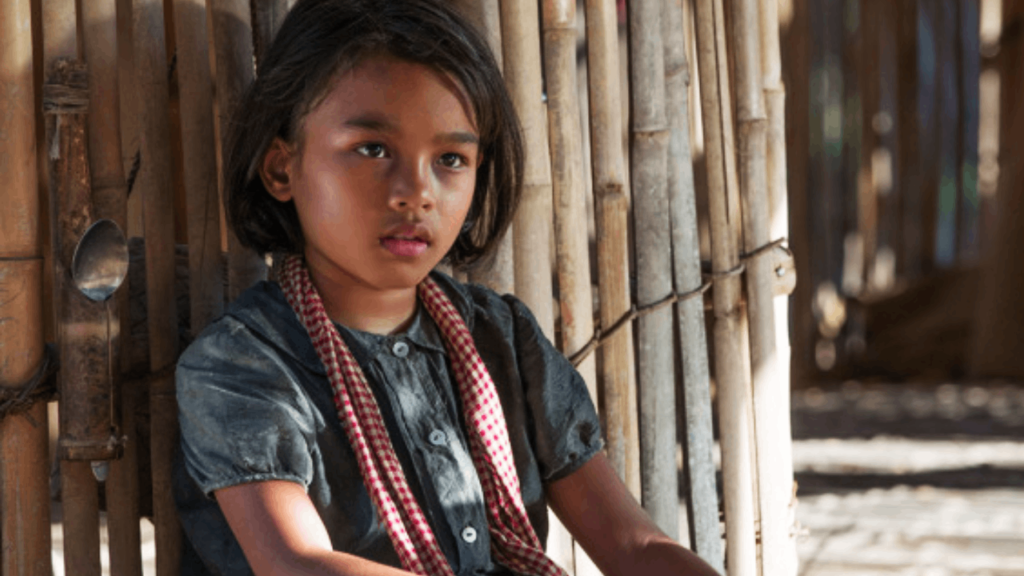
It is against this backdrop that First They Killed My Father, directed by Angelina Jolie, unfolds. The film is a first-hand account by Loung Ung, who was only five years old when the Khmer Rouge regime took over and spread hatred and violence across the country. She was there. In the midst of it all, with her parents and siblings. It was the time when families were forced to abandon their homes, live in labour camps, and wake up every day unsure if it would be their last. A life lived in constant fear of life itself.
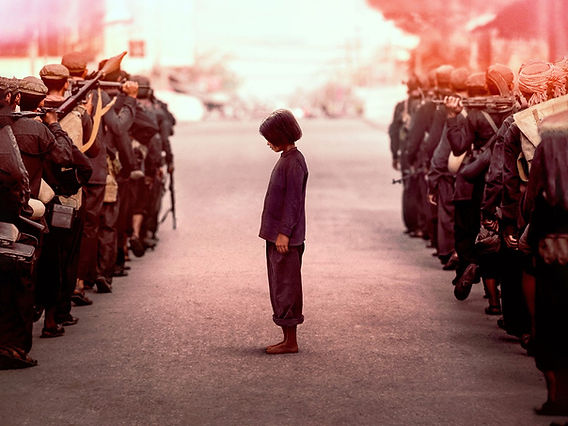
The film is based on Loung Ung’s memoir, First They Killed My Father: A Daughter of Cambodia Remembers. What eventually became the film also began with something deeply human. Angelina Jolie had read the book simply as a reader, with no intention of ever adapting it into a film. But the memoir stayed with her. It moved her in a way few books do. She reached out to Loung Ung, sharing how profoundly the book had affected her and how special it had become to her personally. From there began a relationship built on trust, understanding, and a genuine desire to tell this story with honesty.
On the surface, the film is about war, survival, and the pain, suffering, and loss that come with it. Yet, at the same time, it is equally about love. About sacrifice of self for your loved ones’ survival. About understanding. About togetherness. About the quiet strength that refuses to disappear even when everything else has.
While the Cambodian genocide scarred an entire nation, let us follow one family for a while. Loung Ung’s story is only one among millions.
When the Khmer Rouge arrive and order the evacuation of Phnom Penh, Loung’s family is left stunned. Her father had worked for the Cambodian government alongside American forces. Their family was relatively well-off, something that had once provided stability and comfort. But overnight, everything that had once protected them became the very reason they were in danger.
The Khmer Rouge sought to eliminate anyone associated with the previous government or Western influence. They did not care about choice or freedom. They dismissed anything they believed represented Western ideals, regardless of whether those ideas were fair, reasonable, or humane. If Loung’s father was recognised, he would almost certainly be executed. And soon after, the rest of the family would likely follow.
Loung’s innocence becomes one of the film’s greatest strengths. At times, the film almost feels hopeful simply because of the eyes through which we are experiencing it.
Three days into the evacuation, after the family has been travelling endlessly without any destination, Loung says to her father, “Soldiers said we could go back home after three days.” Her father quietly replies, “I’m not so sure.” To which Loung, completely matter-of-factly, responds, “But it’s the third day.” She cannot yet comprehend the scale of what is happening. As a child, she understands the world in straightforward terms. She cannot understand why they cannot simply go back home when the soldiers had promised they could.
For her father, however, that exchange becomes heartbreaking. It is one of those moments where the horror is not expressed through violence, but through helplessness. A father forced to admit, without actually saying the words, that he cannot protect his children anymore. That he cannot take them back to the safety of their home.
The family continues moving from one place to another, searching for shelter, never truly finding it. Their lives have changed beyond recognition. They have gone from living comfortably in a large home with more than they needed, to becoming people no one wishes to take in because of the danger attached to helping them.
Even when they finally reach Loung’s uncle’s house, the first thing she notices is how poor they are. She innocently tells her father that they are so poor. The remark does not come from arrogance or entitlement. It comes from honesty. Up until then, that world was completely unfamiliar to her. She had grown up surrounded by privilege, and as a child she simply describes what she sees, without understanding everything that lies beneath it.
The camps become the family’s new reality. There is no room left for individuality. Everyone is expected to become one among many, stripped of anything that once made them who they were.
One of the moments that quietly captures this is when everyone is given the same clothes to wear, and all the girls are ordered to cut their hair short. The urgency of that scene feels suffocating. Girlhood, in so many ways, is tied to discovering yourself. Whether someone chooses to keep their hair short or long should simply be a choice made by them. But here, even that smallest sense of ownership is taken away. The authority to discover yourself, to slowly grow into the person you wish to become, no longer belongs to you. It is dictated by someone else. The tragedy is not the haircut itself; it is the deliberate removal of choice. The understanding that even your own body is no longer yours to decide for.
The film understands that oppression rarely begins with grand gestures. It begins with slowly erasing every part of a person’s individuality until they become easier to control.
Then comes the scene where Loung’s father is taken away. It feels like the end. Especially because we witness it through Loung’s eyes, there is no dramatic announcement, no grand declaration that he is gone forever. There is only confusion, fear, and silence. As he quietly walks beside the two Khmer Rouge soldiers, every emotion sinks to the very bottom, unable to stay afloat.
Yet, as always, and as forever forward, life goes on.
The absence of her father never truly settles because survival never allows the family enough time to grieve. Every day demands another decision, another sacrifice. Soon enough comes perhaps the most devastating decision in the entire film. Loung’s mother asks her children to leave. She asks the three siblings to separate from her and travel in different directions, believing that it would give them a better chance of surviving.
For Loung, it feels like betrayal.
As adults, we almost immediately understand what the mother is trying to do. We recognise the impossible choice standing before her. She is not abandoning her children; she is desperately trying to save them. But Loung is still a child. Children do not naturally understand sacrifice disguised as separation. All they understand is presence, being held, and the feeling of home.
So when Loung says, “I don’t want to go,” it comes from the only truth she knows. Her mother, however, carries another truth entirely. She knows that keeping her children close may mean losing all of them together. Sending them away is most likely, in that scenario, the only chance, however blind, however uncertain, that they might one day have a future.
It is difficult to imagine the kind of strength required for a mother to deliberately separate herself from her own children. To willingly live without knowing whether they are alive or dead, only because staying together has become even more dangerous.
Throughout these unbearable moments, the film repeatedly returns to fragments of Loung’s earlier life. Brief flashes of happier days. These flashbacks remind us of what was stolen. Not just lives. Entire childhoods. Entire futures. Entire versions of people who would never get the chance to exist. The frustration that accompanies those memories becomes overwhelming because we, just like Loung, know there is no going back.
It reminds us how wars fought by governments, ideologies, and men trying to prove power end up costing everyone except those who begin them.
As the years pass, Loung herself begins to change. Alongside many other children, when she is selected for special military training, she is taught discipline, obedience, and above all, hatred. The saddest part is not simply that children are trained for war. It is accepting that they are being shaped during the most impressionable years of their lives. Their innocence is slowly replaced with conditioning.
The film never portrays these children as monsters. Nor does it ask us to hate them. Instead, it quietly asks us to recognise what happens when childhood itself becomes another casualty of war.
Towards the end of the film, when people are seen running through the jungle only to be blown apart by the landmines buried beneath the ground, it becomes almost unbearable to watch. There is a moment where Loung freezes.
The last scene of the film when the surviving siblings finally come together again and we see them praying, the feeling is unexpectedly hopeful. Not because everything has been repaired. But because they are still here together.
The background music during these final moments stands in complete contrast to everything that has come before. After spending nearly, the entire film surrounded by dread, silence, and fear, the music gently allows hope to enter. It never feels forced. It feels earned. Hope, here, does not arrive because suffering has ended. It arrives because despite everything that tried to erase them, they survived.
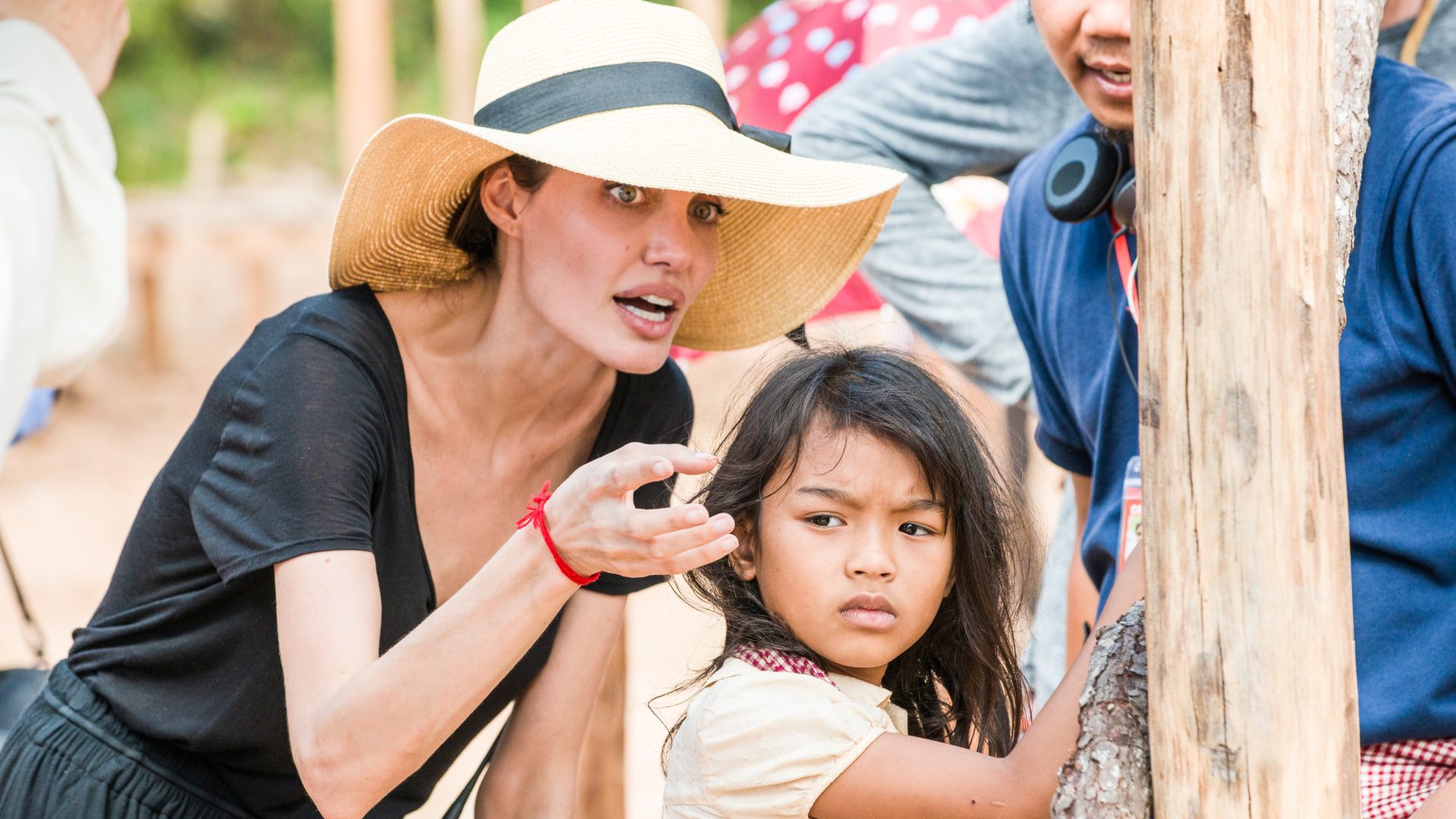
Angelina Jolie has often spoken about questioning whether she was the right person to tell this story. Rather than approaching it with certainty, she approached it with doubt, responsibility, and the awareness that this history was not hers to claim. She once said, “Did I feel I had the right to be the one doing that? It was hard every day to know if I was good enough or the right person to do it. But I did feel so honoured to be welcomed into another culture and allowed to witness, bear witness, encourage, share, and really put forward their history.” She tried to make sure it remained Cambodia’s story in the most honest sense.
Rather than recreating Cambodia from a distance, Jolie chose to make the film with Cambodians themselves. Most of the cast consisted of Cambodian actors, many members of the crew were Cambodian, and the filmmaking process actively involved the very people whose history the film was telling. It transformed the film from simply being about Cambodia into something made with Cambodia.
Cinema can only become the medium through which voices continue travelling.
While Angelina Jolie may have questioned herself at every step, wondering whether she was being fair and honest in telling this story, I cannot think of a more compassionate or sincere cinematic translation of this tragedy.
First They Killed My Father does not ask us to look at Cambodia with pity. It asks us to remember. To remember a history that is too often forgotten. To remember the families that never made it home. To remember the children whose childhoods ended before they ever truly began. And to remember that behind every statistic of war is a life that mattered.
Watch First They Killed My Father Trailer:
Read More: