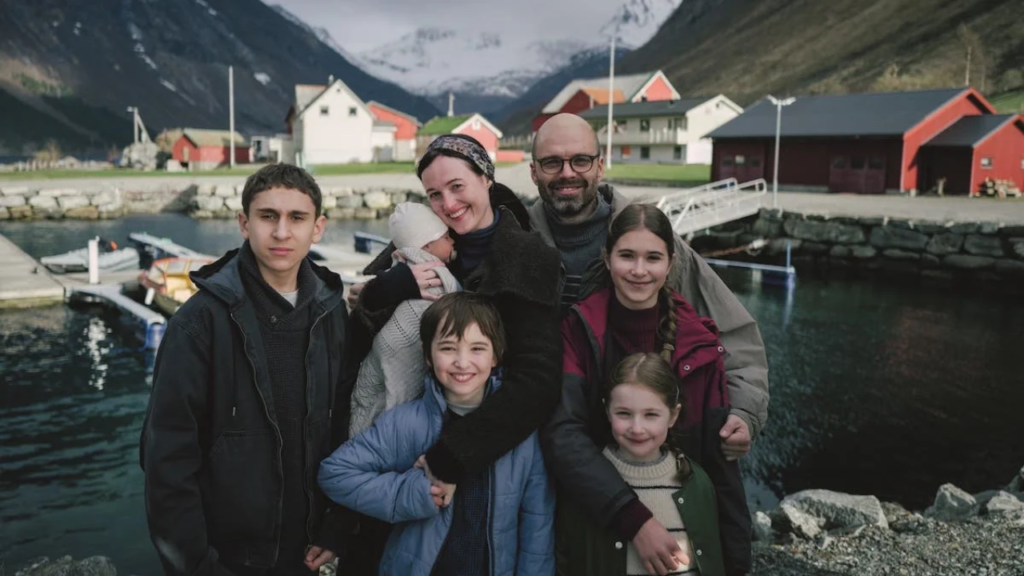
Fjord Cannes Review Roundup: Cristian Mungiu returns to Cannes Competition with a Norway-set moral drama starring Sebastian Stan and Renate Reinsve, and early reviews suggest a sharply divided response. Some critics praise the film as a rigorous, morally complex drama about parenting, faith and state authority, while others find it underpowered, overlong and less emotionally piercing than Mungiu’s strongest work.
The film follows the Gheorghiu family, who move to a remote Norwegian fjord town after years in Romania. Mihai, played by Sebastian Stan, is a Romanian father with deeply conservative Christian beliefs, while Lisbet, played by Renate Reinsve, is Norwegian and returns to her home country with their five children. The family follows strict religious rules at home, including Bible study and restrictions on phones, internet, modern music and dancing. Their children begin adjusting to school and local life, but the family’s fragile place in the community is shaken when bruises are discovered on their eldest daughter, Elia.
That discovery triggers an investigation by Norway’s child protection services. What begins as concern from teachers and school officials quickly escalates into the removal of the children from their parents while the case is examined. The situation becomes even more painful because one of the children is still a breastfeeding infant. From there, Fjord turns into a procedural and moral drama about parenting, discipline, faith, state authority, cultural suspicion and the question of who gets to decide what protection means.
The overall critical mood around Fjord is serious but divided. Critics agree that Mungiu is working with thorny material and familiar concerns: institutions, ethical pressure, community judgment and the violence that can emerge from certainty. Sebastian Stan and Renate Reinsve are repeatedly praised for restrained performances. But the film itself has not received a uniformly enthusiastic response. Positive reviews admire its refusal to offer easy answers, while mixed reviews argue that the drama is too long, too muted and not as emotionally devastating as Mungiu’s strongest work.
Pete Hammond of Deadline offers one of the most positive responses, calling Fjord a “masterful drama of our polarized times” and describing it as a Palme d’Or-worthy film. His review praises Mungiu’s refusal to take sides, arguing that the film asks viewers to sit with moral grey zones rather than choose a simple position. For Hammond, the power of Fjord lies in the way it places conservative parenting and progressive state values against each other without turning either side into an easy villain.
Deadline’s reading also highlights the film’s relevance to a divided public culture. The review notes that the family’s conservative religious lifestyle becomes central to the investigation, especially after Mihai admits to slapping the children, a disciplinary practice viewed differently in Romania and Norway. Hammond sees the film as asking difficult questions: does the state have the right to remove children because it disapproves of how they are being raised, and do parents have the right to discipline according to their own beliefs?
Hammond also praises the performances. He writes that both Stan and Reinsve are excellent because they avoid melodrama and keep the story grounded as their characters’ world collapses around them. He also singles out the supporting cast and the cinematography, which captures the natural beauty of the fjord setting. In this reading, the landscape becomes a quiet contrast to the emotional and institutional storm surrounding the family.
David Rooney of The Hollywood Reporter takes a more measured view, calling Fjord “compellingly squirm-inducing” while also saying it is “far from the director’s best.” His review frames the film as a knotty drama about parenting, education, community values and Norway’s child protection system. Rooney sees the film as a study of how suspicion of possible child abuse can escalate into a rush to judgment, while also examining how otherness and nonconformity invite distrust inside a supposedly progressive community.
The Hollywood Reporter’s review is especially useful in explaining the institutional pressure at the center of the film. Rooney notes that the Gheorghiu family’s religious lifestyle — Bible study, restrictions on technology and rejection of certain modern cultural habits — later becomes part of the evidence used to question whether Mihai and Lisbet are fit parents. The review also emphasizes the speed with which child services remove the children, including the breastfeeding infant, despite limited tangible evidence beyond admitted light disciplinary smacks.
Rooney also points to restraint as one of the film’s strengths. He says Reinsve gives Lisbet depth and compassion, while Stan’s Mihai is arrogant and self-righteous but also clearly devoted to his children. That duality is important to the film’s moral design. Fjord does not present Mihai as an innocent victim of state overreach, but it also does not reduce him to a monster. The discomfort comes from the fact that multiple things can be true at once.
Lee Marshall of Screen Daily offers one of the clearest mixed responses. He calls Mungiu one of the great moral thinkers of contemporary cinema and says Fjord begins with slow, icy dramatic potency. But Marshall ultimately finds the film “bloodless and underpowered,” arguing that Mungiu dilutes the force of the drama by getting lost in screenplay rabbit holes.
Screen Daily’s review suggests that Fjord works best when it presents two sides and forces the audience to take a stand. Marshall identifies the film’s strongest questions: when does traditional parenting become coercive control, should child services intervene when a child repeats religious condemnation of homosexuality, and where do restrictions on phones or social life fit into debates around parental authority? But he argues that the film loses potency through side plots, including Noora’s crush on Elia, which he says veers toward teen-movie territory.
That criticism captures one of the recurring concerns around Fjord. The film’s central conflict is powerful, but some critics feel its dramatic energy gets diluted. Mungiu’s best films often create unbearable pressure through moral compression. Here, according to mixed reviews, the pressure exists but does not always tighten. The film raises difficult questions, but not every subplot appears to deepen them.
Ben Croll of TheWrap frames Fjord as a film where Sebastian Stan and Renate Reinsve help Mungiu put ethics on trial. That phrase is useful because it describes the film’s central mode. Fjord is not simply about whether Mihai and Lisbet are guilty or innocent. It is about competing ethical systems: parental authority, religious conviction, child protection, cultural assimilation and institutional responsibility.
TheWrap’s response also supports the idea that Stan and Reinsve fit naturally into Mungiu’s precise filmmaking machinery. Their performances are not built around emotional explosions. They work through stillness, frustration, repression and small shifts in control. That restraint is central to the film’s tone. Fjord seems designed less as a courtroom thriller than as a slow moral inquiry.
Peter Bradshaw of The Guardian gives one of the strongest negative or mixed responses, calling Fjord anticlimactic and underpowered. He notes that Mungiu’s signature style is visible, including long shots and restrained framing, but argues that the pain and trauma of the story do not produce the rewarding complexity associated with the director’s best work. For Bradshaw, the film lacks revelation, mystery and emotional force.
This criticism matters because it comes from expectations around Mungiu himself. A new film from the director of 4 Months, 3 Weeks and 2 Days and R.M.N. carries a certain promise of moral intensity. Bradshaw’s response suggests that Fjord has the shape of a major Mungiu drama, but not always the impact. It contains serious questions, but he does not feel those questions lead to a powerful enough dramatic discovery.
Chase Hutchinson of The Playlist also lands in a mixed space, calling the film fascinating but flawed. His review praises Stan and Reinsve as terrific and recognizes the film’s engagement with faith, abuse, punishment and community. But he argues that Fjord exposes a culture-war-like nerve without cutting deeply enough into it. This is another way of saying that the film’s premise may be sharper than its execution.
The Playlist’s view helps explain why the film is dividing critics. For some, the refusal to resolve the conflict is a strength. For others, that refusal may feel like hesitation. The film wants to sit inside ambiguity, but ambiguity only works when it becomes emotionally and dramatically charged. Some critics feel Fjord achieves that charge; others feel it remains too controlled and distant.
Across reviews, the performances are one of the clearest points of agreement. Stan and Reinsve are praised for keeping the drama restrained rather than theatrical. Deadline says they avoid melodrama. The Hollywood Reporter highlights Reinsve’s compassion and Stan’s layered portrayal of a rigid but devoted father. Screen Daily calls both performances intriguingly understated. TheWrap sees them as intuitive fits for Mungiu’s controlled style. Even critics who question the film’s overall power seem to recognize the value of the acting.
That restraint is important because Fjord is built around uncertainty. If the performances pushed too hard, the film might become a simple story of victims and villains. Instead, Stan and Reinsve appear to hold the characters in uncomfortable tension. Mihai may be authoritarian, defensive and self-righteous, but he is also a father who believes he is protecting his children. Lisbet is devastated by the institutional response, but she is also caught between her family, her country and the rules of a society that sees her household as dangerous.
The film’s central moral conflict is also its most interesting idea. Fjord places conservative religious parenting against Norway’s progressive child protection system. It asks where discipline becomes abuse, whether the state can intervene before certainty is established, and whether cultural difference can be mistaken for danger. At the same time, the film does not fully absolve the parents. Mihai’s admitted slapping of the children and rigid household rules make the case morally uncomfortable rather than clean.
This is where Mungiu’s cinema often operates: not in simple opposition, but in pressure. The parents may be rigid, but the state may be overconfident. The institutions may be trying to protect children, but they may also be influenced by cultural prejudice. The neighbours may be concerned, but concern can become suspicion. The community may claim tolerance, but tolerance has limits when someone refuses to conform.
The common praise across reviews is clear. Critics admire the seriousness of the subject, Mungiu’s controlled realism, the ethical ambiguity, the procedural tension and the performances by Sebastian Stan and Renate Reinsve. Positive responses also highlight the film’s refusal to offer easy answers and its timely engagement with polarization, parenting, faith and state authority. The Norwegian setting, with its visual grandeur and cold beauty, gives the drama a strong physical atmosphere.
The common criticism is equally clear. Some critics find Fjord underpowered. The runtime is long. The tone is emotionally muted. The film may be less piercing than Mungiu’s strongest work. Certain screenplay detours dilute the central conflict. Some reviewers feel the ambiguity remains unresolved rather than deepening into revelation. For them, Fjord is intellectually designed but not always emotionally involving.
From a Planet of Films perspective, Fjord appears to divide critics because it places two forms of certainty against each other: the certainty of religious parenting and the certainty of state protection. Mungiu’s film seems most interesting when it refuses to make either side fully comfortable. The parents may be rigid and authoritarian, but the institutions may also be prejudiced, overconfident or too quick to punish. The real tension lies in what happens when every side believes it is protecting children, but no one fully understands them.
That is also why the film’s title feels important. A fjord is a place of depth, coldness and distance, shaped by pressure over time. The drama seems to work in a similar way. The conflict is not explosive at first; it cuts slowly. The family’s private beliefs, the school’s concern, the state’s intervention and the community’s judgment all build into a situation where no decision feels clean. The question is not only whether the parents are right or wrong. It is whether any system can protect children without also risking harm.
The final consensus is that Fjord is a serious, controlled and morally ambitious Cannes Competition title, but not an undisputed triumph. Its strongest reviews praise Cristian Mungiu’s refusal to take sides, the restrained performances of Sebastian Stan and Renate Reinsve, and the film’s examination of parenting, faith and state authority. More mixed responses find it underpowered, overlong and less emotionally piercing than Mungiu’s best work. The result is a demanding drama that raises difficult questions, even if not all critics feel it answers them with enough force.
Film: Fjord
Director: Cristian Mungiu
Writer: Cristian Mungiu
Cast: Sebastian Stan, Renate Reinsve, Lisa Carlehed, Ellen Dorrit Petersen, Lisa Loven Kongsli, Henrikke Lund-Olsen, Vanessa Ceban
Festival: Cannes Film Festival
Section: Competition
Genre: Drama
Runtime: 146 minutes
Countries: Romania, France, Norway, Sweden, Denmark
Languages: Romanian, Norwegian, English
Sales Agent: Goodfellas
Premise: A Romanian-Norwegian family living in a remote Norwegian village comes under investigation after bruises are found on their eldest daughter, forcing the parents, neighbours and authorities into a moral conflict over faith, parenting, child protection and cultural prejudice.
Read More Review Roundups on POF