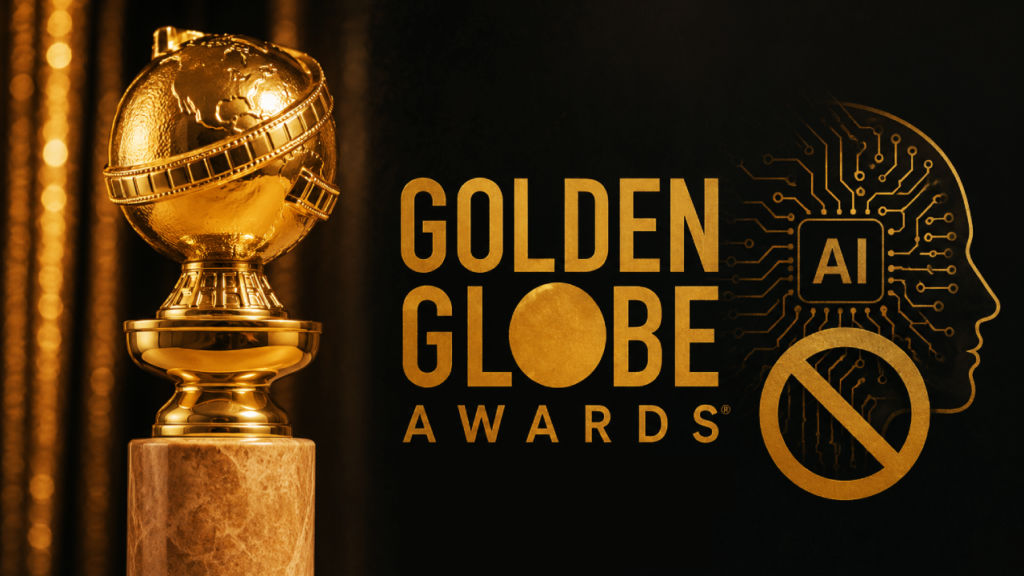
The Golden Globe Awards have officially introduced new rules regarding the use of artificial intelligence in film and television productions, becoming one of the clearest signals yet that major Hollywood awards bodies are now actively trying to define AI’s place inside modern filmmaking.
Under the newly updated eligibility guidelines, the Golden Globes stated that the use of AI “does not automatically disqualify” a film or television show from awards consideration, provided that “human creative direction, artistic judgment and authorship remain primary throughout the production process.” The announcement reflects a noticeably flexible approach toward generative AI at a time when the entertainment industry remains deeply divided over how far the technology should be allowed to shape creative work.
The new policy also requires studios and distributors to disclose AI involvement in submitted projects, including the use of generative AI tools, AI-assisted performances, altered voices or digitally manipulated likenesses. The organization has reserved the right to request additional materials or clarification regarding AI usage during the awards evaluation process.
The move arrives only days after the Academy of Motion Picture Arts and Sciences introduced its own updated rules for the 2027 Oscars, where the Academy similarly addressed artificial intelligence within filmmaking. As previously reported by Planet of Films, the Oscars clarified that performances must still be physically executed by human actors with their consent, while screenplays must remain authored by humans to qualify for awards consideration. The Academy also noted that it could request further information about AI-generated material in submitted works.
Together, the Oscars and Golden Globes announcements underline how rapidly AI has moved from being a future industry concern to an immediate institutional issue. Rather than debating whether artificial intelligence belongs in filmmaking at all, awards organizations are now attempting to establish where the boundary between AI assistance and human authorship actually exists.
The Golden Globes’ rules appear somewhat more permissive than the Academy’s current approach. While the Oscars emphasized stronger human-authorship protections, the Globes are allowing broader AI usage as long as human creative leadership remains dominant. That distinction could become increasingly important as studios continue experimenting with AI-assisted production tools across visual effects, editing, dubbing, de-aging and voice enhancement.
One of the most sensitive areas addressed by the Globes involves acting performances. According to the updated rules, performances submitted for acting categories must still primarily derive from the credited performer. AI may assist or cosmetically enhance certain elements, but it cannot replace the actor’s core creative work. Unauthorized digital replication or non-consensual AI-generated likeness manipulation could potentially jeopardize eligibility.
The new framework directly reflects many of the fears that fueled Hollywood’s labor battles during the SAG-AFTRA and Writers Guild strikes. Concerns surrounding AI-written scripts, digital replicas, voice cloning and performer replacement became central issues during negotiations, with actors and writers pushing for stronger protections over creative ownership and consent.
At the same time, the Globes’ decision also acknowledges a reality the industry has become increasingly reluctant to publicly confront: AI tools are already deeply embedded inside contemporary filmmaking workflows. From visual-effects cleanup and automated editing support to machine-learning-assisted dubbing and post-production enhancement, many productions are already using forms of AI technology in ways audiences may never notice.
That reality is part of what makes enforcement so complicated. The Globes’ guidelines repeatedly emphasize that human creativity must remain “primary,” but the organization has not fully clarified how much AI usage would cross the line into disqualifying territory. Questions surrounding authorship, disclosure standards and creative control remain highly subjective, and the boundaries will likely continue evolving as the technology develops.
The broader significance of the announcement goes far beyond awards eligibility itself. Hollywood awards institutions are now effectively being forced to redefine some of cinema’s oldest concepts — performance, authorship, originality and artistic ownership — within the context of rapidly advancing artificial intelligence tools.
Online reaction to the Globes’ new rules has already been sharply divided. Some industry observers have praised the organization for taking a realistic and adaptable stance toward emerging technology, while others argue the rules are too lenient and risk normalizing AI involvement in creative work before stronger safeguards are established.
What is becoming increasingly clear, however, is that AI is no longer a theoretical issue for the entertainment industry. The conversation has already shifted from whether AI belongs in filmmaking to how much creative authority humans must retain for a work to still be considered fundamentally human-made.
The Golden Globes’ new rules may not settle that debate, but they represent one of Hollywood’s most direct attempts yet to formally establish the balance between technological assistance and artistic authorship in the AI era.
Read More: