Hindi cinema has produced many great screenwriters. It has produced many memorable lyricists. It has also produced a few public intellectuals who are unafraid to speak their minds.
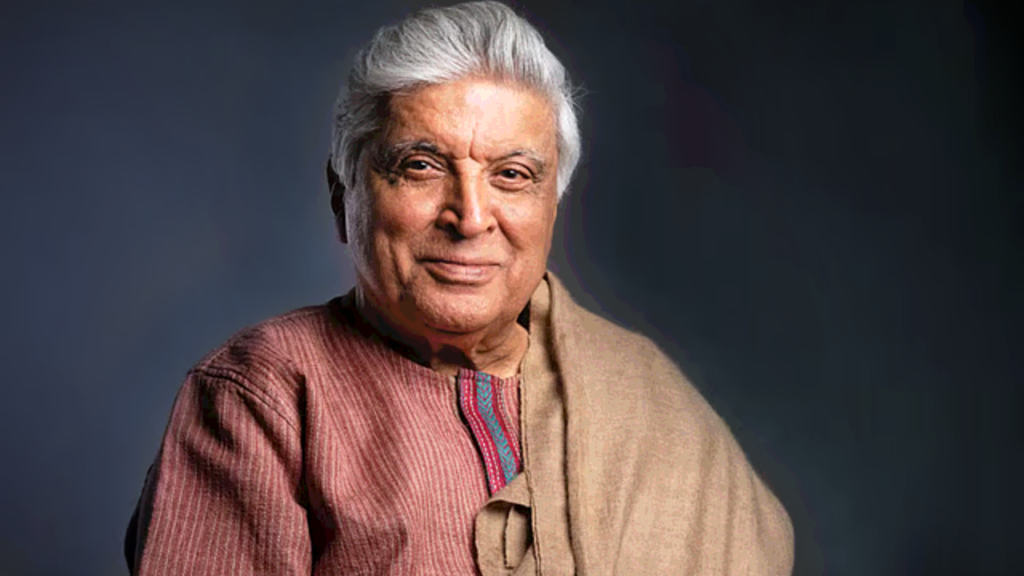
Javed Akhtar is one of the rare people who has been all three.
His journey is remarkable not because it spans over five decades, but because every phase of it has left a lasting mark on Indian cinema.
As one half of the legendary Salim-Javed duo, he helped redefine the Hindi film hero. Films like Zanjeer (1973), Deewaar (1975), Sholay (1975), Trishul (1978), and Don (1978) replaced the romantic dreamer with a man angry at a broken system. Amitabh Bachchan became the face of that movement, but the emotions, conflicts, and unforgettable dialogues were born on the writers’ table.
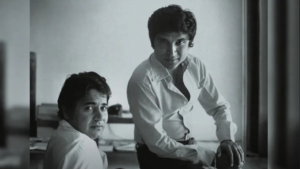
Their writing wasn’t merely commercial. It reflected an India frustrated with unemployment, corruption, and failing institutions. Decades later, the “Angry Young Man” remains one of Hindi cinema’s most influential character archetypes.
Ironically, some of these classics have also attracted debates over originality. Sholay, for instance, has often been compared to films such as Seven Samurai (1954), The Magnificent Seven (1960), and Sergio Leone’s westerns. Javed Akhtar has consistently rejected the idea that Sholay was a copy, arguing that while every filmmaker is influenced by world cinema, influence should not be confused with plagiarism. The debate continues among film scholars, but no plagiarism has ever been established.
When Salim-Javed parted ways in the early 1980s, many believed Javed Akhtar’s greatest work was behind him.
Instead, he began a second career.
Starting almost from scratch, he turned to lyric writing, a craft that demanded an entirely different vocabulary. Over the next three decades, he wrote songs that became part of everyday life. From Ek Ladki Ko Dekha and Sandese Aate Hain to Kal Ho Naa Ho, Mitwa, and Main Yahaan Hoon, his lyrics proved that poetry could remain accessible without becoming simplistic.
Unlike many of his contemporaries, Javed Akhtar has largely escaped allegations of literary plagiarism. His reputation as a lyricist rests on originality, linguistic precision, and a deep understanding of Urdu and Hindustani poetry. The criticism he has occasionally received has been of a different kind, that some of his later songs became too conversational and less poetic. Yet others argue that this simplicity is exactly what allowed his words to connect with millions.
Perhaps the biggest battle of his career wasn’t fought on paper at all.
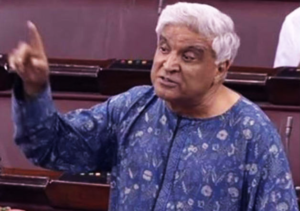
In the late 2000s, Javed Akhtar became the most visible face of the campaign demanding royalty rights for lyricists and composers. At the time, many writers were forced to sign contracts surrendering all future earnings from their work. Akhtar argued that songs continued to generate revenue long after films left theatres, and writers deserved a share of that income. His stand faced fierce resistance from several producers and music companies, and he later revealed that some producers boycotted him because of it. The Copyright (Amendment) Act of 2012 eventually strengthened royalty rights for authors and composers, making it one of the most significant reforms for creative professionals in Indian cinema.
Outside films, Javed Akhtar has remained equally outspoken.
Whether discussing secularism, religious extremism, freedom of expression, or the declining quality of public discourse, he rarely avoids difficult conversations. His criticism of fundamentalism across religions has often drawn backlash from opposing ideological groups. More recently, his comments on increasing violence in mainstream cinema also sparked debate, especially because the man who once co-created the Angry Young Man questioned whether today’s violence reflected growing frustration in society.
Agree with him or disagree with him, Javed Akhtar has never chosen silence over conviction.
That may ultimately be his greatest legacy.
Not the countless awards. Not the iconic dialogues. Not even the timeless songs.
But the fact that, across generations, he has continued to remind us that writing isn’t merely about entertainment. Sometimes, it is about questioning the world around us.
Read More: