Christopher Nolan has never been a filmmaker content with simply retelling familiar stories. From Memento to Oppenheimer, he has consistently reshaped established narratives through his fascination with time, memory and human psychology. With The Odyssey, critics believe he has achieved something equally remarkable—transforming Homer’s nearly 3,000-year-old epic into one of the most ambitious theatrical spectacles of modern cinema. Early reviews have been overwhelmingly enthusiastic, with major publications and Rotten Tomatoes critics alike praising Nolan’s breathtaking direction, Matt Damon’s career-defining performance, Hoyte van Hoytema’s extraordinary IMAX cinematography and Ludwig Göransson’s immersive score. Many critics are already describing it as one of the year’s finest films and another landmark in Nolan’s filmography. The only significant debate isn’t whether The Odyssey succeeds—it overwhelmingly does—but whether its colossal spectacle consistently reaches the same emotional heights as its astonishing technical achievements.
Set after the devastating Trojan War, The Odyssey follows the legendary Greek king Odysseus as he embarks on a perilous ten-year journey home to Ithaca after offending the gods. Along the way, he confronts mythical creatures, supernatural temptations and increasingly impossible trials that test not only his physical endurance but also his identity as a husband, father and king. Meanwhile, Queen Penelope struggles to defend Ithaca from increasingly aggressive suitors determined to seize the throne, while their son Telemachus undertakes his own coming-of-age journey searching for the father he barely remembers. Rather than presenting the story as a straightforward fantasy adventure, Nolan embraces Homer’s fragmented narrative, weaving together multiple timelines, memories and perspectives that gradually reveal the emotional cost of war, exile and survival without sacrificing the mythic grandeur of the original poem.
If there is one area where critics speak with near unanimity, it is Christopher Nolan’s direction. Across virtually every major publication, reviewers describe The Odyssey as one of the filmmaker’s most ambitious and fully realized works. Owen Gleiberman of Variety praises Nolan for refusing to turn Homer into a museum piece, instead crafting a psychologically rich epic that transforms ancient mythology into a story of memory, trauma and perseverance. Peter Bradshaw of The Guardian awards the film five stars, calling it a monumental cinematic achievement that balances mythic spectacle with a deeply human examination of war and its lasting consequences. Matt Zoller Seitz of RogerEbert.com similarly applauds Nolan’s bold restructuring of Homer’s nonlinear storytelling, arguing that the filmmaker’s signature manipulation of time gives the ancient tale remarkable immediacy and emotional resonance. David Ehrlich of IndieWire goes a step further, suggesting that Nolan has delivered one of his warmest and most emotionally accessible films, while Pete Hammond of Deadline describes the adaptation as another towering achievement from a filmmaker operating at the peak of his creative powers.
The broader Rotten Tomatoes critical consensus reinforces those observations. Numerous reviewers describe The Odyssey as Nolan’s most confident filmmaking since Oppenheimer, praising the way he blends intimate psychological drama with breathtaking large-scale spectacle. Several critics note that the director avoids simply illustrating Homer’s text, instead reinterpreting it through themes that have defined much of his own career—identity, memory, guilt and the enduring psychological scars of conflict. Others describe it as a rare modern blockbuster that trusts audiences to engage with classical literature without simplifying its moral complexity. Even critics who rank Oppenheimer or Interstellar slightly higher acknowledge that The Odyssey belongs comfortably alongside Nolan’s finest work, further cementing his reputation as one of contemporary cinema’s defining storytellers.
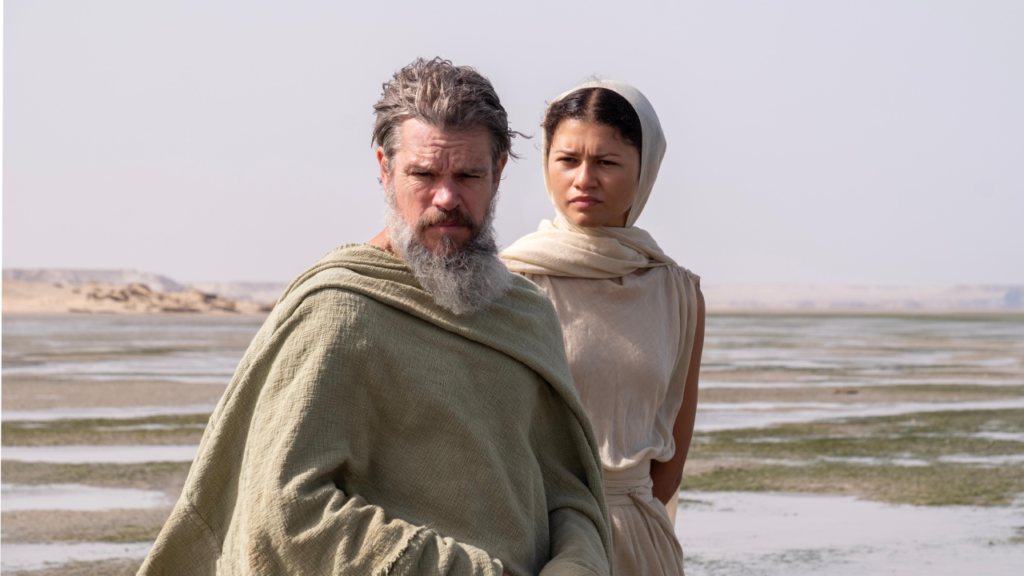
Matt Damon has emerged as perhaps the film’s single greatest point of consensus. Nearly every major review highlights his portrayal of Odysseus as one of the finest performances of his career, with several critics openly suggesting that awards recognition now appears inevitable. Rather than playing Odysseus as an untouchable mythological hero, Damon emphasizes the emotional exhaustion of a man haunted by years of violence and loss. Gleiberman admires the actor’s remarkable restraint, arguing that he quietly transforms one of literature’s greatest warriors into a profoundly human figure. Seitz similarly praises the subtle vulnerability Damon brings to the role, allowing audiences to witness the gradual erosion of confidence beneath the legendary hero’s stoic exterior. David Rooney of The Hollywood Reporter notes that Damon’s grounded performance becomes the emotional anchor that prevents Nolan’s enormous production from drifting into abstraction, while Caryn James of the BBC applauds the actor’s ability to communicate immense emotional weight through understated performances rather than grand speeches.
The Rotten Tomatoes grid amplifies that praise even further. Brian Truitt of USA Today goes so far as to declare, “Just give him the Best Actor Oscar now,” while several other critics describe the performance as career-best work. Many reviewers repeatedly use words such as “haunted,” “vulnerable,” “weathered” and “deeply human” when discussing Damon’s interpretation of Odysseus. Rather than celebrating heroism alone, critics admire the way Damon presents a man struggling beneath the burden of leadership, fatherhood and survivor’s guilt. That emotional vulnerability, many argue, transforms the legendary king into one of Nolan’s most relatable protagonists.
The supporting cast has also earned widespread praise for bringing surprising emotional depth to one of literature’s oldest stories. Anne Hathaway’s Penelope is repeatedly described as far more than the patient wife awaiting her husband’s return, with critics praising the intelligence, resilience and quiet authority she brings to the character. Tom Holland has emerged as one of the film’s biggest surprises. Across both major publications and the Rotten Tomatoes critics’ consensus, reviewers suggest this may be Holland’s strongest dramatic performance outside the Spider-Man franchise, with many highlighting the emotional maturity he brings to Telemachus’ search for his father. Samantha Morton receives particularly enthusiastic notices for her haunting interpretation of Circe, with several critics identifying her as the film’s standout supporting performer. Zendaya, Robert Pattinson, Charlize Theron and Lupita Nyong’o also receive praise for making lasting impressions despite relatively limited screen time. A handful of reviewers, however, observe that the sheer scale of Nolan’s ensemble inevitably leaves certain characters feeling less developed than they might have been in a more intimate adaptation.
If Christopher Nolan’s direction forms the backbone of The Odyssey, critics almost unanimously agree that Hoyte van Hoytema’s cinematography is its greatest technical triumph. Across major publications and the Rotten Tomatoes critics’ consensus, reviewers repeatedly describe the film as one of the most visually astonishing achievements of modern blockbuster filmmaking. Shot entirely with next-generation IMAX cameras, the film transforms Homer’s mythical world into a tangible, lived-in landscape of storm-lashed seas, towering cliffs, ancient kingdoms and sprawling battlefields. David Rooney of The Hollywood Reporter praises the extraordinary sense of scale created through practical photography, while Screen Daily describes the visuals as “towering” and immersive without ever feeling artificial. Pete Hammond of Deadline argues that Nolan continues to prove why practical filmmaking remains unmatched when executed at this level, calling the production one of the most technically accomplished spectacles ever mounted for the big screen.
The Rotten Tomatoes critic grid reinforces this consensus even more emphatically. Critics from publications including Time Out, Rolling Stone, USA Today, The Wrap, MovieFreak.com and several regional outlets repeatedly stress that The Odyssey is not simply another blockbuster—it is a theatrical event built specifically for IMAX exhibition. Words such as “jaw-dropping,” “breathtaking,” “monumental,” “immersive” and “awe-inspiring” appear throughout the review landscape. Many reviewers point to Nolan’s reliance on real ships, practical sets and authentic locations as key reasons the mythical world feels so physically convincing, arguing that the absence of overreliance on CGI gives every sequence remarkable texture and weight. Several critics even suggest that The Odyssey may be the finest-looking film Nolan has ever directed, surpassing even Dunkirk and Oppenheimer in sheer visual ambition.
While the visuals dominate much of the critical conversation, reviewers are nearly as enthusiastic about Ludwig Göransson’s score, which many describe as the film’s emotional heartbeat. Critics praise the composer for creating music that evolves alongside Odysseus’ journey, shifting seamlessly between triumphant orchestral grandeur and moments of aching introspection. Rather than simply emphasizing action, Göransson’s compositions reinforce themes of longing, grief, resilience and redemption. Several Rotten Tomatoes critics also single out the film’s sound design, noting how the combination of crashing waves, battle sequences, supernatural encounters and Göransson’s score creates one of the most immersive audio experiences of the year. Together with van Hoytema’s cinematography, critics argue that the music elevates The Odyssey into a genuinely transporting theatrical experience.
One of the most fascinating aspects of the critical response concerns Nolan’s interpretation of Homer’s text. Rather than pursuing strict literary fidelity, critics widely agree that the filmmaker reshapes The Odyssey through themes that have defined his own body of work. David Ehrlich of IndieWire argues that Nolan transforms an ancient adventure into a deeply contemporary exploration of memory, trauma and identity without losing the timeless qualities that have allowed Homer’s poem to endure for centuries. Owen Gleiberman similarly praises the director for refusing to reduce the mythology into conventional blockbuster fantasy, instead treating the material as psychological drama first and mythological spectacle second.
Several critics admire how Nolan modernizes the emotional core of the story rather than its setting. The film’s exploration of post-war trauma, fractured families and the burden of leadership feels remarkably relevant despite its ancient origins. The Rotten Tomatoes critics’ consensus repeatedly highlights this achievement, with reviewers describing the adaptation as “surprisingly contemporary,” “emotionally universal” and “remarkably accessible” without sacrificing the philosophical depth of the original poem. Amy Nicholson of the Los Angeles Times praises Nolan’s ability to preserve Homer’s sense of wonder while giving the characters greater emotional complexity, while Jake Cole of Slant Magazine applauds the filmmaker for embracing the poem’s mythic scale without losing sight of its intimate human relationships.
Not everyone, however, is entirely convinced by Nolan’s interpretive choices. Danny Leigh of the Financial Times argues that the adaptation simplifies some of Homer’s wit, ambiguity and sensuality in favour of a more conventionally heroic narrative. A handful of critics make similar observations, suggesting that Nolan occasionally privileges philosophical seriousness over the playful unpredictability found in the original text. Even so, these criticisms remain relatively minor within an otherwise overwhelmingly enthusiastic critical consensus.
If there is one genuine point of disagreement among critics, it concerns emotional intimacy. Nearly everyone agrees that The Odyssey is visually magnificent, intellectually ambitious and technically extraordinary. The debate begins when reviewers ask whether its emotional core consistently matches that astonishing craftsmanship.
David Rooney of The Hollywood Reporter argues that while the film is often spectacular, certain quieter dramatic passages do not always resonate with the same force as the breathtaking action sequences surrounding them. Caryn James of the BBC similarly suggests that although The Odyssey is an extraordinary achievement, Oppenheimer ultimately remains Nolan’s more emotionally complete work. Screen Daily notes that the enormous scope occasionally compresses supporting characters and interpersonal relationships, while several Rotten Tomatoes critics observe that Nolan’s intellectual precision can sometimes create emotional distance between the audience and the characters.
Yet an equally large group of critics reaches precisely the opposite conclusion. Matt Zoller Seitz argues that the film’s emotional restraint reflects the psychological state of a man profoundly damaged by war rather than any failure of storytelling. Empire, The Guardian, IndieWire and numerous Rotten Tomatoes reviewers likewise contend that Nolan’s refusal to indulge in overt sentimentality makes the emotional payoffs significantly more powerful when they finally arrive. For these critics, The Odyssey succeeds precisely because it trusts audiences to discover emotion beneath silence, memory and visual storytelling rather than through conventional dramatic exposition.
Beyond its technical achievements, critics repeatedly return to the film’s central themes. Many describe The Odyssey not as a fantasy adventure but as an anti-war epic examining the long-term psychological cost of violence. Odysseus’ journey becomes less about defeating monsters than surviving the memories that continue to haunt him. Others focus on the film’s exploration of fatherhood, identity and redemption, particularly the evolving relationship between Odysseus and Telemachus. The Rotten Tomatoes critics’ consensus frequently identifies these themes as the film’s greatest strength, arguing that Nolan transforms one of literature’s oldest stories into a surprisingly contemporary reflection on trauma, family and the difficult process of rebuilding a life after conflict.
Given the extraordinary critical reception, awards speculation has arrived almost immediately. Multiple critics openly describe The Odyssey as an early frontrunner for Best Picture, while Christopher Nolan is already being discussed as a major contender for Best Director. Matt Damon’s performance has generated particularly strong Oscar buzz, with several reviewers predicting a Best Actor nomination and others going even further by calling it career-best work worthy of immediate awards recognition. Hoyte van Hoytema’s cinematography, Ludwig Göransson’s score, Jennifer Lame’s editing, the production design, sound design and visual effects are likewise expected to feature prominently throughout awards season. Whether those predictions ultimately materialize remains to be seen, but critics overwhelmingly agree that The Odyssey will be central to this year’s awards conversation.
Christopher Nolan has spent more than two decades redefining what blockbuster filmmaking can achieve, consistently proving that large-scale spectacle and intellectual ambition do not have to exist separately. With The Odyssey, he returns to one of humanity’s oldest stories and somehow makes it feel startlingly modern. Critics overwhelmingly agree that the film represents one of the greatest theatrical experiences of recent years, combining breathtaking practical filmmaking, career-best work from Matt Damon and extraordinary technical craftsmanship into an epic that demands to be seen on the biggest screen possible. The conversation surrounding The Odyssey is no longer about whether Christopher Nolan has succeeded—it is about where this remarkable achievement ultimately ranks alongside The Dark Knight, Interstellar, Dunkirk and Oppenheimer. Judging by the critical consensus, that debate may continue for years, but few dispute that The Odyssey has already secured its place among the defining cinematic events of the decade.
The Odyssey Trailer
Film Details: The Odyssey
Director: Christopher Nolan
Writer: Christopher Nolan
Based on: The Odyssey by Homer
Cast: Matt Damon, Tom Holland, Anne Hathaway, Zendaya, Robert Pattinson, Samantha Morton, Charlize Theron, Lupita Nyong’o, Jon Bernthal, Benny Safdie, John Leguizamo
Genre: Adventure, Action, Fantasy
Rating: R
Runtime: 3 hours
Cinematography: Hoyte van Hoytema
Music: Ludwig Göransson
Editor: Jennifer Lame
Production Companies: Syncopy, Universal Pictures
Distributor: Universal Pictures
Release Date: July 17, 2026
Read More Review Roundups on POF