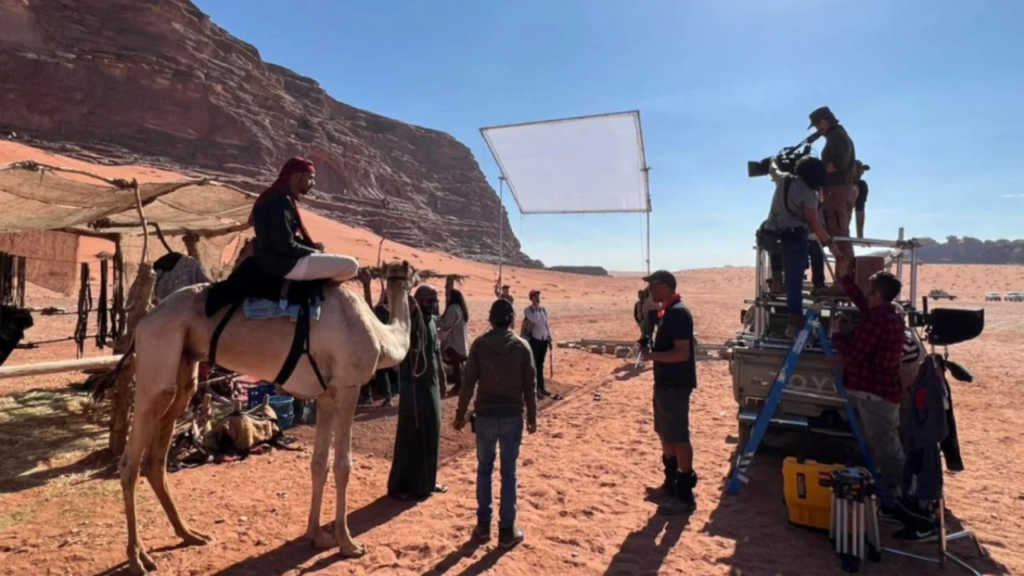
For much of modern cinema history, conversations about the world’s most influential film industries have largely revolved around Hollywood, India, Europe, and, more recently, parts of East Asia. Yet a quieter transformation has been taking place across the Middle East, where governments, investors, studios, and streaming platforms are collectively reshaping the region’s place within the global entertainment economy. What was once viewed primarily as a consumer market for international content is increasingly emerging as a production center, financing hub, and creative ecosystem capable of influencing the future direction of filmmaking.
The shift is significant because it extends far beyond the construction of new cinemas or the launch of production incentives. Across the region, long-term strategies are being developed around infrastructure, talent, education, content creation, and audience development. The result is an increasingly competitive landscape in which countries are not merely attempting to attract productions but are positioning themselves as essential partners in the global film business.
The Middle East’s ambitions should not be mistaken for an attempt to replace Hollywood or challenge its dominance directly. Hollywood’s position was built over more than a century through intellectual property, distribution networks, talent pipelines, technological innovation, and global cultural influence. Instead, the region appears to be pursuing a different objective altogether: becoming indispensable to the future of international filmmaking by offering a combination of capital, incentives, infrastructure, locations, and audiences that few markets can currently match.
No country illustrates that ambition more clearly than Saudi Arabia.
Since reopening cinemas in 2018 after a decades-long ban, Saudi Arabia has undergone one of the most dramatic entertainment transformations seen anywhere in the world. In less than a decade, the kingdom has evolved from a nation without a commercial exhibition sector into one of the fastest-growing film markets globally. The remarkable pace of that transformation can be seen through The Evolution of Saudi Arabian Cinema, which charts the development of an industry that barely existed a generation ago.
Today, Saudi Arabia is home to more than 700 cinema screens, while annual box office revenues have surpassed SAR 1 billion. During the first half of 2025 alone, the market generated approximately SAR 448 million from more than nine million admissions, demonstrating that the country’s investment in cinema infrastructure is translating into audience engagement at scale.
Yet exhibition is only one part of the kingdom’s strategy. Saudi Arabia has simultaneously moved to establish itself as one of the world’s most competitive production destinations. The Saudi Film Commission’s decision to increase production incentives to as much as 60 percent of eligible local expenditure has fundamentally altered the country’s position within the global production marketplace. The impact of Saudi Arabia’s 60 percent production rebate extends beyond regional competition, placing the kingdom among the most aggressive incentive jurisdictions currently operating anywhere in the world.
Such measures are closely aligned with Vision 2030, the broader national strategy that seeks to diversify the economy and expand the country’s cultural and creative sectors. The ambition is clear: Saudi Arabia is not simply seeking to host productions. It wants to build an ecosystem capable of supporting filmmakers, attracting international partners, creating jobs, and eventually generating globally recognized intellectual property.
At the same time, rapid expansion inevitably raises questions about sustainability. Building cinemas, sound stages, and production infrastructure is a relatively straightforward process when substantial investment is available. Developing writers, directors, actors, and producers who can create stories that resonate across borders is a far more complex challenge. The debate surrounding whether Saudi Arabia’s film ambitions can match reality increasingly centers on this distinction between industrial growth and cultural influence.
While Saudi Arabia is investing aggressively in scale, Abu Dhabi has focused on establishing credibility.
Over the past decade, the emirate has quietly become one of the most attractive production destinations outside traditional Western hubs. Through the Abu Dhabi Film Commission and a steadily expanding incentive structure, the region has successfully attracted major international franchises including Star Wars, Mission: Impossible, Fast & Furious, and Dune. These productions have not only brought economic activity but have also helped establish local expertise, technical capabilities, and international confidence in the region’s production infrastructure.
The strategy has become even more competitive following the enhancement of Abu Dhabi’s rebate system, which now offers a baseline incentive of 35 percent while allowing qualifying productions to access benefits of up to 50 percent. Rather than focusing first on domestic box office expansion, Abu Dhabi has concentrated on becoming an efficient and reliable production base for global content creators. In many respects, it has already created a blueprint for how smaller markets can position themselves within the international film economy.
Yet perhaps the most important lesson for emerging Gulf markets comes not from Saudi Arabia or the United Arab Emirates, but from Egypt.
Long before production incentives became a global competition, Egypt had already established itself as the cultural center of Arabic-language cinema. For decades, Egyptian films, actors, directors, and television dramas shaped popular culture throughout the Middle East and North Africa. The country’s influence demonstrates that cinematic power is not measured solely through infrastructure spending, studio construction, or government support. Storytelling traditions, cultural identity, audience loyalty, and creative talent remain equally valuable assets.
Egypt’s continued relevance serves as a reminder that successful film industries are ultimately built around stories rather than facilities. While newer markets may possess larger budgets and more modern infrastructure, cultural influence cannot be purchased as easily as production equipment.
The rapid expansion of streaming has added another dimension to this transformation.
Global platforms such as Netflix, Amazon Prime Video, and Disney+ continue to increase their investment in Middle Eastern content, recognizing both the scale of the audience and the growing demand for locally relevant stories. However, perhaps the most influential player in this space remains MBC Group. Through Shahid and its production arm, MBC Studios, the company has emerged as one of the most significant content investors in the Arabic-speaking world. Recent developments surrounding MBC Studios’ expanding Saudi slate demonstrate how aggressively regional companies are investing in original productions designed to serve both domestic and international audiences.
Streaming has fundamentally altered the economics of regional storytelling. Filmmakers are no longer entirely dependent on theatrical distribution to reach viewers beyond their home markets. Stories produced in Riyadh, Cairo, Abu Dhabi, or Beirut can now travel globally through digital platforms, creating opportunities that were largely unavailable only a decade ago.
This convergence of production incentives, streaming investment, audience growth, and infrastructure development gives the Middle East a unique advantage within the global entertainment landscape.
Hollywood continues to dominate through scale and intellectual property. India remains unmatched in volume and cost efficiency. The United Kingdom offers world-class crews and studio infrastructure, while Canada and Australia have built successful production sectors around incentive-driven models. Increasingly, however, the Middle East is assembling elements of all these strengths simultaneously. The region offers access to capital, competitive incentives, strategic geographic locations, modern infrastructure, and one of the world’s youngest populations.
Whether those advantages translate into long-term influence will depend on what happens next.
History repeatedly demonstrates that film industries are not defined by the size of their incentives or the number of sound stages they build. They are defined by the stories they tell and the cultural impact those stories achieve. Building facilities is relatively straightforward. Creating the next globally recognized franchise, filmmaker, or cinematic movement is considerably more difficult.
That is why the region’s most important challenge may have little to do with infrastructure and everything to do with creativity. The future will not be determined solely by how many international productions arrive or how much money is invested. It will be determined by whether filmmakers from the region can create stories that travel across cultures and resonate with audiences around the world.
Even beyond the Gulf states, the region already possesses evidence that such influence is possible. Iranian cinema, for example, continues to command extraordinary respect on the international festival circuit despite operating under significant restrictions. The resilience of Iranian filmmakers working against censorship and political limitations demonstrates that artistic influence often emerges from creative vision rather than economic power alone.
Ultimately, the next great film race is not a contest between Hollywood and the Middle East. It is a competition among countries and regions seeking to become indispensable to the future of global filmmaking. Saudi Arabia is pursuing scale and investment. Abu Dhabi is refining a production-driven model. Egypt continues to draw strength from decades of cultural influence, while streaming platforms are accelerating opportunities across the entire region.
The Middle East has already succeeded in attracting the attention of the global film industry. The far more important question is whether it can create the filmmakers, stories, and intellectual property capable of sustaining that attention for decades to come. If it succeeds, the region may not simply become an important market within the global entertainment business. It could emerge as one of the defining cinematic centers of the twenty-first century.
More Articles for You: