Some stories feel as though they have existed for centuries, even when they have never been told before. Guillermo del Toro‘s Pan’s Labyrinth draws from the ancient language of folklore, fairy tales and mythology to create a world that feels strangely familiar, yet entirely its own.
There is something peculiar about certain stories. We encounter them for the first time, yet they carry the familiarity of something remembered rather than discovered. A child wanders into an enchanted forest, encounters a mysterious creature, is given a series of impossible tasks and finds herself caught between two worlds. We recognise the journey even when we have never heard the story. Perhaps this is because fairy tales have never really belonged to individual storytellers. They are fragments of a much older cultural memory, passed down, altered, forgotten and rediscovered across generations.
Pan’s Labyrinth (2006) possesses precisely this peculiar familiarity. Set against the violence of post-Civil War Spain in 1944, the film follows a young girl named Ofelia, whose encounters with a faun, a labyrinth and a series of mysterious trials gradually unfold into a dark fairy tale. Yet its mythology does not originate from any single folktale or ancient legend. Its creatures, rituals and magical objects seem to belong to a world that we recognise, although we cannot quite place it. The film borrows from the traditions of folklore, classical mythology and fairy-tale storytelling to construct a mythology of its own.
And perhaps that is where its most interesting achievement lies.
Before fairy tales became the colourful bedtime stories we associate with childhood, they were often rather grim affairs. They emerged from oral traditions in which stories travelled from one generation to another, changing with every retelling. They dealt with hunger, death, abandonment, jealousy, temptation, punishment and survival. There were forests where children disappeared, strangers who offered impossible bargains, creatures that devoured the innocent and journeys from which not everyone returned.
The storytelling patterns of these tales often repeated themselves. A mysterious guide would appear, a forbidden door would have to remain unopened, a traveller would be warned against eating or drinking something, or a young protagonist would be asked to complete three difficult tasks. The details changed, but the underlying structures survived.
One of the literary references behind Pan’s Labyrinth was Edwin Sidney Hartland’s 1891 book, The Science of Fairy Tales: An Enquiry into Fairy Mythology. Hartland examined recurring patterns in traditional fairy tales and their oral origins. In an interview with Mark Kermode for Sight and Sound, del Toro spoke about drawing from these recurring motifs, including the prohibition against eating or drinking in the fairy world, encounters with frogs and the recurring idea of choice. Rather than adapting a particular fairy tale, he brought together different elements that appeared across folklore.
This distinction matters. Pan’s Labyrinth does not retell an old story; it borrows the grammar through which old stories were told.
Almost every element in Ofelia’s imaginary world seems to carry the weight of an older tradition. Consider the labyrinth. Long before it appeared in the film, the labyrinth occupied an important place in Greek mythology, most famously in the story of Theseus and the Minotaur. It was a place of danger, confusion and confrontation, where entering was considerably easier than finding a way out. In the film, however, the labyrinth becomes something more than a mysterious passage. It represents a journey towards discovery, one that is as much moral as it is physical.
Then there is the faun, the strange creature who introduces Ofelia to the possibility of another world. In classical mythology, fauns are woodland spirits associated with nature and the wilderness. Their Greek counterparts, the satyrs, are often depicted as creatures of appetite, mischief and excess. The faun in the film carries something of this ancient ancestry, but remains deliberately difficult to understand. He is neither entirely trustworthy nor entirely threatening. His intentions are never completely clear, and his appearance seems to change with our perception of him.

Interestingly, despite the film’s English title, the creature is not actually the Greek god Pan. The distinction is worth making because the faun belongs to a much wider tradition of woodland beings and nature spirits.
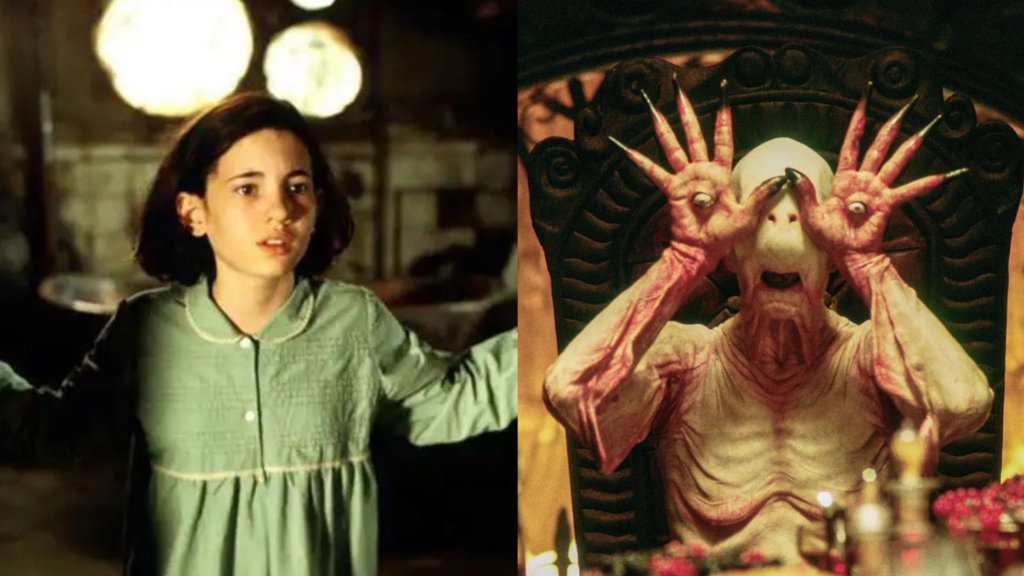
Perhaps the most memorable encounter, however, takes place inside the Pale Man’s dining room. Ofelia enters a chamber filled with food, where a grotesque creature sits motionless at the head of an enormous banquet. She has been warned not to eat anything. Yet hunger gets the better of her, and she takes two grapes from the table.
It is a familiar fairy-tale situation, the forbidden act, the temptation and the punishment that follows. From the forbidden fruit in religious tradition to enchanted feasts in European folklore, food has often been used as a test of restraint. In Pan’s Labyrinth, this familiar motif becomes particularly disturbing. The Pale Man is surrounded by abundance, yet he represents a world that devours children. His enormous feast is not an invitation to pleasure but a warning about the dangers of temptation and unchecked power.

The creature’s appearance also carries a disturbing visual idea. He has no eyes in his face; instead, he places them in his hands. The image is grotesque, but it also suggests a form of authority that watches and punishes without understanding. The creature can be read as a symbol of institutional power, particularly because of the religious imagery associated with his design. The room, the feast and the monster become part of a larger visual language in which horror is rarely just horror.
These are not random decorations placed inside a fantasy world. They are familiar symbols given new life.
One of the oldest and most recognisable patterns in folklore is the repetition of three. Three wishes, three brothers, three doors, three trials, three attempts. From European fairy tales to stories across Asia and the Middle East, the number appears repeatedly in traditional storytelling. It gives a story rhythm, anticipation and a sense of completion.
Ofelia’s journey is built around three tasks. First, she must enter the hollow tree and retrieve a key from a giant toad. Next, she must enter the Pale Man’s chamber and recover a dagger. Finally, she must bring her infant brother to the labyrinth.

The structure feels almost instinctively familiar. We know that the tasks will become progressively more difficult, that each will test the protagonist in a different way, and that the final challenge will reveal something about her character. It is a storytelling pattern that has survived because it works.
But the film also plays with our expectations. The first two tasks test Ofelia’s courage, judgement and ability to navigate an unfamiliar world. The third, however, presents a moral dilemma. The faun asks her to spill the blood of her innocent brother. She refuses.
In that moment, the familiar fairy-tale structure takes an unexpected turn. The final test is not about completing an instruction. It is about knowing when not to follow one. Ofelia’s journey becomes less about proving herself worthy of a magical kingdom and more about discovering her own moral independence.
A traditional fairy tale often rewards obedience, courage or cleverness. Here, the greatest act of courage is disobedience.
What makes the mythology of Pan’s Labyrinth particularly interesting is the world in which it exists. The film is set in 1944, under the dictatorship of Francisco Franco, when remnants of the Republican resistance were still fighting in the Spanish countryside. Ofelia’s stepfather, Captain Vidal, is a military officer tasked with hunting down these guerrilla fighters.
The historical world is cold, rigid and violent. It is governed by uniforms, military hierarchy, orders and unquestioning obedience. The fantasy world, by contrast, is filled with strange creatures, ancient rituals, enchanted objects and mysterious rules. Yet the two worlds are not as different as they initially appear.
Vidal demands absolute obedience from everyone around him. The faun, too, gives Ofelia instructions and expects her to follow them. Both occupy positions of authority, although their intentions and moral positions are very different. The Pale Man, meanwhile, can be read as another expression of a system that consumes the vulnerable while protecting its own power.
The monsters of the fantasy world are frightening, but the human world contains its own monsters. Vidal does not need horns, claws or supernatural abilities to be terrifying. His cruelty is entirely human.
This is where the film’s mythology moves beyond the familiar territory of enchanted forests and magical kingdoms. Its creatures become reflections of the political and moral realities surrounding Ofelia. The fantasy does not simply provide an escape from history; it gives history another language through which to speak.
Traditional fairy tales often operate within a clear moral universe. Good and evil may take different forms, but the protagonist is usually required to make choices that reveal their character. The journey is rarely just about reaching a destination. It is about what the traveller becomes along the way.
Ofelia’s journey follows this familiar pattern, but it complicates the idea of right and wrong. The faun is her guide, but he is not always comforting. His instructions are sometimes questionable, and his authority is not beyond challenge. Vidal is openly cruel, while the faun remains mysterious. Yet both expect obedience.
Ofelia’s final decision brings these two worlds together. When she refuses to harm her brother, she makes a choice that is independent of both the human and the supernatural authorities around her. She does not complete the task as instructed, but she fulfils something far more important, her own moral responsibility.
Whether the underground kingdom exists beyond her imagination is ultimately less important than what the journey reveals about her. The fantasy world gives shape to a struggle that is taking place within the child herself. It allows her to confront fear, temptation, authority and sacrifice through the language of myth.
And this is perhaps why the film’s ending feels so deeply connected to the oldest traditions of fairy-tale storytelling. Death, transformation and the possibility of another world have always occupied a place in such stories. The ending does not offer a simple escape from tragedy. It gives tragedy a mythical dimension.
Folklore has never been a fixed collection of stories sitting quietly in old books. It has travelled through voices, songs, illustrations, theatre, literature and, eventually, cinema. Every generation has found new ways to tell old stories, sometimes preserving their original meanings and sometimes changing them completely.
Cinema, in this sense, is not merely a medium for adapting folklore. It can also become a place where new folklore is created.
The creatures, symbols and rituals of Pan’s Labyrinth do not belong to one ancient culture or one forgotten legend. They are assembled from different traditions, reshaped by a particular historical setting and given meaning through the journey of a young girl. The film’s mythology is invented, but its emotional vocabulary is recognisable.
Perhaps that is the secret behind why the world of Pan’s Labyrinth feels so old. It understands that myths do not survive simply because of the creatures that inhabit them or the magical places they describe. They survive because they continue to speak about things that human beings never quite stop fearing or wanting; belonging, freedom, courage, sacrifice, love and the possibility of finding a place in a world that often feels hostile.
A story does not necessarily need centuries behind it to feel timeless. Sometimes, all it needs is the right combination of an old symbol, a familiar fear and a question that refuses to go away.
And somewhere between a labyrinth, a forbidden feast and a little girl’s refusal to obey, Pan’s Labyrinth reminds us that the oldest stories are not always the ones passed down to us.
Sometimes, they are the ones we have yet to tell.