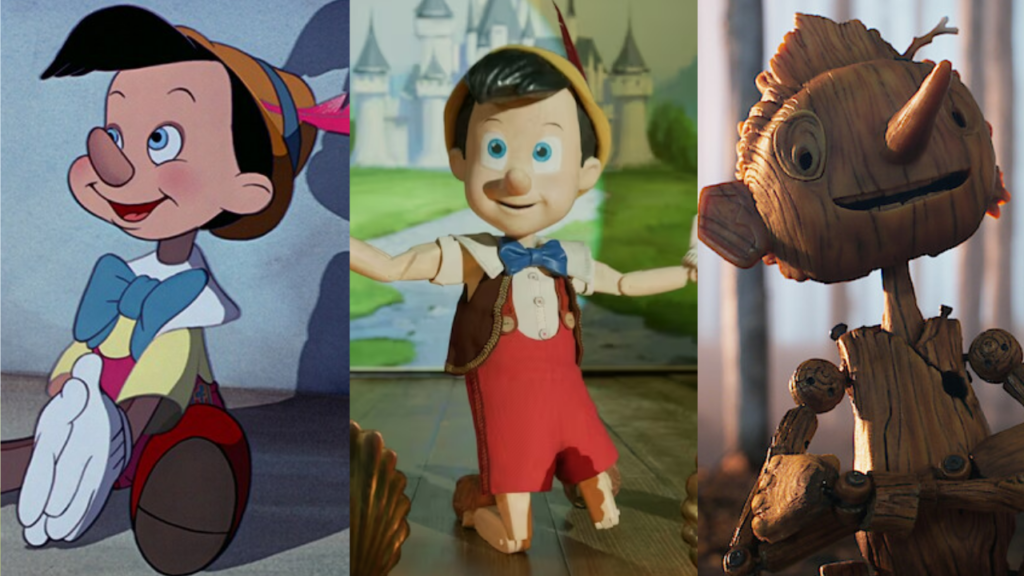
While there have been so many different versions of Pinocchio over the years, in different forms, Guillermo del Toro’s version feels like one of new and unusual depth.
Perhaps that is because del Toro understands something that has allowed Pinocchio to survive for almost a century and a half. Every generation finds itself in this story. Every era reshapes it according to its own fears, hopes, and questions. The details change, the setting changes, even the medium changes, but the core idea remains untouched. And what an idea it is of course.
Created by Italian author Carlo Collodi through The Adventures of Pinocchio in 1883, Pinocchio has become one of the most recognizable characters in world literature. Yet for most people around the world, Pinocchio is not Collodi’s creation but Walt Disney’s, that they first recall. When we think of Pinocchio, we think of the cheerful wooden puppet whose nose grows when he lies. A character who became synonymous with honesty and obedience, especially as a tool for parents to teach their children growing up.
The original story was much darker. While Disney’s 1940 adaptation popularized the lovable puppet worldwide, Collodi’s novel was a strange, often severe morality tale. It was less interested in comforting children than warning them. There is something almost sad in the fact that Collodi died in 1890, only five years before cinema was invented by The Lumière brothers in 1895. He never lived to see what his creation would become, or the countless filmmakers who would spend the next century returning to the world he built. And they keep returning to it, to this date. And there might even be more.
The 1940 Disney adaptation remains the definitive Pinocchio for most audiences. It softened much of Collodi’s darkness and brought the character into a children’s world. Disney’s influence was largely positive. It transformed Pinocchio into something more accessible, more lovable, and ultimately more universal. And yet, every generation seems compelled to carve its own version from the same piece of wood.
The first ever feature-length adaptation of Pinocchio arrived as early as 1911, in Italy, directed by Giulio Antamoro. Italy would return to the character repeatedly. Other countries would too. Even Russia found its own way into Pinocchio. But what is fascinating is that some of the most interesting Pinocchio adaptations are not adaptations at all.
Steven Spielberg’s A.I. Artificial Intelligence (2001), developed from Stanley Kubrick’s long-gestating project, may be one of the most fascinating examples. Usually, the justification for retelling a story “for a new generation” feels weak. Great stories remain timeless. They do not need updating simply because time has passed. Yet, within this reasoning, A.I. Artificial Intelligence feels essential.
David, a robotic child, desperately wants to become a real boy so that he can earn his mother’s love. While not a direct adaptation, it is impossible to ignore how deeply intertwined it is with Pinocchio. The story takes modern anxieties surrounding technology, artificial intelligence, and humanity itself and places them inside the framework of Collodi’s tale.
The same can be said of Takashi Nakamura’s A Tree of Palme (2002), where Pinocchio takes the form of an artificial boy who loses his purpose after the death of his surrogate mother. Different culture, different form, same eternal idea.
Perhaps that is why Pinocchio continues to connect so strongly. The story is not really about lying. It is not even about becoming a real boy. It is about becoming human. A puppet trying to understand the world. A child trying to find his place within it. A parent learning how to love. An artificial searching for something real. The shape changes. The questions remain.
That is what makes Guillermo del Toro’s version so remarkable.
As del Toro said, “Pinocchio is a tale that has lived through the centuries, a fable very close to my heart, and we are very sure that this incarnation is a particularly beautiful one.”
Unlike many modern adaptations, del Toro is not interested in retelling Pinocchio for the sake of retelling it. He seems interested in discovering what the story can reveal when placed inside a particular moment in history. Choosing Fascist Italy is one of the film’s greatest decisions. The rise of fascism hangs over the entire story. It is everywhere and nowhere at the same time. The war itself largely remains off-screen, which is precisely what makes it effective.
As del Toro explained, “If I can avoid it, I refuse to have a proper war scene because then that opens the entire balance. I need to keep it sort of off-screen, but the dynamics of the ghostly, corrosive, parental power that fascism exerts over certain souls. It needs to be there.” This influence can be felt throughout the film. In gestures, in symbols, in speeches. The obsession with obedience. And into that world walks Pinocchio.
A child who refuses to stop asking questions. A child who does not understand why authority should automatically be respected. A child whose very nature is disobedience. His curiosity collides directly with a society demanding conformity.
Through Pinocchio’s eyes, del Toro is able to approach subjects like war, ideology, grief, mortality, and authority with unusual clarity. Because Pinocchio is seeing everything for the first time, he asks questions that everyone else has stopped asking.
At the heart of all of this is Geppetto. While those around him frame war as patriotic and necessary, Geppetto understands its reality. He says to Pinocchio, “War is not fun. War is not good. War took Carlo away from me.”
The death of Carlo becomes the emotional foundation of the entire film. What makes it especially tragic is its randomness. Carlo is not killed because somebody specifically wanted him dead or a section of location was targeted where he was, hence becoming the collateral. None of it. He is killed because a bomb is casually discarded from an aircraft to lighten its load. A human life disappeared because of an act of convenience.
And from that loss grows the film’s most beautiful symbol. The pine cone.
At the beginning, Carlo offers Geppetto a pine cone missing some of its scales. Geppetto rejects it because it is imperfect. Gepetto says, “When one life is lost, another must grow… the pine cone has to be perfect. Complete! This one is missing some of its scales.”
The irony is that the entire film becomes an argument against perfection. Pinocchio is incomplete. He is imperfect. He is reckless, loud, disobedient, and unfinished. And those imperfections are exactly what make him alive. The pine cone mirrors Pinocchio himself. A symbol of renewal, growth, and continuation. Even the film’s ending returns to that image, as if reminding us that life moves forward not through perfection, but through change.
There is another idea running through del Toro’s film that feels equally powerful.
Traditionally, Pinocchio is a story about becoming real. del Toro turns it into a story about mortality.
The film quietly suggests that immortal life may not be all it’s, cooked up to be. While it may seem wonderful at first, later you only realise that you’ll be left alone in it. All your loved ones are bound to leave you one day because their life is limited. So, it’s more of a curse than a blessing.
The gift slowly becomes a burden. The film’s understanding of death is surprisingly gentle. It never treats mortality as something unfair. Instead, it treats it as the very thing that gives life meaning.
As Sebastian J. Cricket says, “What happens happens, and then we’re gone.” It is a simple line, but it feels like the emotional centre of the entire film.
Life matters because it ends. Perhaps that is why del Toro’s version stands out among the dozens of Pinocchio adaptations that exist. Every era finds a new meaning in Pinocchio. But del Toro’s feels the most different, first for its use of stop-motion to tell the story, whereas previous versions of Pinocchio had been either animated or live-action. del Toro sees grief, parenthood, fascism, mortality, and love.
As he beautifully put it, “Parents have a hard time becoming a real parent.” And maybe that is the secret hidden within Pinocchio. The story was never just about a puppet becoming a real boy. It was always about people trying to become more human.
What is it about Pinocchio that resonates so deeply with people that there have been countless versions of it, perhaps thirty or forty adaptations by now?
I think the very idea of Pinocchio is extraordinary, but even calling it extraordinary feels like an understatement. The concept seems to transcend the ordinary bounds of imagination. When people talk about ideas that are “out of the box,” this is precisely what they mean. It is the very definition of being outside the box, outside all boxes, even.
It makes sense, then, that every filmmaker would want to create their own version of Pinocchio. However, I also feel there is a difference between wanting to tell a story because of a personal connection to its world and having the confidence that you are bringing something genuinely new to an adaptation. A filmmaker should not make a film solely out of love for the source material; there should also be a compelling reason for retelling it, a fresh perspective that justifies its existence.
Which feels more than justified with Guillermo del Toro’s Pinocchio.
Read More: