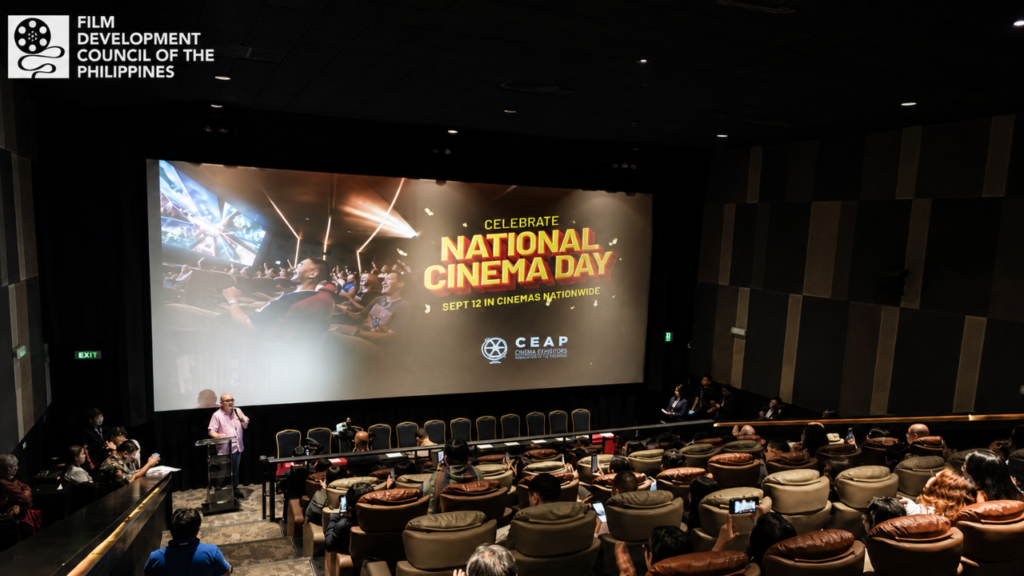
The Philippines will hold its first National Cinema Day on September 12, 2026, bringing the country’s film industry together for a nationwide effort to encourage audiences to return to movie theaters. Carrying the theme “One Industry. One Message. One Big Day,” the initiative will take place as part of the 2026 Philippine Film Industry Month, with the Film Development Council of the Philippines leading the wider celebration under Chairman and CEO Jose Javier Reyes.
The launch comes at a significant moment for Philippine theaters and filmmakers. With audiences having more options than ever to watch films at home, National Cinema Day places renewed attention on the shared experience of seeing a movie on the big screen. It also brings exhibitors, filmmakers and other sectors of the industry together around a common objective: reminding audiences that cinemas remain an important part of how films are discovered, experienced and enjoyed.
The choice of September 12 also has a direct connection to Philippine cinema history. The date marks the premiere of Dalagang Bukid, the 1919 film by Jose Nepomuceno widely recognised as the first Filipino-produced and directed feature film. The historical significance of the date later contributed to the establishment of September as Philippine Film Industry Month.
This year’s Philippine Film Industry Month carries the theme “Pelikula: Ginintuang Ikalawa,” or “Philippine Cinema’s Second Golden Age.” The 2026 programme looks back at the period from the mid-1970s through the late 1980s, a period in which filmmakers including Ishmael Bernal, Lino Brocka, Mario O’Hara, Lupita Aquino-Kashiwahara, Mike De Leon and Eddie Romero played important roles in shaping modern Philippine cinema.
The month-long programme will include screenings of restored classics, new competitions and festivals, educational events and other industry celebrations. Among the films scheduled for screening are Itim, Insiang, Tatlong Taong Walang Diyos, Minsa’y Isang Gamu-Gamo, Ganito Kami Noon Paano Kayo Ngayon? and Nunal sa Tubig. The programme will also feature the ninth Sine Kabataan youth film festival and a new PFIM Short Film Competition.
Against this broader celebration of Philippine cinema, National Cinema Day has a more immediate goal: getting people into theaters. The theatrical business is competing with streaming platforms, mobile viewing and the convenience of watching films at home. A nationwide cinema event gives the industry an opportunity to make a direct case for the communal experience of watching a film on the big screen — something that cannot be fully replicated on a phone, tablet or television.
The initiative also highlights the interconnected nature of theatrical exhibition. A cinema ticket supports not only the theater itself but also distributors, producers, filmmakers and the wider chain involved in bringing a film from production to an audience. Encouraging stronger moviegoing, therefore, has the potential to benefit the wider film ecosystem rather than a single cinema or individual title.
The Film Development Council of the Philippines has a broad mandate to promote the growth and development of the country’s film industry, including its cultural, educational and economic contributions. Its work extends across the filmmaking process, from development and production to distribution and exhibition, making an initiative focused on audience engagement a natural part of its wider role.
The bigger test for National Cinema Day, however, will come after September 12. A successful one-day celebration could introduce audiences to films, cinemas or forms of moviegoing they might otherwise overlook. It could also give regular moviegoers another reason to return and demonstrate to exhibitors that audiences can respond when the industry creates a clear and unified invitation to visit theaters.
The Philippines will therefore be celebrating more than a significant date in its cinematic history. Its first National Cinema Day will also serve as a test of whether a unified industry-wide event can translate attention into sustained moviegoing.
Ultimately, the success of the initiative may not be measured only by how many seats are filled on September 12. Its more lasting impact could be determined by how many of those moviegoers decide to return to a cinema for another film after the celebration is over.
More Articles: