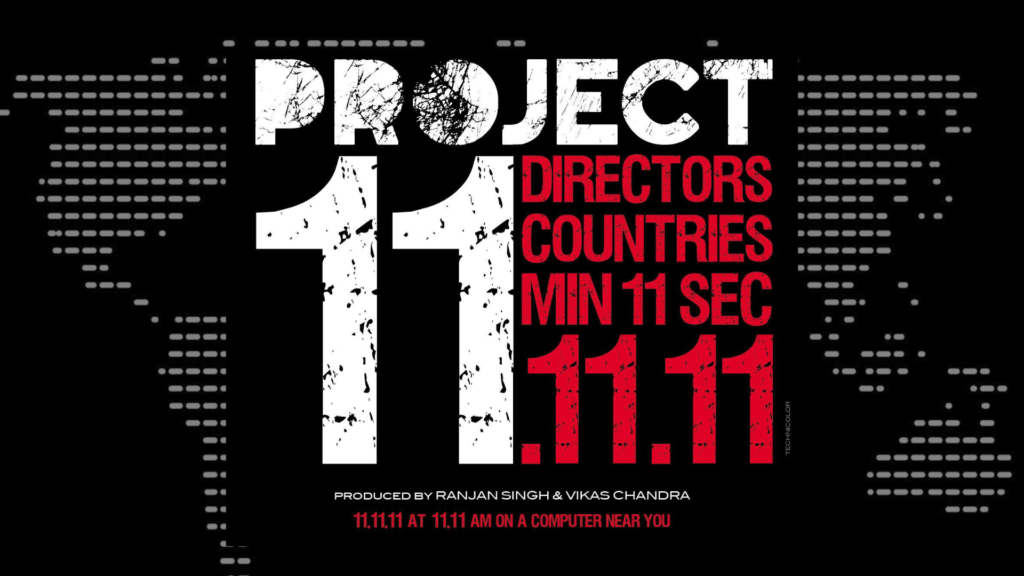
A film made by 11 directors who never met in person is preparing to reach a new generation of viewers. Project 11, the 2011 survival thriller conceived by Mumbai-based filmmaker Vikas Chandra, will return on November 26, 2026, as the first release under Oh Short Flips’ Classic Shorts vertical. Co-produced by Ranjan Singh, the film follows 11 gamers caught in a deadly online contest, with each given just 11 minutes to survive. More than a decade after its original release, the film’s production across 11 cities remains as compelling a part of its story as the thriller itself.
What makes Project 11 particularly unusual is the way it brought together 11 directors working across different countries and continents, none of whom met in person during the filmmaking process. Alongside Vikas Chandra in Mumbai, the directing team included Alessio Giorgetti, Ali Ahmed Brohi, Dharamveer Singh Chauhan, Ikematsu Hiro, Joseph Cohen, Nkumi Mtingwa, Rafal Rakoczy, Ryan Singh, Sydney Walsh and Yi Luo. Their respective teams worked across New York, Los Angeles, Toronto, London, Luxembourg, Tel Aviv, Dar es Salaam, Balochistan, Beijing and Tokyo.
Bringing together so many filmmakers in different locations required a production approach built around constant communication and a shared understanding of the film’s visual language. There was no artificial intelligence or sophisticated cloud-based production infrastructure helping the directors coordinate their work. Instead, the filmmakers relied on late-night Skype calls, storyboards and continuous discussions to ensure that every individual contribution remained consistent with the larger vision.
Chandra described this approach as “HumInt”, referring to human intelligence. The idea was to make the collaboration work through people, communication and creative understanding rather than relying on automated systems. Each director had to interpret the broader narrative, recreate the required scenes in their own location and remain connected to the work being completed by the other filmmakers. It was an ambitious experiment in collaborative filmmaking at a time when remote production was considerably less common.
The biggest technical challenge was ensuring that the separate performances appeared as though the actors were sharing the same physical space. With scenes being filmed thousands of miles apart, even small differences in camera positioning, lighting or actor movement could disrupt the continuity of a sequence. The directors therefore had to coordinate several visual elements carefully to create the illusion of a shared environment.
Eyelines were particularly important. If an actor in London looked in a particular direction, the corresponding actor filmed in New York had to appear to be looking directly back at them. The filmmakers also recreated over-the-shoulder shots, identified locations with similar visual characteristics and coordinated lighting conditions, camera lenses and actor movements. These details helped the individual performances blend into a continuous narrative, allowing the film to move between locations without drawing attention to the geographical distance separating its cast and crew.
The scale of this coordination becomes clearer when the production figures are considered. Approximately 100 crew members worked across the 11 production hubs, taking the film from its script to the completed cut in just 149 days. The editing process also followed the project’s numerical concept. The first cut ran for 25 minutes before the filmmakers trimmed it to precisely 11 minutes and 11 seconds.
The number 11 was not simply a reference in the title. It became the organising principle behind almost every aspect of the project. There were 11 directors working across 11 cities, while the story centred on 11 gamers participating in a contest built around an 11-minute survival countdown. The final running time also reflected the same number, giving the film a consistent creative identity across its narrative, production and editing.
Even the original online premiere followed the numerical pattern. Project 11 premiered at exactly 11:11 AM on November 11, 2011, creating the distinctive date and time combination of 11/11/11. It was an unusual release strategy that extended the film’s central concept beyond the screen, making the number 11 an integral part of its production history and public presentation.
The film’s subject matter also makes it particularly interesting to revisit today. Years before the Blue Whale Challenge became a widely reported online phenomenon, Project 11 explored the disturbing possibility of an underground video game in which losing could result in death in the real world. Rather than keeping the danger confined to a computer screen, the thriller brought the consequences into the physical world, transforming an online gaming contest into a fight for survival.
Its premise reflects an early exploration of the relationship between digital entertainment and real-world danger. The idea of an online contest in which participants face potentially fatal consequences gives the film a survival-thriller framework while connecting its narrative to broader anxieties about the influence of technology and online communities.
Now, Oh Short Flips’ Classic Shorts vertical is preparing to introduce the film to a new generation of digital viewers. The initiative aims to bring acclaimed older short films that have become difficult to access back into circulation, giving them another opportunity to find audiences. The announcement was made around the WAVES Film Bazaar in Goa, with producer Ranjan Singh backing the initiative.
The return of Project 11 also highlights the value of preserving and rediscovering earlier independent filmmaking experiments. Short films often have limited opportunities for sustained visibility after their initial festival appearances or online releases. Platforms that bring such projects back into circulation can help audiences discover work that might otherwise become difficult to find, while giving filmmakers and their creative approaches renewed attention.
For a film whose characters are racing against an 11-minute deadline, Project 11 has had quite a journey of its own. Its return on November 26, 2026, offers audiences an opportunity to revisit not only an unusual survival thriller but also a filmmaking experiment that brought 11 creative voices together to tell one story. The directors were separated by thousands of miles and worked independently across different production hubs, yet their individual contributions were designed to function as parts of a single cinematic experience. More than a decade after its original release, that remains the most distinctive achievement of Project 11.