How does a country become a global film powerhouse? Is it by making one great film? Winning one major award? Having one filmmaker break through internationally?
No. Because none of those things happen in isolation. And South Korea is probably one of the clearest examples of that.
Today, Korean cinema is watched across the world. Korean filmmakers regularly appear at Cannes, Berlin, and Venice. Korean films are distributed internationally, picked up by streaming platforms, and discussed far beyond the country they come from. Parasite (2019) became the first non-English-language film to win the Academy Award for Best Picture. Oldboy (2003) became a global cult classic. Train to Busan (2016) turned a Korean zombie film into an international phenomenon. The Handmaiden (2016) found an audience far beyond the boundaries of Korean cinema.
But none of this began with Parasite.
South Korea did not suddenly wake up one morning and become a global cinematic powerhouse. It took decades of political change, censorship, experimentation, investment, festivals, filmmakers, audiences and, most importantly, a growing confidence in its own stories.
The roots of Korean cinema go back to the Japanese colonial period. Early filmmakers had to work under a system where cinema was heavily controlled, but that did not stop films from becoming a way of expressing something larger. Na Woon-gyu’s Arirang (1926) became one of the most vital films of this period. Beneath its story was a sense of national identity and resistance that could not always be expressed openly.
Cinema was already becoming more than entertainment.
Then came liberation in 1945, followed by the Korean War between 1950 and 1953. South Korea was left devastated, and its film industry faced the same destruction. Yet, cinema returned. A country trying to rebuild itself also needed ways of understanding what it had just been through.
The 1960s eventually became the Golden Age of South Korean cinema. Filmmakers like Kim Ki-young, Yu Hyun-mok, and Shin Sang-ok began making films that looked at Korean society with greater confidence. Kim Ki-young’s The Housemaid (1960) was not simply a domestic thriller. It became a disturbing examination of class, desire, and patriarchy. Yu Hyun-mok’s Aimless Bullet (1961) looked at post-war despair with an almost unbearable bleakness.
These films were Korean stories. But the emotions inside them were not limited to Korea. And that would become important much later.
Because the road to becoming global does not begin by trying to make stories that everyone will understand. It begins by understanding what you want to say yourself. But Korean cinema would soon lose much of that freedom.
The 1970s and early 1980s were marked by authoritarian rule and heavy censorship. Government regulations restricted what filmmakers could say, and how they could say it. Cinema became safer, more formulaic, and less willing to take risks. Yet even under censorship, some filmmakers continued to find ways of looking at Korean society through history, tradition, family, and allegory. Im Kwon-taek, one of Korea’s most enduring filmmakers, continued to push boundaries. His persistence during this restrictive era later made him a key figure in the revival of the South Korean film industry.
And then South Korea itself began to change.
Democratization in the late 1980s created greater creative freedom, and with it came a new generation of filmmakers who were willing to look directly at the country’s political and social realities. It was more politically aware, more socially critical, and far less afraid of confronting uncomfortable realities. Directors like Park Kwang-su, Jang Sun-woo, and Lee Chang-dong began addressing political repression, labour, inequality, and the everyday consequences of a rapidly changing society. This was the beginning of what would come to be known as the Korean New Wave.
But the filmmakers were not the only thing changing. The industry around them was changing too.
Private and corporate investment entered Korean cinema. Production became more sophisticated. Domestic audiences grew. Filmmakers had greater access to technology and larger budgets, while still retaining the creative freedom to experiment. And this combination was powerful. Because Korean cinema did something that many industries struggle to do. It began to understand that commercial cinema and serious cinema did not necessarily have to be enemies.
A film could make money and still have something to say. A thriller could be political. A horror film could be about class. A revenge story could be psychological and about grief. A monster movie could be about society. Korean filmmakers began treating genre less like a limitation and more like a playground.
And then came film festivals.
The Busan International Film Festival was established in 1996, at a time when South Korean cinema was becoming increasingly ambitious. It became an important platform for Asian filmmakers, and helped connect Korean cinema with international filmmakers, critics, distributors, and audiences.
Cannes, Berlin, and Venice offered another kind of visibility. This mattered because a film festival does more than hand out awards. It can introduce a filmmaker to people who might otherwise never see their work. It can create conversations. It can create relationships. It can turn a film made in one country into something that begins travelling through another.
South Korean cinema increasingly became part of that international conversation.
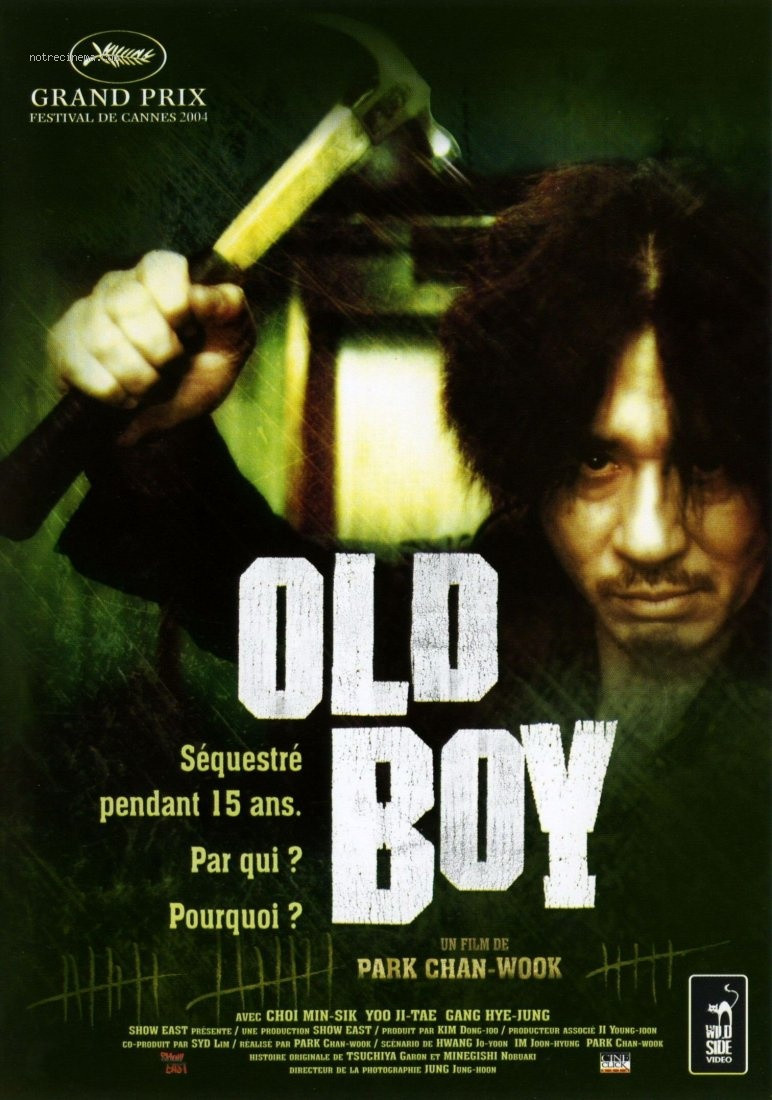
Then came the filmmakers who would make it impossible to ignore. Park Chan-wook’s Oldboy was one of the defining moments. The film was violent, disturbing and deeply strange, but it was also visually precise and emotionally charged. When it won the Grand Prix at Cannes in 2004, it was not simply an award for one Korean film. It was another indication that Korean cinema had something the rest of the world wanted to watch.
Then there was Bong Joon Ho. Memories of Murder (2003) took a crime story and turned it into an examination of violence, failure, and society. The Host (2006) combined horror, comedy, family drama, and social commentary. It was entertaining, yes. But underneath the entertainment was criticism.
And this became one of the greatest strengths of Korean cinema. It could entertain you first and disturb you later.

Yeon Sang-ho’s Train to Busan (2016) is another example. On the surface, it is a zombie film about a father and daughter trying to survive a viral outbreak on a train. But the film works because the zombies are not the only thing the characters are fighting. Fear is there. Self-preservation is there. Class is there. And so is the question of how much humanity people are willing to sacrifice when survival becomes the only thing that matters. The film travelled far beyond South Korea and gained a huge international following.
It proved that a Korean genre film did not need to become Western to become global.
Park Chan-wook’s The Handmaiden made a similar statement in a completely different way. Adapted from Sarah Waters’ Fingersmith, the film combined psychological thriller, romance, deception, and sexuality with extraordinary visual precision. It won the BAFTA for Best Film Not in the English Language in 2018, and became a major success within international arthouse cinema.
And then came Parasite.

By the time Bong Joon Ho made Parasite in 2019, Korean cinema had already spent decades building towards this moment. The film was about two families. One wealthy. One struggling to survive. One living in a beautiful house. The other living in a semi-basement. It was deeply Korean in its setting, its humour, and its social observations. Yet, people everywhere understood it. Because inequality does not belong to one country. Neither does the feeling of looking at somebody else’s life and wondering why yours seems so different.
Parasite won the Palme d’Or at Cannes and then went on to win four Academy Awards, including Best Picture, Best Director, Best Original Screenplay, and Best International Feature Film. Its becoming the first non-English-language film to win Best Picture was historic. But more than that, it was symbolic. The world was no longer simply discovering Korean cinema. It was recognising it.
And this is where the rise of the Korean Wave (or Hallyu), becomes important too.
Korean cinema did not grow globally by itself. Korean dramas, music, and popular culture had already created curiosity about South Korea around the world. Streaming platforms then made Korean content even easier to access. A viewer did not have to live in Seoul to watch a Korean film anymore. They just needed a screen. Platforms like Netflix invested heavily in Korean content, while digital distribution allowed films and filmmakers to reach audiences that traditional theatrical distribution might never have reached. The distance between Korea and the rest of the world became smaller.
And once audiences discovered Korean cinema, they had an entire history waiting for them. They could watch Parasite and then discover Oldboy. They could watch Train to Busan and then explore Korean horror and thrillers. They could discover Park Chan-wook, Bong Joon Ho, Lee Chang-dong, Hong Sang-soo, and countless other filmmakers whose work had existed long before the global mainstream began paying attention.
That is the thing about a film industry becoming global. The world does not only discover its biggest film. It begins discovering the industry behind it.
And South Korea had built that industry over decades. It had filmmakers willing to take risks. It had audiences willing to watch domestic cinema. It had private investment willing to fund ambitious productions. It had film festivals creating international connections. It had a cultural movement already carrying Korean stories beyond borders. And eventually, it had streaming platforms capable of taking those stories almost anywhere.
None of these things alone could have created what South Korean cinema is today.
Together, they did.