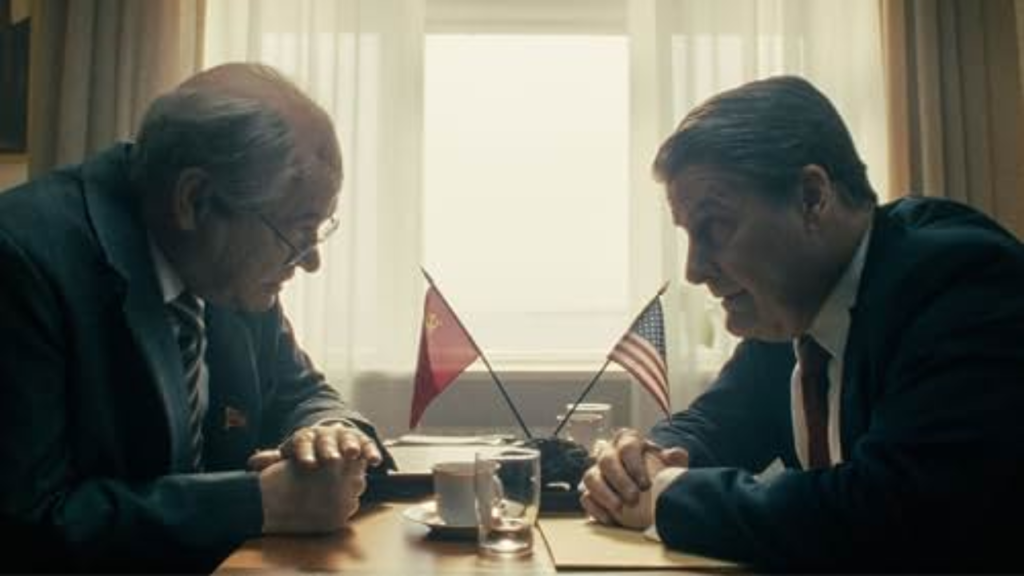
The Brink of War opens in theatres on August 14 through Angel Studios, telling the story of the October 1986 Reykjavík Summit between U.S. President Ronald Reagan and Soviet General Secretary Mikhail Gorbachev. Written and directed by Michael Russell Gunn, the film stars Jeff Daniels as Reagan and Jared Harris as Gorbachev, with J.K. Simmons as Secretary of State George Shultz and Hope Davis as Nancy Reagan. The critical response is mixed, with most reviewers finding the central performances genuinely compelling while questioning whether the film built around them is as dramatically alive as its subject deserves.
The film opens with Reagan staring at a stormy sea at the end of the 30-hour Reykjavík Summit. His first words are, “I failed.” From there, the story flashes back to the beginning of the talks, as two world leaders meet in a remote, reportedly haunted house on the edge of the sea to discuss the possibility of dismantling both nations’ nuclear arsenals. The negotiations seesaw between hope and collapse, with Reagan and Gorbachev finding common ground on arms reduction before retreating when the conversation shifts to human rights, Soviet emigration policy and deeply held ideological differences. Running alongside the summit are subplots involving Nancy Reagan at home, Raisa Gorbachev’s public relations tour of Iceland, and two journalists covering the story from outside the negotiations.
The consensus across most major publications is that the two lead performances are the film’s best and most reliable element, while the screenplay, though earnest and historically grounded, too often tips into speechifying rather than drama. The Hollywood Reporter criticises the film’s tendency to tell audiences exactly how to think, noting that its characters repeatedly explain the importance of their mission in language that feels less like natural dialogue and more like a band performing its greatest hits. Phrases such as “Trust but verify” and “Peace through strength” are invoked with a familiarity that the review compares to a concert-like greatest-hits performance.
Variety describes the film as having a slightly “waxworks” quality and argues that what is crucially missing is a particularly compelling sense of Reagan and Gorbachev as human beings rather than historical figures. Flickering Myth acknowledges that the film can be dry—”as dry as the Cold War conflict itself”—but argues that it is carried by the requisite weight and intrigue of its subject and lead performances. Movieguide is among the more positive voices, calling the film an informative and detailed glimpse into the conversations surrounding the summit while praising its three leading performances.
Jeff Daniels’ performance as Reagan has divided critics more than any other element of the film. Nick Schager of The Daily Beast gives Daniels considerable credit, arguing that he portrays Reagan as a man capable of being both resolute and flexible. Schager also contrasts the performance with Dennis Quaid’s more surface-level approach in the 2024 biopic Reagan. Daniels’ evocation of Reagan’s voice is subtle, while his portrayal of a president shaped by his near-fatal encounter with John Hinckley Jr. and haunted by a trembling hand that foreshadows future health problems gives the character a quiet vulnerability. MovieWeb similarly calls it a thrilling performance that carries the film through its duller passages.
Variety is less persuaded, arguing that Daniels captures Reagan’s folksy manner and social conservatism without quite making him a dynamic screen subject. Even with a more substantial approach than Quaid’s, the review suggests Reagan remains a less compelling movie character than his historical reputation might imply. The Hollywood Reporter also takes issue with the facial prosthetics Daniels wears, calling them distracting—particularly because Jared Harris requires no comparable makeup to become convincing as Gorbachev.
Almost every review agrees on one thing without reservation: Jared Harris is the best thing in the film. Variety describes his Gorbachev as arriving in Reykjavík with a genuine desire for arms reduction and a willingness to find compromise, while noting that his exchanges with Daniels provide the film’s most compelling passages even when the pacing begins to drag. The Hollywood Reporter praises Harris for creating a convincing Gorbachev without relying on prosthetics, while The Daily Beast notes that he approaches the Soviet leader as a committed but conflicted individual rather than an icon. That choice makes Gorbachev feel genuinely human in a film that sometimes struggles to humanise its historical subjects. Flickering Myth goes further, calling Harris’ performance the most memorable element of the entire film.
J.K. Simmons also receives warm notices for his portrayal of George Shultz. Variety describes him as bringing a gruff, salt-of-the-earth decency to a character positioned as the voice of reason throughout the negotiations, while The Daily Beast calls him the film’s most reliably entertaining presence. The film’s dedication to Shultz gives the character additional weight, a detail several reviewers noted.
Hope Davis’ performance as Nancy Reagan divides critics more sharply. The Daily Beast describes her as the film’s most unintentionally amusing component, largely confined to sitting at home and seething while offering supportive conversations with her husband over the phone. Variety calls her participation transparently ornamental, arguing that the women in the story are used primarily to fill out its edges without being given enough substantive material. Aya Cash and Guy Burnet play journalists covering Raisa Gorbachev’s public relations tour, but their subplot also receives criticism. The Hollywood Reporter describes it as clunky and primarily a vehicle for elaborating on U.S.-Soviet tensions rather than a story worth following in its own right.
One area where critics consistently find quality is the production itself. The film was shot at the actual house in Reykjavík where the summit took place, a significant production advantage that gives it an authenticity most historical dramas cannot easily replicate. Variety acknowledges that the location adds genuine texture, while MovieWeb calls it a major asset. The Daily Beast similarly notes that the real location gives several scenes a grounded quality that the more theatrical moments in the screenplay struggle to achieve.
Michael Russell Gunn also uses several visual devices to alleviate the film’s essentially static setting. These include occasional split screens and a recurring technique in which the table between Reagan and Gorbachev appears to grow smaller in successive shots, suggesting progress in their diplomatic relationship. Variety considers the latter device heavy-handed, while Flickering Myth is more forgiving of the film’s limited visual imagination, noting that Gunn nevertheless treats the historical material with appropriate weight.
The Brink of War is ultimately a film that means well, is carried by two strong central performances and achieves modest success as a historical document. Whether it succeeds as cinema is a more complicated question. Variety perhaps captures the critical consensus best, suggesting that talk-heavy political dramas of recent history, carried by skilled name actors, were once more naturally suited to awards-minded television than the theatrical screen. As a theatrical release, the film asks audiences to invest in a story whose historical outcome is already known, while relying on dialogue that too often tells rather than shows.
The result is, as The Daily Beast puts it, a serviceable film whose hagiographic earnestness is offset by understated performances and genuine engagement with a pivotal moment in Cold War history. It is not a great film, critics suggest, but neither is it an unworthy one. Its strongest achievement lies in putting Jeff Daniels and Jared Harris across from one another and allowing their performances to bring human tension to a historical encounter that the screenplay itself sometimes struggles to dramatise.
Watch The Brink Of War Trailer:
Film Details: The Brink of War
Director: Michael Russell Gunn
Writer: Michael Russell Gunn
Cast: Jeff Daniels, Jared Harris, J.K. Simmons, Hope Davis, Branka Katić, Aya Cash, Guy Burnet
Cinematography: Magdalena Górka
Music: Austin Wintory
Genre: Historical Drama, Political Drama
Rating: PG
Running Time: 1 hour 57 minutes
Production Companies: SK Global, 2521 Entertainment
Distributor: Angel Studios
Country: United States
Language: English
Release Date: 14 August 2026
Read More Review Roundups on POF