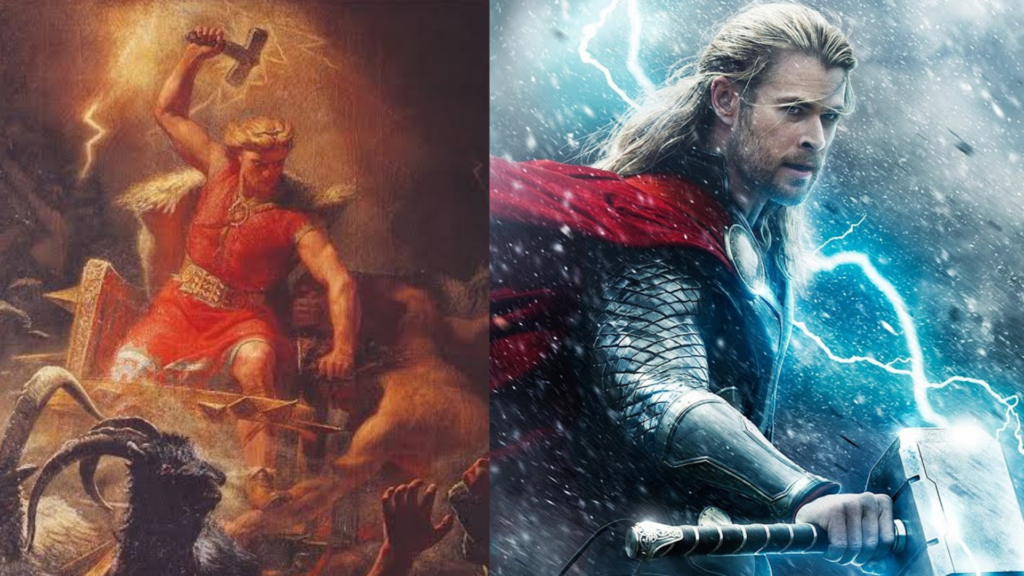
What happens when a character who has existed in mythology for centuries becomes a superhero in contemporary cinema? What stays the same about Thor, and what changes when he is brought into a different world?
Thor is a fascinating character to look at because he comes from a mythology that already has its own ideas about his power, strength, and what it means to protect others. When Marvel brings him into its films, these ideas remain on the surface, but the deeper story and Thor’s evolution throughout the films are what change. As a result, the way we understand him also begins to change.
In Norse mythology, Thor is the god of thunder, and his hammer, Mjölnir, is closely associated with him. He is known for his strength and for protecting both gods and humans from their enemies. But the Thor we find in these stories is not always the kind of hero we have come to expect from superhero films. He can be reckless, short-tempered, and quick to use his strength. There is something important about this, because the mythology does not separate his power from his flaws. Both are part of who he is.
When Kenneth Branagh’s Thor came to the screen in 2011, it brought this character into a world that was quite different from the one he came from. Asgard, its gods, and their conflicts were still there, but they now existed within a cinematic world shaped by science fiction and the modern superhero. Thor’s mythology was not simply being retold. It was being reinterpreted for an audience that would understand him through a different idea of heroism.
And the interesting part is seeing how the film holds on to the imagery and character of the Norse god while changing the world around him.
One of the first things worth looking at is the way Thor’s strength is presented in both mythology and the film. In Norse mythology, Thor’s strength is central to his role as a protector. He fights giants and other beings who threaten the world of the gods, with his hammer serving as a defining symbol of his power. But his strength also makes him a character who can be quick to anger and act without thinking about the consequences. The film carries this quality into its portrayal of Thor, but it uses it to tell a story about what happens when someone who has always had power is made to live without it. His journey towards becoming a hero is also a journey towards understanding what his strength is meant for.

There is a difference, however, between the way mythology presents a god and the way a modern superhero film presents one. In the old stories, Thor’s power is part of the world he belongs to. His battles are connected to the survival of the gods and the forces that threaten them. In Marvel’s Thor, his power is also connected to the question of whether he deserves to have it. This is a more contemporary understanding of heroism, where a character’s abilities matter less than the way he chooses to use them.
The film takes something that already existed in the mythology and gives it a different meaning for the audience. This change can also be seen in the way the film presents Asgard.
In Norse mythology, Asgard is the realm of the gods, connected to other worlds through a larger cosmic order. Marvel retains this idea but gives Asgard the appearance of a technologically advanced civilisation. Its buildings, weapons, and the Bifrost, which allows travel between worlds, make it look as though magic and technology exist together. This is quite different from the way we might imagine an ancient mythological world, but it allows the film to bring the gods into a world shaped by science fiction.
There is a line in the film that makes this particularly clear. When Jane Foster tries to understand where Thor comes from, he tells her, “Your ancestors called it magic, and you call it science. I come from a land where they are one and the same.” The line becomes a way for the film to bring two different ways of understanding the world together. What appears supernatural to humans is ordinary to Thor. And what humans have tried to explain through science does not necessarily contradict the world he comes from.
In this way, Marvel did not abandon the mythology to make it fit into contemporary cinema. It changed how that mythology was presented.
The same thing happens with Mjölnir. In Norse mythology, Thor’s hammer is a powerful weapon associated with thunder and the protection of the gods and humans. It is also an important part of who he is. Marvel keeps this idea but adds another meaning to the hammer: only someone worthy can lift it. This makes it more than just a weapon or a sign of strength. It becomes a way of looking at the person who wields it. Thor may have the strength of a god, but that does not automatically make him worthy of his power.
The film uses an object from mythology to express a very modern idea that power must come with responsibility.
Thor’s arrival on Earth brings another change in the way the mythology is translated. Instead of keeping him within the world of gods and extraordinary beings, the film places him in Puente Antiguo, a small town in New Mexico. The setting is important because it is so different from Asgard. Thor is surrounded by ordinary people, and the life he encounters is far removed from the world in which he was raised. There is also something familiar about the setting, with its small town, open landscape, and a stranger who has to find his place in a community. It brings the character closer to the tradition of the American Western, where a man who arrives with a certain idea of himself has to discover what kind of a person he really is.
This is one of the ways in which Thor becomes more than a retelling of Norse mythology. It brings the character into the world of the American superhero, where the hero is often defined by his relationship with ordinary people. Thor’s time on Earth allows him to see a life that does not revolve around his position as a prince or his ability to fight. When Thor chooses to protect the people around him, even without his powers, we begin to understand what being a protector means to him. He may have the qualities of the Thor we know from Norse mythology, but the film shows that being a hero is not just about how powerful someone is.
The film’s use of mythology is not limited to the characters and objects it takes from the old stories. It also changes the way their conflicts are understood.
When Thor first meets the Frost Giants, he is ready to fight them because he sees them as a threat to Asgard. But later, when Loki wants to destroy Jotunheim, Thor refuses to let him do so. He does so because at that time he has begun to see things differently. The people he once saw as enemies are not people he needs to defeat anymore. Thor still has the strength to fight, but he understands that being a protector also means knowing when not to.

This idea continues in Thor: Ragnarok (2017), directed by Taika Waititi. The film draws from the Norse myth of Ragnarok, which speaks of the destruction of the gods and their world. But what makes the film different is how this destruction changes Thor’s understanding of Asgard. Until then, his home has been closely tied to its grandeur, its throne, and his family’s place in it. By the end, he begins to see that Asgard can exist without all of these things too. And what matters most are the people who make it home, much more than the castles and immaculate structures around them.
In Avengers: Endgame (2019), we see another side of Thor. He struggles with grief and the feeling that he has failed the people who depended on him. For someone who has spent so much of his life being supremely powerful, it is especially difficult for him to face a situation he cannot fight his way out of. His strength has not vanished, it’s still within him, but it cannot take away his pain or change what has happened.
Thor’s story makes room for this side of him, allowing him to be more than the god who is expected to win every battle. There is something quite gripping about this journey from mythology to cinema.
Thor still has the qualities that make him recognisable from Norse mythology. His hammer, his connection to thunder, his family, and his role as a protector are all still part of who he is. But the film gives these things a different meaning. His strength becomes a question of responsibility, his hammer becomes a symbol of worthiness, and his place among the gods becomes a way of exploring what it means to belong and to lead.
Perhaps the most crucial difference is that Marvel’s Thor is not simply a god who has been brought into a modern world. He is a mythological character whose story has been reshaped by the kind of hero contemporary cinema wants to tell and see.
The mythology gives the films their characters, conflicts, and imagery, while the superhero genre gives these elements a new context. And in bringing the two together, Marvel has made Thor part of a world that continues to grow beyond the stories in which he first appeared.