What does it really mean when an actor becomes bigger than the film they are in?
There is, of course, a reason why we go to the theatres to watch certain actors. Over the years, we become familiar with their faces, their mannerisms, the way they speak, and even the kind of characters we expect them to play. Sometimes, it is this precise familiarity that makes us want to watch a film in the first place. Even when we may not know much about its story, knowing who is in it is enough to make us curious.
But a film is much bigger than the actors who act in it. It is a story someone wants to tell, brought to life by a director and the characters a writer creates. The actors are undoubtedly an integral part of bringing this world to life, but they are not the entirety of it. And yet, there are times when we begin to see a film almost entirely through the actor at its centre, as though everything else in it exists to serve their presence.
Hindi cinema, in particular, has always had a close relationship with its stars.

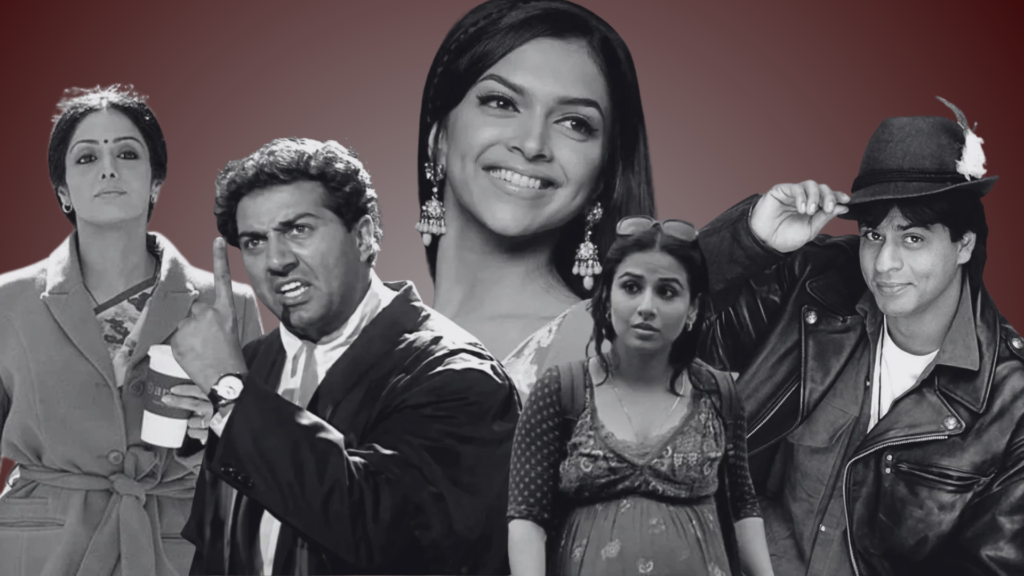
Amitabh Bachchan’s angry young man in Zanjeer (1973) and Deewaar (1975) was not just another character being played by an actor. He became a figure audiences could recognise and relate to, especially at a time when the anger he carried seemed to find an echo outside the cinema halls. Shah Rukh Khan, too, became closely associated with the romantic hero through films like Dilwale Dulhania Le Jayenge (1995) and Kuch Kuch Hota Hai (1998). These characters became memorable partly because of the actors who played them, and the actors became stars partly because of these characters.
The same can be said about female actors, too. Sridevi, for instance, became known for the kind of characters she played, from ChaalBaaz (1989) to English Vinglish (2012). Vidya Balan, through films like The Dirty Picture (2011) and Kahaani (2012), also showed how an actor could become known for playing characters that were different from what audiences were used to seeing leading actresses play. In both cases, the actors drew audiences to their films, but the characters they played also became a part of what made them stars.
There is an interesting relationship here. Sometimes, a character makes an actor a star. At other times, an actor’s stardom gives a character a life beyond the film they were a part of. The two do not necessarily have to compete with each other. In fact, some of the most memorable films are those in which the actor and the character become difficult to separate, without the story losing its own identity.
The difficulty arises when a film begins to rely on what we already know about an actor, rather than what the story might allow them to become. We start recognising the star before we have had the chance to understand the character. We wait for the signature dialogue, the dramatic entry, the action sequence or the moment when the hero does something that only this particular actor can get away with. There is a certain pleasure in this, of course. But when these moments become more important than the story connecting them, the film can begin to feel like a vehicle for the star rather than a world of its own.

Take Salman Khan’s Dabangg (2010), for instance. Chulbul Pandey became a character whose swagger, humour, and mannerisms were central to the film’s appeal. The film gave audiences a hero they could enjoy watching, and Salman brought a screen presence that made the character work. And that somehow became the highlight of the film, while the story took a backseat. But when a character becomes so closely associated with the star playing them, it also becomes difficult to move beyond what made them popular in the first place. The audience wants more of what it already knows. And the filmmaker, in turn, has to decide whether to build on that familiarity or risk taking the character somewhere new.
This is not only about sequels or recurring characters.
It can also be seen in the way films are presented to us. A poster may place the actor at the centre, a trailer may be built around their entry and their dialogue, and the marketing and publicity may depend more on their name than on the story itself. The film doesn’t even reach the theatre, and we may already have an idea of what kind of experience we are being promised. In a star-driven industry like Hindi cinema, this is understandable. A renowned face can help a film find its audience.
But it also raises the question of how much space the story is being given to speak for itself.
Chennai Express (2013), for example, drew much of its appeal from Shah Rukh Khan’s well-known romantic-comic persona, while Rowdy Rathore (2012) leaned into the mass-hero image associated with Akshay Kumar. These films were made to entertain, and there is no reason why a film should be criticised simply because it wants its star to be a large part of the experience. The question is not whether actors should be allowed to command the screen. It is whether the film around them has enough of its own life to make that screen presence meaningful.

This question is equally relevant when we look at films led by female actors like Vidya Balan’s Kahaani, for instance, centres on a pregnant woman searching for her missing husband in Kolkata. While her performance is an important part of the film, the mystery that unfolds around her is just as important. Similarly, Queen (2014), starring Kangana Ranaut, follows a woman who decides to go on her honeymoon alone after her fiancé calls off their wedding. Both films give their lead actors an important role to play, but the stories are not limited to their presence alone.
Because a good actor can do more than repeat what audiences expect from them.
They can surprise us, make us see something unfamiliar in a face we have known for years, or bring a character to life in a way that changes our understanding of the story. Shah Rukh Khan in Swades (2004) is not remembered in quite the same way as the romantic hero of his earlier films. Aamir Khan in Taare Zameen Par (2007) is part of a story whose emotional centre belongs to a child who struggles to be understood. Sridevi in English Vinglish, too, gave us a character whose journey was not about being the most powerful person in the room, but about learning to believe in herself after years of being made to feel inadequate. In these films, the actors matter, but the stories also allow us to see something beyond the images we have come to associate with them.
And this is where the distinction becomes important. There is a difference between an actor being the reason we watch a film and the actor becoming the only reason the film seems to exist. The first is a natural part of cinema. We may follow an actor’s career because we want to see what they do next. The second can leave little room for the unexpected, because the film is already expected to deliver a version of the star we recognise.
Filmmaking, after all, is not just about the actors. It is about the writing, the direction, the performances that may not appear on the poster, the music, the editing and all the small decisions that come together to create what we experience on screen. A film can have a star at its centre and still have all these elements to matter. It can give its actor the freedom to command the screen without making every other part of the film feel secondary.
One can grow without the other having to be left behind.
There is nothing wrong with wanting to see your favourite actors on the big screen. There is nothing wrong with a film celebrating the very qualities that made an actor a star. But it is worth asking what we are left with when the presence of the star becomes more dominant than the story they are a part of.
Once we’re through watching a film, do we remember the film for what it truly was, or only for the moments we expected from the person playing its lead?
A film should be able to give an actor a character worth remembering, just as an actor should be able to give a film something that stays with the audience. The two can make each other greater. But when one begins to overshadow the other, we risk forgetting that the actor was never the whole film to begin with.