An actor spends years learning to inhabit someone else’s world, to understand a character, and to make us believe in the life that unfolds on screen. They work with directors, watch them make decisions, and become familiar with the many things that go into bringing a film to life.
And yet, when they finally sit in the director’s chair themselves, something might not always come together.
The films may have scale, the performances may be convincing, and the audiences may turn up to watch them. But the film, as a whole, can still feel like it is missing something.
This becomes even more worth examining in Hindi cinema, where the hero has occupied such a central place in the way we tell stories. For years, we have watched films built around one person. The story follows his journey, the conflicts exist for him to overcome, and the world of the film often seems to wait for him to arrive. We grow accustomed to seeing the hero as the person who holds everything together.
But what happens when that same person becomes responsible for holding the entire film together?
The problem may lie in the difference between understanding a character and understanding a film.
An actor may know exactly how to make a scene work. They may understand what their character is feeling, how a line should be delivered, or when a silence can say more than words. But directing asks for more. It asks you to look beyond the person in front of the camera and understand everything that makes their existence in that film meaningful. It requires one to see the other characters, the world they inhabit, and the story that connects them all. Sometimes, it even requires one to recognise that the character one is playing, if they’re in the film, is not the most important part of the story.

And that can be difficult when one has spent years being the hero.
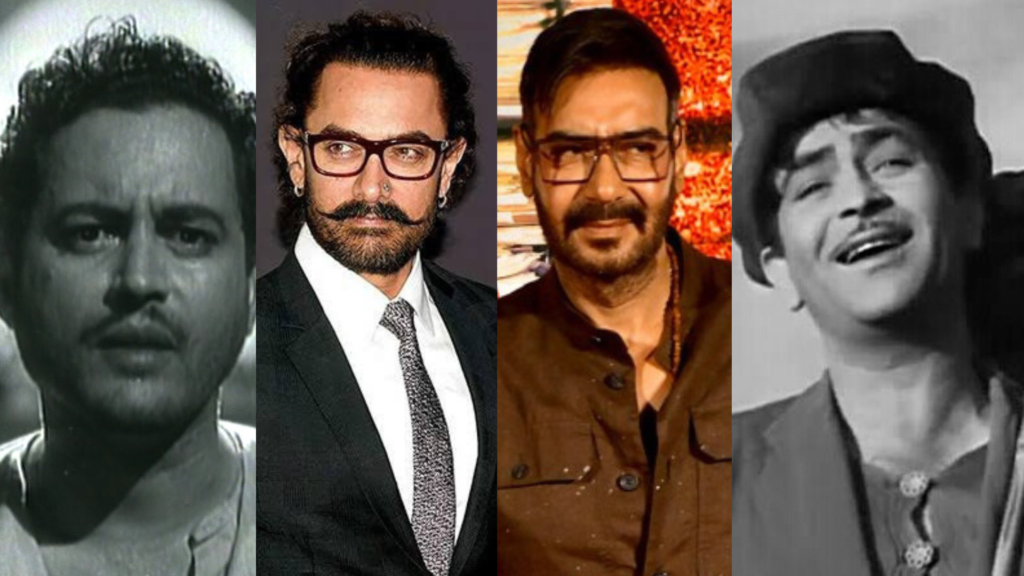
Ajay Devgn’s directorial ventures offer an interesting example of this distinction. His debut film, U Me Aur Hum (2008), struggled at the box office, and its emotional premise did not translate into a film that resonated with everyone. His later films, such as Shivaay (2016), Runway 34 (2022), and Bholaa (2023), show an interest in action and spectacle, but impressive visuals alone cannot make a film work. Bholaa, for instance, had its share of elaborate action sequences, yet its writing and character development were criticised. It is a reminder that a film can have ambition and look impressive without telling a story that is as compelling as it could have been.
Ajay Devgn is not the only actor-director whose films have struggled to bring their ambition and storytelling together. Sunny Deol’s Dillagi (1999), which he directed and starred in, was criticised for its clichéd storyline and direction. Salman Khan’s Veer (2010), although directed by Anil Sharma, offers another example of how a grand idea and a star at its centre cannot always compensate for a weak script, particularly when the star himself writes it.
These films are different in their approach, but they raise a similar question: when so much attention goes into creating a hero and the world around him, does the story itself sometimes get left behind?
This is where I think we need to distinguish between a film that succeeds at the box office and one that succeeds as cinema of quality. They are not the same thing. A film can earn a great deal of money and still leave us with very little to think about. Another can struggle commercially and yet offer something that stays with us. There is nothing wrong with wanting audiences to come to a film, but when commercial success becomes the only measure of its worth, we risk overlooking what the film has actually contributed to cinema.
The question is not whether a hero can make a film that people want to watch. It is whether they can make a film that has a life beyond themselves.
There is a comfort in knowing what an audience expects from a star. Over time, an actor develops an image that people recognise and respond to. The way they speak, the way they move, even the kind of conflicts they are expected to overcome become a part of their image. But that image can also become a limitation. When an actor becomes a director, there is a temptation to carry that image into the film, to give the audience more of the person they already know. The story then begins to serve the star, instead of allowing the star to serve the story.
And a film can only go so far when everything in it has to lead back to one person.
The supporting characters become less important, the writing makes room for the hero’s moments, and the emotional journey of the film can begin to feel secondary to the image at its centre. We may still enjoy the spectacle, the dialogue, or the performance. But we are left wondering what the film might have been if it had been allowed to look beyond its leading man.
Perhaps the more difficult part of directing is learning to question yourself.
When an actor has spent years being celebrated for their instincts, it can become harder to recognise when those instincts are not serving the film. And when that actor is also the person making the decisions, who tells them when something is not working?
A director needs people who can disagree with them, who can question a scene or challenge an idea without feeling that they are challenging the person in charge. Stardom can bring creative freedom, but freedom alone cannot give a filmmaker the vision to use it well.

This is not to say that actors cannot become great directors. Clint Eastwood’s Unforgiven (1992) is an interesting example of what happens when a filmmaker is willing to look at the very image that made him famous and question it. The film does not treat its ageing gunslinger as an uncomplicated hero. It looks at violence, regret, and the cost of living with the choices one has made. Eastwood’s experience as an actor becomes part of his understanding of the character, but the film is never just about celebrating the man playing him.
Greta Gerwig’s Lady Bird (2017) offers a different kind of example. Having worked as an actor before moving into directing, she makes a film whose emotional centre belongs to a young woman trying to understand herself and her place in the world. Angelina Jolie’s First They Killed My Father (2017) and Chiwetel Ejiofor’s The Boy Who Harnessed the Wind (2019) similarly turn their attention towards lives and experiences beyond their own. These filmmakers remind us that an actor’s understanding of people can be a strength behind the camera, provided they are willing to let the story lead them somewhere beyond themselves.

Hindi cinema has had its own examples of this. Raj Kapoor’s Awaara (1951) and Shree 420 (1955) were built around the persona audiences associated with him, but they also looked at the world beyond the hero. Poverty, class, morality, and the contradictions of a changing society were not merely backdrops to his journey. They were part of what gave the films their meaning. Guru Dutt’s Pyaasa (1957), too, uses the story of a struggling poet to look at a society that has little regard for art or the people who create it. Aamir Khan’s Taare Zameen Par (2007) takes a different approach, placing its emotional weight on a child whose struggles the adults around him fail to understand. The film does not need its established star to be the centre of every emotion. Its power comes from allowing us to see the world through someone who has been overlooked.
These examples matter because they show that the challenge is not in moving from acting to directing. It is in changing one’s relationship with the story. A director must be willing to let another character take centre stage, to allow a moment to remain quiet when spectacle might be easier, and to accept that a film’s most important contribution may have nothing to do with the person whose face is on every poster.
Because cinema, at its heart, is not about how much of ourselves we can put into a film. It is about what we are willing to discover once we look beyond ourselves. And for a hero who has spent years being the centre of the story, that might be the hardest part of all.