The jury for this year’s Cannes Film Festival has now taken its final shape, with the festival unveiling a diverse and globally representative panel that will join Park Chan-wook, whose appointment as Jury President had been announced earlier. With the Cannes full Jury line-up now in place, the identity of this year’s jury — and the perspective it brings — is far clearer.
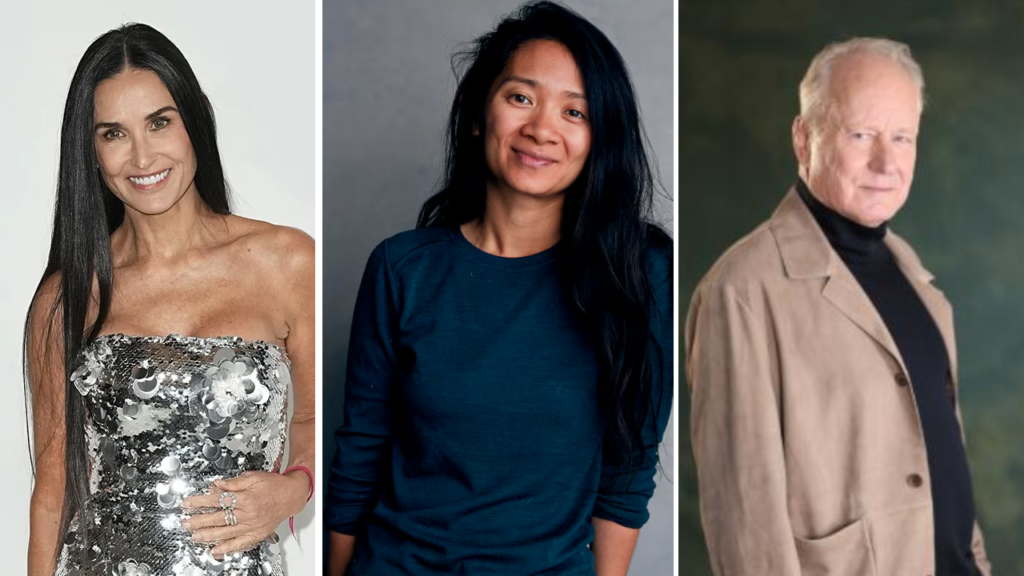
Among the newly revealed members are Demi Moore, Chloé Zhao and Stellan Skarsgård, alongside Ruth Negga, Laura Wandel, Diego Céspedes, Isaach De Bankolé and Paul Laverty. The composition brings together a wide spectrum of cinematic voices — from award-winning directors and screenwriters to actors with deep experience across both independent and mainstream cinema.
The inclusion of Demi Moore adds a compelling dimension to the jury, particularly following her recent return to the festival circuit with renewed momentum. Her presence reflects Cannes’ continued engagement with performers who have redefined their careers across different phases of the industry. Similarly, Chloé Zhao brings significant auteur weight to the panel, having established herself as one of the most globally respected filmmakers of her generation. Her journey from independent cinema to Academy Award-winning recognition positions her as a voice that bridges intimate storytelling with large-scale filmmaking.
Stellan Skarsgård’s addition further strengthens the jury’s international character. With a career spanning European cinema and major global productions, he represents a rare balance between artistic credibility and mainstream visibility. Together, these names anchor a jury that is not built around a single cinematic philosophy, but rather a convergence of perspectives shaped by different industries, cultures and storytelling traditions.
What stands out most about this year’s jury is its deliberate balance. The panel brings together actors, directors and a screenwriter, ensuring that films in competition will be evaluated from multiple creative vantage points — performance, direction and writing. Geographically, the representation stretches across continents, reinforcing Cannes’ long-standing identity as a truly global festival.
This group will be responsible for awarding the Palme d’Or, the festival’s highest honor, to one of the films competing in the main selection. With a line-up expected to feature some of the most prominent filmmakers working today, the role of the jury becomes even more significant. Their collective sensibility often shapes not just the outcome of the festival, but also the larger conversation around global cinema in the months that follow.
The completion of the jury also brings renewed focus to Park Chan-wook’s leadership. Already a towering figure in world cinema, his role as Jury President carries additional historical weight — marking a notable moment for Korean cinema on the global stage. With a filmmaker known for his precise visual language and thematic depth guiding the panel, the decision-making process is expected to lean toward strong authorial voices and distinctive storytelling.
With the full jury now in place, Cannes appears to be reinforcing a clear direction. This is not a panel assembled merely for star power, but one carefully constructed to reflect the evolving landscape of international cinema — where boundaries between industries are increasingly fluid, and storytelling voices are more diverse than ever.
As the festival approaches, the focus will naturally shift to the films themselves. But the composition of this jury ensures that whatever emerges as the Palme d’Or winner will carry the imprint of a group that represents not just different regions of cinema, but different ways of understanding it.
Read More:
- Beyond Hype: The 10 Indian Films Defining Anticipation in 2026
- When Beauty Becomes a Prison: The Eternal Relevance of Jalsaghar
- When Fiction Predicts Reality: Movies That Became Tru
- How much does responsibility seep into filmmaking? Or does it at all?
- Roger Corman: The King of Cult Cinema and His Enduring Legacy
- The Vanishing Art of Literary Adaptation in Indian Films