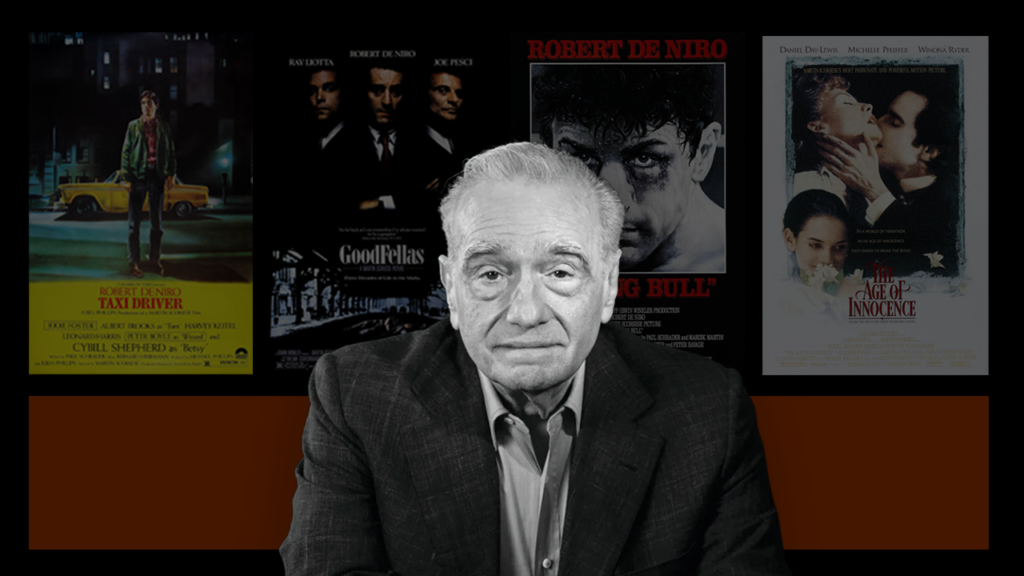
There are filmmakers who adapt literature, and then there is Martin Scorsese, who seems to translate the experience of reading itself into cinema. His films do not merely tell stories; they unfold like pages turned in the mind. The camera observes, but more importantly, it confesses. Characters do not just act, they narrate themselves, justify themselves, and sometimes unknowingly indict themselves, as if aware that they are being read.
This is why watching a Scorsese film often feels less like witnessing events and more like entering a consciousness. Whether it is the restless insomnia of Travis Bickle from Taxi Driver, writing his way through moral decay, or the quiet suffocation of desire in The Age of Innocence, his cinema, like the rhythm of literature, is reflective, interior, and deeply psychological. It is not just influenced by literature, it thinks like literature.
And perhaps that is the difference. While many directors borrow from books, Scorsese borrows from what books do to us, the intimacy of being inside a mind, the discomfort of confronting its contradictions, and the slow, inescapable realization that understanding a character does not mean forgiving them.
To understand Martin Scorsese as a filmmaker is to look beyond his stories and into how those stories are told. His cinema resists the external. It is not driven by plot as much as it is driven by perception, by the way a character sees the world, and more importantly, how they see themselves within it.
This is where his work begins to resemble literature. Not in adaptation, but in interiority.
Take Taxi Driver. The film does not unfold like a conventional narrative, it accumulates like a diary. Travis Bickle does not simply move through events, he documents them, filters them through his loneliness, his disgust, his fragile sense of purpose. The voice-over is not exposition, it is confession. And like many literary narrators, it is unreliable, revealing more about the fractures of the mind than the reality of the world.
Scorsese returns to this device repeatedly. In Goodfellas, Henry Hill narrates his rise and fall not with regret, but with seduction. The words draw us in even as the images betray them. This tension between what is said and what is shown mirrors the experience of reading a novel where the narrator cannot be fully trusted, where truth exists somewhere between voice and observation.
Even structurally, these films resist the clean arcs of conventional cinema. They drift, linger, return, much like memory itself. Time is not compressed for efficiency, it is expanded for immersion. Moments are allowed to breathe, not because they advance the plot, but because they deepen our access to a character’s inner life. In this sense, Scorsese’s cinema does not just depict characters, it reads them. And in doing so, it invites us to read alongside it, to question, to interpret, and sometimes, to doubt.
If literature offers us anything unique, it is the ability to enter a mind as it speaks to itself. Not to the world, not to an audience, but inwardly, in fragments, in justifications, in half-truths.
This is where Martin Scorsese finds his most powerful connection to literature. His characters are rarely observed from a distance, they are heard from within. They explain themselves, defend themselves, sometimes even perform for an invisible listener, as if aware that their lives must make sense when spoken aloud.
In Taxi Driver, Travis Bickle writes because he cannot exist without narrating his own decay. His words attempt order, but a mind trying to convince itself of purpose while slipping further into isolation. The act of narration becomes survival.
A similar pattern emerges in Raging Bull. Jake LaMotta does not articulate his thoughts in clean sentences, but his life unfolds like an unspoken confession. Violence becomes language. Regret arrives too late. And when self-awareness finally appears, it does not redeem him, it simply makes his downfall more visible.
What makes these characters feel literary is not complexity alone, but self-consciousness. They are not just living their lives, but in some sense, watching themselves live. And in that distance between action and awareness, something deeply human emerges, the need to explain oneself, even when explanation fails.
Scorsese understands this instinct intimately. His cinema does not ask us to judge these characters immediately, it asks us to listen first, to sit inside their version of truth, and then slowly recognize its fractures.
And yet, when Martin Scorsese turns to direct literary adaptation, something in his cinema changes. The urgency softens. The voice recedes. What remains is not the restless need to confess, but the quiet discipline of observing.
In movie The Age of Innocence, Scorsese does not impose himself loudly onto the material. Instead, he surrenders to its rhythm. The narration here does not feel like a character speaking, it feels like prose being remembered. Sentences arrive with a measured elegance, carrying emotions that the characters themselves are too restrained to express. Desire is not declared, it lingers in glances, in pauses, in what remains unsaid.
It is a different kind of interiority, one that does not erupt, but quietly accumulates.
A similar stillness defines movie Silence, based on 1966 novel of the same name. Here, the struggle is no longer between a man and society, but between a man and faith itself. The film moves with a meditative patience, allowing doubt to take form slowly, almost imperceptibly. Questions are not answered, they are endured.
What is striking in both these films is how Scorsese resists the temptation to dramatize. He does not translate literature into spectacle, he translates it into experience. The silences are not empty, they are filled with thought. The stillness is not passive, it is searching.
In doing so, Scorsese reveals something essential about his relationship with literature. He does not approach it as material to be reshaped, but as a language to be listened to. Perhaps this is why Martin Scorsese continues to feel so distinct, even in a medium built on images. His films are not satisfied with showing us what happens, they are compelled to understand why it feels the way it does to the person living it.
And that is a fundamentally literary instinct.
In his world, a man is never just his actions. He is his justifications, his contradictions, his silences, and the quiet stories he tells himself to keep going. The camera does not simply follow him, it listens to him, questions him, sometimes even doubts him. And in that process, we are drawn into an experience that feels less like watching and more like reading a life from the inside.
This is where Scorsese’s love for literature truly reveals itself, not in the books he adapts, but in the way his cinema refuses surface. It searches for interiority, for moral tension, for the fragile space between who we are and who we believe ourselves to be.
Because in the end, Scorsese does not just make films about people. He makes films about the stories people tell themselves and what remains when those stories begin to fall apart.
Read More: