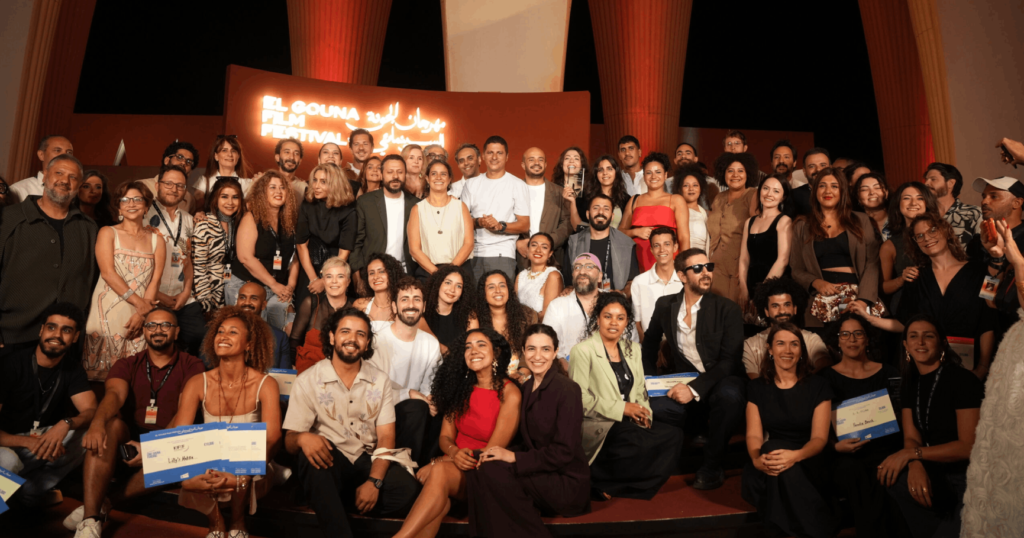
The ninth edition of the El Gouna Film Festival closed on October 23 with awards recognising films from Egypt, Palestine, Lebanon and beyond, while its industry programme distributed more than $350,000 in financial and in-kind support to film projects. The closing results offered a snapshot of the stories emerging from the region, but the festival’s broader agenda extended beyond its competition selections. Through expanded development programmes, industry meetings and initiatives for emerging and displaced filmmakers, El Gouna is seeking to establish itself as a year-round platform for Arab cinema.
Mohammed Hammad’s Safe Exit, a psychological drama about a young Coptic security guard in Cairo confronting trauma rooted in religious violence, won the Golden Star for Best Narrative Feature. Ahmed Hassouna’s Citizen Osama, which follows a Gaza photojournalist balancing his professional responsibilities with family life amid war, received the Golden Star for Best Documentary Feature and the award for Best Arab Documentary. Hassouna remained in Gaza during the festival, underscoring the difficult circumstances in which some filmmakers from the region continue to work.
Anders Davidsen’s Stolen Memories, about an 18-year-old who begins questioning his past after discovering childhood photographs, won the Golden Star for Best Short Film. Rakan Mayasi’s Yesterday the Eye Didn’t Sleep, set in Lebanon’s Bekaa Valley, was named Best Arab Narrative Film, while Marie Rose Ousta’s One Day Born, about an 11-year-old boy living under the constant threat of warplanes in Lebanon, won Best Arab Short Film. Jordanian actress Rakeen Saad received the Best Actress award for Boomah, while Jovan Ginić won Best Actor for Miroslav Terzić’s 3 Weeks After.
The selection of winning films brought together stories about conflict, trauma, family, memory and identity. Their recognition also reflected the festival’s commitment to presenting narratives rooted in specific communities while engaging with experiences that extend beyond national boundaries. That emphasis is consistent with the festival’s founding theme, Cinema for Humanity, which places cultural exchange and the ability of cinema to connect people at the centre of its mission.
Yet the closing awards represented only one part of the ninth edition’s wider activity. CineGouna, the festival’s industry platform, distributed more than $350,000 across 40 financial and in-kind awards to 16 film projects selected from 19 projects competing in its funding programme. The support covered development, post-production and distribution, while participating filmmakers held more than 140 individual meetings with companies, institutions and international festivals.
The figures underline the increasing importance of CineGouna to the festival’s identity. Rather than limiting its role to screening completed films, El Gouna is building a structure intended to help projects progress through different stages of development and production. Its industry activities now include CineGouna Funding, the CineGouna Forum, CineGouna Market and CineGouna Emerge, alongside new programmes for Egyptian filmmakers, displaced professionals and television projects.
“We want the industry to be our hero,” co-founder and executive director Amr Mansi said ahead of the ninth edition. The statement captures a shift in emphasis: the festival’s ambition is not simply to bring filmmakers together for nine days, but to create professional connections that continue after participants leave El Gouna.
CineGouna Funding remains central to that effort. The programme offers financial grants and services intended to help selected projects advance, while its meetings with potential partners give filmmakers opportunities to discuss financing, production and distribution. The ninth edition also introduced Egyptian Voices, a development initiative that selected four Egyptian projects and offered tailored training in pitching, packaging and co-production. The programme is designed to help filmmakers refine their projects and improve their prospects of securing industry partners.
The expansion comes against a backdrop of changing production activity in Egypt. Figures cited by the country’s Chamber of Cinema Industry show that Egypt produced 112 films in 1988, compared with just 16 in 1998. Production subsequently rose to 51 feature films in 2022 and 67 in 2023. Although the increase indicates renewed activity, industry professionals argue that production numbers alone cannot guarantee a sustainable film sector. Stronger screenplays, better distribution planning, more effective financing and closer collaboration between established professionals and emerging filmmakers remain important challenges.
Syrian producer Mohamed Mashish, who produced the Egyptian drama Grand Hotel, released internationally on Netflix as Secret of the Nile in 2018, has argued that Egyptian cinema needs to devote more time to screenplay development. While Egypt has the technical infrastructure and creative talent required to make films, he believes stronger writing is essential to improving the quality of its output. He also sees younger filmmakers as increasingly open to different storytelling approaches, partly because streaming platforms and the internet have broadened their exposure to international cinema.
Director Hadi El Bagoury, whose Hepta: The Last Lecture became the highest-grossing romantic film in Egyptian cinema, has similarly highlighted the influence of streaming on audience expectations. Greater access to international content has introduced viewers to new stories, genres and directors, making them more selective about what they watch. He has also pointed to changes in Saudi Arabia and the wider Gulf region, where the expansion of cinemas has increased access to international films.
Lebanese producer and distributor Ziad Srouji, whose credits include Palestine 36, has argued that culturally specific stories can travel internationally without imitating Western cinema. Films with a clear identity, in his view, have a stronger chance of connecting with audiences across different markets than projects built around generic narratives. He also stresses that distribution planning should begin early in a film’s development, with filmmakers considering sales agents, delivery materials and market positioning well before a festival premiere.
These concerns give CineGouna’s development and market activities a wider significance. A festival screening can attract attention, but it does not guarantee financing for a filmmaker’s next project or ensure that a completed film will reach audiences. The longer-term objective is to help create conditions in which filmmakers can move more consistently from development to production and distribution, rather than repeatedly struggling to secure support for a first or second feature.
CineGouna’s expansion into television development addresses a related gap in the regional industry. The inaugural CineGouna Series programme selected six Arab projects for a development lab and industry market, giving their creators opportunities to pitch their work and meet potential partners. Screenwriter and producer Mariam Naoum, who led the six-week lab, has highlighted the limited number of platforms available to Arab television creators. With fewer outlets competing for new projects, writers and producers can face difficulties finding buyers willing to support development and production.
The programme seeks to give projects a more structured route towards potential industry partners. Its introduction also reflects the growing overlap between film and television development, as writers, directors and producers work across formats while competing for a limited pool of financing and distribution opportunities. By extending its activities beyond feature films, CineGouna is attempting to respond to a broader range of professional needs across the region’s screen industries.
Support for filmmakers affected by conflict and displacement has also become part of the festival’s industry agenda. Safe Harbour MENA, launched in partnership with the International Film Festival Rotterdam and the International Emerging Film Talent Association, brought four filmmakers displaced within the region into a programme of training, project development and industry networking. The initiative focuses on helping participants maintain professional connections and continue developing their work in difficult circumstances.
The recognition of Citizen Osama at the closing ceremony gave that commitment a direct connection to the films in competition. The documentary’s focus on a Gaza photojournalist balancing work and family life amid war brought the realities of conflict into the festival’s awards programme. Its director’s continued presence in Gaza also highlighted the distance between the professional opportunities offered by an international festival and the circumstances in which some filmmakers are attempting to sustain their careers.
The festival’s wider mission extends beyond the professional industry. Its organisers have sought to make El Gouna a platform for cultural exchange and to expand access to films beyond the resort town itself. Cinema on Wheels, an initiative taking three short films from the festival programme on a free screening tour through Hurghada, Minya, Qena, Luxor and Aswan before concluding in Cairo, is intended to bring selected films to audiences elsewhere in Egypt. The screenings are accompanied by discussions, giving audiences an opportunity to engage with the work beyond the viewing experience.
The initiative addresses a question that also shapes the future of Egyptian cinema: how to make films accessible to local audiences while creating opportunities for international circulation. El Bagoury has argued for more Egyptian-owned platforms and affordable cinema tickets, pointing to the need for filmmakers to reach audiences at home as well as abroad. Distribution planning, audience access and the availability of exhibition outlets remain essential parts of the wider ecosystem that CineGouna is trying to strengthen.
The festival’s own evolution provides context for these ambitions. Founded in 2017 by Samih Sawiris, Naguib Sawiris, Amr Mansi, Bushra Abdallah Rozza and Kamal Zadeh, GFF began as an effort to establish a cinematic meeting point on Egypt’s Red Sea coast. Its mission is to showcase cultural diversity through film, support emerging filmmakers and foster professional connections across the MENA region. Its vision is to amplify young filmmakers’ voices and contribute to an industry that reflects the region’s diverse stories and perspectives.
Preparations for the ninth edition offered a visible reminder of how much work takes place behind the annual event. Before the Festival Plaza was ready, workers were installing lighting, arranging exhibition spaces and moving furniture, while organisers dealt with last-minute changes and travel disruptions. Beyond the plaza, El Gouna retained its character as a coastal resort town, but the festival’s activity extended into its cafés, offices and public spaces. The preparations reflected an institution that has spent nearly a decade building, adjusting and expanding its operations.
The festival’s leadership and teams now span programming, operations, guest relations, marketing and the various CineGouna initiatives. Its International Advisory Board includes figures from across cinema, among them actress Yousra, director Yousry Nasrallah, actress and director Hiam Abbass, filmmaker Abderrahmane Sissako and producer Tarak Ben Ammar. Artistic director Andrew Mohsen has described the ninth edition as an effort to broaden the festival across its film selection, industry programmes and partnerships, bringing a wider range of stories and perspectives into the event.
That approach was reflected in the programme’s emphasis on Arab cinema, including 10 Arab films, the highest number in the festival’s history at the time. The Window on Palestine programme returned for a fourth consecutive year, while discussions marking the tenth anniversary of Egyptian filmmaker Mohamed Khan’s death examined his work and legacy. These elements connected the festival’s contemporary selection to the broader histories and social contexts that have shaped filmmaking in the region.
The closing ceremony marked the end of nine days of screenings and industry activity, but the festival’s stated ambitions extend well beyond that period. Its next chapter will be shaped not only by the films it selects or the awards it distributes, but also by whether its programmes help filmmakers secure financing, sustain careers and reach audiences across Egypt and the wider MENA region. After nine editions, El Gouna Film Festival is working to establish itself not simply as an annual cinematic meeting point, but as a continuing platform for the development and circulation of Arab cinema.