Patrick Stewart’s decision to play the villain in Green Room did more than give the 2015 horror-thriller one of its most unsettling performances. It helped save the film from being abandoned. Director Jeremy Saulnier recently revisited that crucial turning point during a 10th-anniversary screening in Los Angeles, where a tribute to the late actor became a personal account of how close the production came to shutting down before filming could properly begin.
Saulnier had been preparing to shoot the film in Oregon, with sets already under construction, but one crucial role remained unfilled. The production was struggling to find an established actor for Darcy Banker, the leader of the violent white supremacist group at the centre of the story. With the production timeline tightening and the sets already taking shape, the absence of a suitable actor threatened to derail the entire project.
Saulnier recalled reaching a point where he was leaving the set believing that the production might have to dismantle everything. The situation appeared increasingly difficult, and the possibility of abandoning the film was becoming real. Then, unexpectedly, Patrick Stewart expressed interest in playing the role.
Stewart signed on shortly before filming began. His involvement helped secure the film’s green light and gave the production the momentum it needed to move forward. Reflecting on just how significant the actor’s decision had been, Saulnier put it plainly at the anniversary screening: “Patrick Stewart is why I still can make movies.”
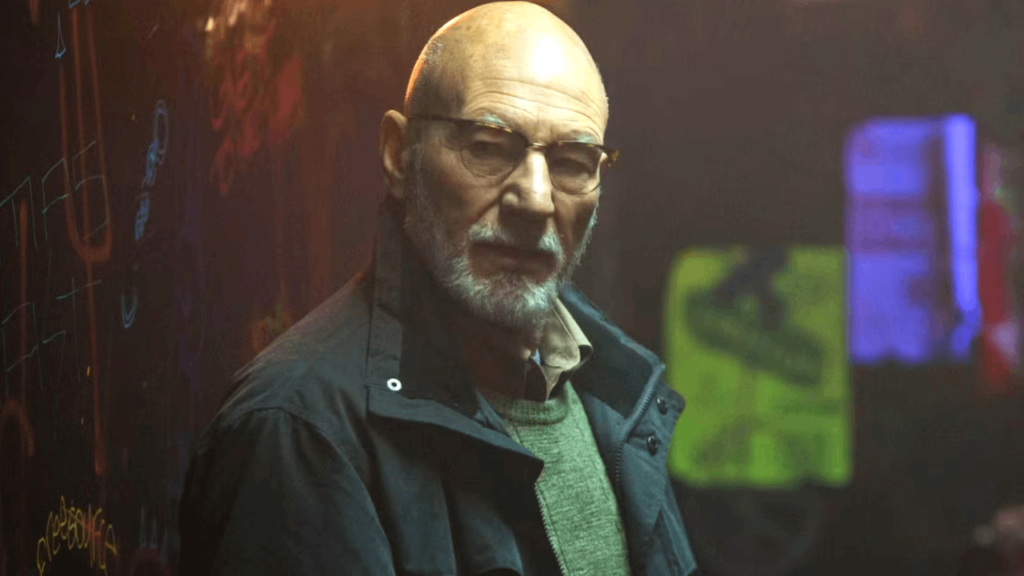
For audiences, Stewart was closely associated with principled and morally upright characters, most notably Captain Jean-Luc Picard in Star Trek and Professor Charles Xavier in the X-Men films. Darcy Banker, however, was almost their complete opposite. Rather than portraying an openly aggressive or theatrical villain, Stewart played a controlled, calculating leader whose quiet authority made him particularly disturbing.
The contrast between the actor’s established screen persona and the character’s disturbing worldview became one of the film’s most effective casting decisions. Stewart understood the appeal of stepping into unfamiliar territory. In an earlier interview, he explained that the character’s wickedness was what seduced him into accepting the role. His interest in exploring such a morally dark personality brought an unexpected dimension to the film, giving Green Room a recognisable face while challenging audience expectations.
Saulnier’s recent recollections also highlighted the difference between Stewart’s screen presence and the person the director encountered during production. Despite playing a deeply unsettling character, Stewart was, according to Saulnier, a “true gentleman” and a sweetheart. The director also remembered him as a kind leader to the cast, demonstrating a generosity that stood in sharp contrast to the character he portrayed.
That distinction was particularly meaningful on a production built around tension, violence and discomfort. Green Room follows a punk band that becomes trapped at a remote venue after witnessing a murder. What begins as a performance at an unfamiliar location quickly turns into a fight for survival as the musicians find themselves surrounded by violent extremists. Darcy Banker directs the threat from inside the club, making him a central figure in the escalating confrontation.
Stewart’s restrained performance helped establish the atmosphere of menace that drives the story. Rather than relying on exaggerated expressions or loud displays of aggression, he brought an unsettling calmness to Darcy. The character’s authority comes from the way others respond to him, and Stewart’s performance reinforces that dynamic throughout the film.
Saulnier also shared a lighter memory from the production, offering a glimpse of Stewart’s understanding of the film’s unconventional tone. During filming, the actor approached the director and said that he wanted to add something to a scene. Saulnier initially expected a substantial change to the dialogue or a more elaborate suggestion. Instead, Stewart’s request was surprisingly simple: he wanted to look towards the camera and say one word, “Fuck!”
Saulnier immediately agreed to the suggestion. He recalled that the moment demonstrated Stewart’s understanding of the film’s rough, punk-rock spirit and his ability to recognise exactly what suited its style. It was a small creative contribution, but one that reflected the actor’s willingness to engage with the film beyond simply delivering his lines.
Released in 2015, Green Room also stars Anton Yelchin, Imogen Poots, Alia Shawkat and Joe Cole. The film’s casting history offers an additional perspective on why Stewart’s performance feels so effectively placed within the story. Darcy is not written as a loud, theatrical monster. His influence comes from his composure, the fear he inspires and the unquestioning authority he exercises over those around him. Stewart understood that distinction and delivered a performance that relied on restraint rather than spectacle.
His involvement ultimately meant more than securing a prominent name for the production. It helped keep Saulnier’s film alive at a moment when its future was uncertain. His casting also gave the film an unexpected centre of gravity, allowing audiences familiar with his earlier work to encounter him in a role that deliberately challenged their expectations.
At the 10th-anniversary screening, Saulnier asked the audience to applaud when Stewart’s one-word addition appeared on screen, turning the recollection into a moment of collective appreciation for the actor. He concluded with a reminder that reflected both Stewart’s performance and the film’s unmistakable moral position: “Whatever you do, don’t root for the Nazis.”
For Saulnier, Stewart’s decision to join Green Room remains a defining moment in the film’s history. What began as a difficult casting problem became an opportunity that helped save the production and gave audiences one of the actor’s most memorable departures from his familiar screen persona.