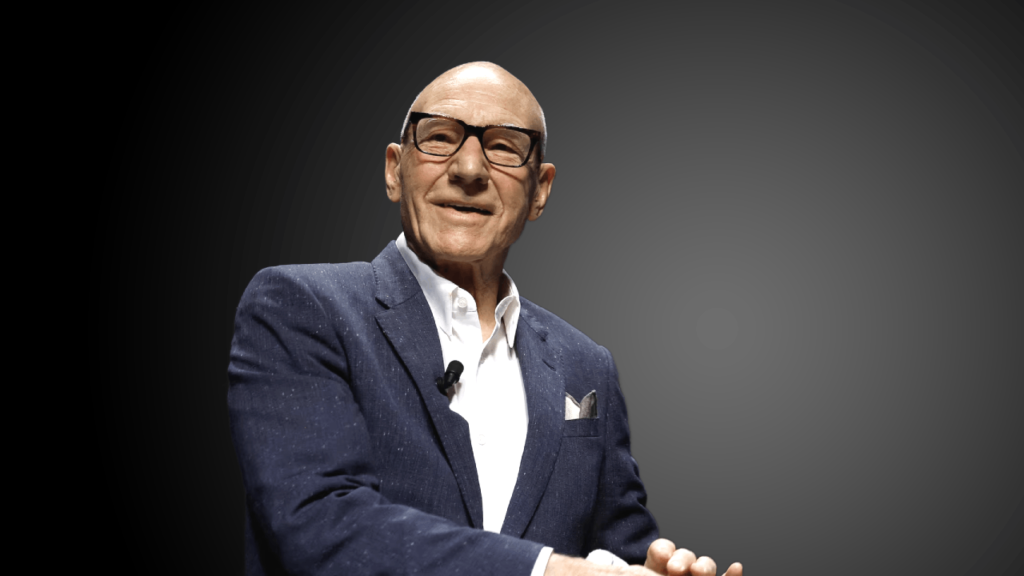
Sir Patrick Stewart, the British actor whose distinguished career spanned Shakespearean theatre, television, film and popular culture, has died at the age of 86. Best known internationally for playing Captain Jean-Luc Picard in Star Trek: The Next Generation and Professor Charles Xavier in the X-Men franchise, Stewart built a body of work that extended far beyond the two characters that introduced him to generations of audiences.
Stewart died on October 28, 2026, at his home in Los Angeles. His death was announced the following day through a statement shared on his social media accounts. The statement said that he had experienced a brief illness involving Alzheimer’s disease and Lewy body dementia. His wife, singer-songwriter Sunny Ozell, was with him.
The announcement also acknowledged his contributions beyond acting, including his support for human rights, survivors of domestic violence, refugees, veterans’ mental health services and animal welfare. His professional achievements were matched by a commitment to causes that remained important throughout his life.
Stewart occupied an unusual place in modern entertainment. He was an established classical stage performer before American television made him internationally recognisable. His interpretation of Picard gave Star Trek a commanding and intellectually grounded central figure, while his portrayal of Professor Xavier brought a similar sense of authority and moral conviction to the X-Men films. Yet neither role fully represented the range of his work. He continued to perform Shakespeare, appeared in comedies and dramatic films, lent his voice to animation and video games, and repeatedly returned to the stage.
His final on-screen appearance will also be seen after his death. Stewart is set to reprise Professor Charles Xavier in Marvel Studios’ Avengers: Doomsday, scheduled for release on December 18, 2026. Ian McKellen will also return as Magneto, bringing the two actors together once again in the franchise that became one of the most recognisable collaborations of their careers. Marvel has confirmed that the film will mark Stewart’s final on-screen appearance.
Born Patrick Hewes Stewart on July 13, 1940, in Mirfield, Yorkshire, England, he developed an interest in acting during his youth. He participated in amateur drama societies in the region and left school at the age of 15. His early working life included a period as a newspaper reporter, but he eventually chose acting over journalism.
Stewart began his professional career at Manchester’s Library Theatre before joining the Royal Shakespeare Company in 1966. That association became a defining part of his professional development and established him as a performer with a strong foundation in classical theatre. During his years with the company, he appeared in numerous productions, taking on roles that demanded a command of Shakespearean language and complex characterisation. His performances included Astrov in Uncle Vanya in 1974, Oberon in A Midsummer Night’s Dream in 1977, Shylock in The Merchant of Venice in 1978 and the title role in Titus Andronicus in 1981.
These performances formed the foundation of a career that would eventually take him into international television and cinema. His stage experience also shaped the qualities audiences would later associate with his screen work: a controlled delivery, a distinctive voice, an ability to command attention through dialogue and a preference for characters whose authority came from their understanding of the world around them.
Stewart’s theatrical career did not end when he became a television star. Even during his years on Star Trek: The Next Generation, he continued to appear on stage. His performance as George in Who’s Afraid of Virginia Woolf? at the Young Vic in 1987 was among his significant theatre appearances. He later returned to the role at the Guthrie Theater in Minneapolis in 2001.
He also adapted Charles Dickens’ A Christmas Carol into a one-man stage production, performing it on several occasions in Los Angeles and on Broadway. The production demonstrated his ability to sustain a performance through language and characterisation without the support of a conventional ensemble.
Stewart’s international profile changed dramatically in 1987 when he was cast as Captain Jean-Luc Picard in Star Trek: The Next Generation. The series introduced a new generation of characters and a new captain for the Enterprise, placing Stewart at the centre of a franchise with an established global following. It ran for seven seasons, concluding in 1994.
His portrayal of Picard became one of the defining performances in the history of the franchise. Rather than relying primarily on the physical authority traditionally associated with a science fiction captain, Stewart’s interpretation placed considerable emphasis on intellect, diplomacy, reason and moral responsibility. Picard was a leader who frequently confronted difficult ethical questions and preferred discussion and negotiation to unnecessary conflict. Stewart’s measured performance gave the character a distinctive presence, allowing him to command the Enterprise through language, judgment and conviction. His classical theatre training was particularly evident in the character’s formal delivery and the importance placed on dialogue.
The New York Times, assessing Stewart’s contribution to the series, described Picard as the moral centre of Star Trek: The Next Generation. The publication highlighted how the actor’s combination of stern authority and seriousness of purpose helped the programme maintain its dramatic identity across seven seasons.
The role also changed the direction of Stewart’s career. He had spent much of the preceding two decades working in British theatre, with occasional appearances in film and television. Star Trek introduced him to a much larger international audience and established him as a recognisable figure in American popular culture.
Stewart continued playing Picard after the television series concluded. He reprised the character in Star Trek: Generations (1994), which brought him together on screen with William Shatner’s Captain James T. Kirk, followed by Star Trek: First Contact (1996), Star Trek: Insurrection (1998) and Star Trek: Nemesis (2002). More than a decade after his last appearance as Picard in a feature film, Stewart returned to the franchise through Star Trek: Picard. The series ran from 2020 to 2023, offering another chapter in the character’s life and allowing the actor to revisit a role that had become inseparable from his screen identity.
Stewart found another defining screen character in Professor Charles Xavier, making his debut in Bryan Singer’s X-Men in 2000. The film introduced him as the founder and mentor of the X-Men, a group of mutants seeking acceptance in a world that feared and misunderstood them.
Xavier’s belief in coexistence and peaceful engagement placed him in direct ideological opposition to Magneto, played by Ian McKellen. Their relationship became one of the central elements of the franchise, with Stewart and McKellen bringing a theatrical dimension to the conflict between the two characters. The casting brought together two actors with substantial experience in classical theatre. Their performances gave the relationship between Xavier and Magneto a foundation beyond the usual hero-and-villain dynamic. The characters were old friends whose differing responses to prejudice and persecution had taken them in opposing directions.
Stewart reprised Xavier in X2: X-Men United (2003), X-Men: The Last Stand (2006), X-Men Origins: Wolverine (2009), The Wolverine (2013), X-Men: Days of Future Past (2014) and Logan (2017). He also appeared as the character in Doctor Strange in the Multiverse of Madness (2022).
His performance in Logan offered a particularly different perspective on Xavier. The film presented an ageing and vulnerable version of the character, moving away from the familiar image of the composed mentor. Stewart’s portrayal brought emotional weight to a figure whose earlier appearances had largely been defined by wisdom and authority.
The character also became part of Stewart’s final chapter in cinema. Marvel Studios confirmed his return as Xavier in Avengers: Doomsday, with McKellen also reprising Magneto. The upcoming film will bring the actors together again, more than two decades after their first appearance as the two central figures of the X-Men films. Marvel Studios and Kevin Feige paid tribute to Stewart following his death, recognising his contribution to the franchise and the qualities he brought to Xavier. His return in Avengers: Doomsday will be a posthumous screen appearance and his final confirmed on-screen performance.
The professional association between Stewart and McKellen developed into a close friendship that extended well beyond their work in the X-Men films. Their contrasting performances as Xavier and Magneto made them central to the franchise, but their shared interest in theatre also brought them together away from the screen.
The two actors appeared in Samuel Beckett’s Waiting for Godot in London’s West End in 2009. They returned to Broadway in 2013–14, performing the Beckett play alongside Harold Pinter’s No Man’s Land in repertory. Their partnership was also visible in their personal lives. McKellen officiated at Stewart’s 2013 wedding to Sunny Ozell. The relationship between the two actors became one of the most widely recognised friendships to emerge from the X-Men films.
Their final screen reunion in Avengers: Doomsday carries additional significance following Stewart’s death. Audiences will see them together again as Xavier and Magneto, extending a collaboration that began with the first X-Men film in 2000 and continued through their stage work.
Although Stewart became internationally identified with science fiction and superhero cinema, his filmography included a wide range of roles. His early appearances in fantasy and science fiction included John Boorman’s Excalibur (1981), in which he played Leondegrance, and David Lynch’s adaptation of Frank Herbert’s Dune (1984), where he portrayed Gurney Halleck.
He also demonstrated a willingness to explore comedy. In Steve Martin’s L.A. Story (1991), he played a comically snooty waiter, while Mel Brooks’ Robin Hood: Men in Tights (1993) cast him as King Richard. His performance in the 1995 comedy Jeffrey demonstrated another side of his screen presence. Playing a flamboyant character associated with an anti-gay-bashing group, Stewart brought a combination of comic timing and theatrical delivery to the role.
His later film work included Match (2014), based on Stephen Belber’s play, in which he played a vain and flamboyant dance instructor. He also appeared in Jeremy Saulnier’s horror-thriller Green Room (2015), taking on the role of a neo-Nazi group leader. The performance was a considerable departure from the dignified authority associated with Picard and Xavier. These roles reflected an actor who was comfortable moving between genres and was not interested in remaining within the boundaries of the characters that had made him famous.
Stewart’s television work began well before Star Trek. His early British credits included the 1975 BBC miniseries North & South, adapted from Elizabeth Gaskell’s novel, and I, Claudius, in which he played Sejanus. Between 1981 and 1983, he starred in the BBC series Maybury as a psychiatrist working at a hospital.
His American television career also included Blunt Talk, a comedy series in which he played an English news presenter who moves to Los Angeles to host a talk show. The role allowed him to explore a more exaggerated comic character, far removed from the restraint associated with Picard.
He lent his voice to animated series including The Simpsons, Family Guy and American Dad!, demonstrating an ease with comedy and voice performance. His narration work included Seth MacFarlane’s Ted and its sequel. He also lent his voice to video games connected with the Star Trek and X-Men franchises. One of his more recent voice roles was Sir Ritchfield in the animated film The Sheep Detectives, adding another entry to a career in which his distinctive voice became an important part of his professional identity.
Despite his success in television and film, Stewart continued to regard theatre as a central part of his career. After Star Trek: The Next Generation concluded, he increased his stage appearances, returning to productions that drew on the classical repertoire.
He played Prospero in a Broadway production of The Tempest in 1996 and appeared in a production of Othello at the Shakespeare Theatre in Washington, D.C., in 1997. His Broadway work also included The Ride Down Mt. Morgan in 2000. In Britain, he returned to productions of Antony and Cleopatra, The Tempest and Macbeth. His performance in Macbeth was particularly notable as a return to the Shakespearean theatre that had shaped his early career. The New York Times captured this contrast in a headline about his return to classical theatre: “To Boldly Go Where Shakespeare Calls.”
Stewart also appeared as Claudius in a 2008 production of Hamlet starring David Tennant. His performance earned him an Olivier Award for Best Supporting Actor. The recognition reinforced his standing as a stage performer even as his screen roles continued to attract international attention. His later stage work with McKellen further demonstrated the importance of theatre to his career. Their productions of Waiting for Godot and No Man’s Land brought together two actors whose screen fame had not diminished their commitment to live performance.
Stewart’s career received recognition across theatre, television and recording. He was nominated for four Emmy Awards and received Olivier Awards for his stage performances. He was also nominated for a Tony Award. His spoken-word recording of Prokofiev: Peter and the Wolf earned him a Grammy Award, reflecting another aspect of his work with language and performance. In 2010, he was knighted for services to drama, becoming Sir Patrick Stewart. He also served as Chancellor of the University of Huddersfield.
Stewart’s public life included sustained support for social and humanitarian causes. The statement announcing his death highlighted his work on behalf of human rights, survivors of domestic violence, refugees, veterans’ mental health services and animal welfare.
His advocacy for survivors of domestic violence was connected to his own experience of growing up in a household affected by violence. He spoke publicly about the issue and supported efforts to raise awareness and provide assistance to those affected. Animal welfare was another cause close to him, particularly the fostering and care of pit bulls. His support for these animals formed part of a wider interest in animal welfare.
Outside his professional and charitable commitments, Stewart was a lifelong supporter of Huddersfield Town football club and had a strong interest in motorsport. These aspects of his life offered a glimpse of the person beyond the screen characters recognised by millions of viewers.
Stewart was married three times. His first marriage was to choreographer Sheila Falconer, with whom he had two children, Sophie and Daniel Stewart. His second marriage was to Wendy Neuss, a producer associated with Star Trek: The Next Generation. He married singer-songwriter Sunny Ozell in 2013, with Ian McKellen officiating at the ceremony. Ozell was with him at his home in Los Angeles when he died. His survivors include his wife and his two children from his first marriage.
Patrick Stewart’s career cannot be defined by a single franchise or performance. Captain Jean-Luc Picard and Professor Charles Xavier brought him to audiences across generations, but the actor behind those characters had spent decades developing his craft on stage before either role came along.
His career moved between Shakespeare and science fiction, superhero films and comedy, television drama and animation. He remained connected to theatre even after becoming one of the most recognisable faces in popular entertainment, returning to classical productions and continuing to perform live alongside his screen commitments.
Stewart brought a distinctive combination of theatrical discipline, intellectual authority and emotional restraint to his best-known characters. His performances as Picard and Xavier gave two major franchises figures whose influence came as much from their ideas and convictions as from their positions of leadership.
His final appearance as Professor X in Avengers: Doomsday will give audiences one more opportunity to see him in a role that became central to his later career. Yet his legacy extends well beyond that farewell. From the stages of the Royal Shakespeare Company to the bridge of the Enterprise and the world of the X-Men, Patrick Stewart built a career that connected classical performance with contemporary popular culture.