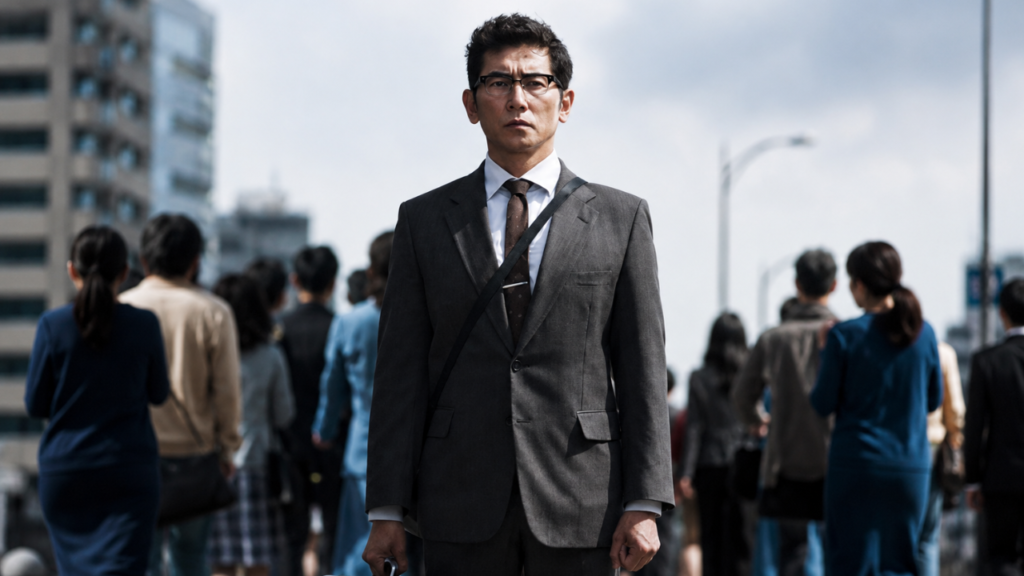
The Man Who Carries the Voice of August, a Japanese drama about a journalist preserving the testimonies of atomic-bomb survivors, will arrive in cinemas across Japan on August 21, 2026. The film expands on a one-part NHK television drama that originally aired in August 2025, adding scenes that were not included in the broadcast and giving greater depth to its central characters.
Set in 1972, the film follows Tamotsu Tsujihara, played by Masahiro Motoki, a journalist who leaves a broadcasting station in Nagasaki and travels across Japan carrying recording equipment. His purpose is to document the memories and experiences of people who survived the atomic bombings and preserve their voices for future generations.
The story is based on the real-life work of journalist Akihiko Ito, who spent much of his life recording the testimonies of atomic-bomb survivors. Ito travelled across Japan and recorded the experiences of more than 1,000 survivors, creating an extensive record of memories that could otherwise have disappeared with the passing of time. His work provides the historical foundation for the film’s story about memory, testimony and the responsibility of preserving personal histories.
The film also introduces a personal mystery through Kazuhei Kuno, played by Sadao Abe. Kuno is a survivor from Nagasaki who continues to live with the effects of the bombing. Having kept his memories largely to himself, he begins speaking about his past after meeting Tsujihara. His testimony has a profound effect on the journalist, while questions surrounding the “voice” Kuno shares add another layer to the historical drama.
The choice of August in the film’s title carries a direct historical connection. The atomic bombings of Hiroshima and Nagasaki took place on August 6 and August 9, 1945, but the film’s focus extends beyond those events themselves. It examines what remained afterward—the memories carried by survivors and the effort to ensure that those experiences are not lost with time.
The project originally premiered as a one-part NHK television drama in August 2025, created as part of programming marking 80 years since the end of World War II. The television production subsequently received several honours, including the 2025 August Galaxy Award Monthly Prize, the 34th Hashida Award, the Broadcasting Culture Foundation Drama Encouragement Award and the 63rd Galaxy Award Television Division Grand Prize. These recognitions were awarded to the original television drama rather than the upcoming theatrical version.
The move from television to cinemas is therefore more than a simple re-release. The theatrical version contains additional scenes that were not part of the broadcast, allowing the characters and their experiences to be explored in greater depth. It will also be presented with 5.1-channel surround sound, giving the recorded voices and quieter moments a different cinematic setting.
Motoki leads the cast as Tsujihara, with Abe playing Kuno. Shizuka Ishibashi stars as Miyako Tachibana, a cabaret hostess whose family history is connected to the bombing’s survivors. Aoi Ito plays Kuno’s sister, while Machiko Ono portrays Yukie Egi, a welfare worker who supports survivors and helps Tsujihara meet Kuno. Tetsushi Tanaka plays Tsujihara’s old friend Mitsuru Kagawa. The film is directed by Takeshi Shibata, with Shunsaku Ikebata writing the screenplay.
The production also sought to connect the performances directly with the historical experiences behind the story. Before filming, Abe listened to recordings of people who had experienced the war, including some of Ito’s original recordings. Hearing the survivors’ voices gave him a greater understanding of the difficulty involved in portraying such experiences through acting and informed his performance as Kuno.
With its August 21 theatrical release, The Man Who Carries the Voice of August brings a story about preserving personal testimony to the big screen more than eight decades after the atomic bombings. By expanding the original television drama and placing greater emphasis on its characters and their memories, the film continues its central concern: how the experiences of those who lived through history can be recorded, remembered and passed on to another generation.
Read More: