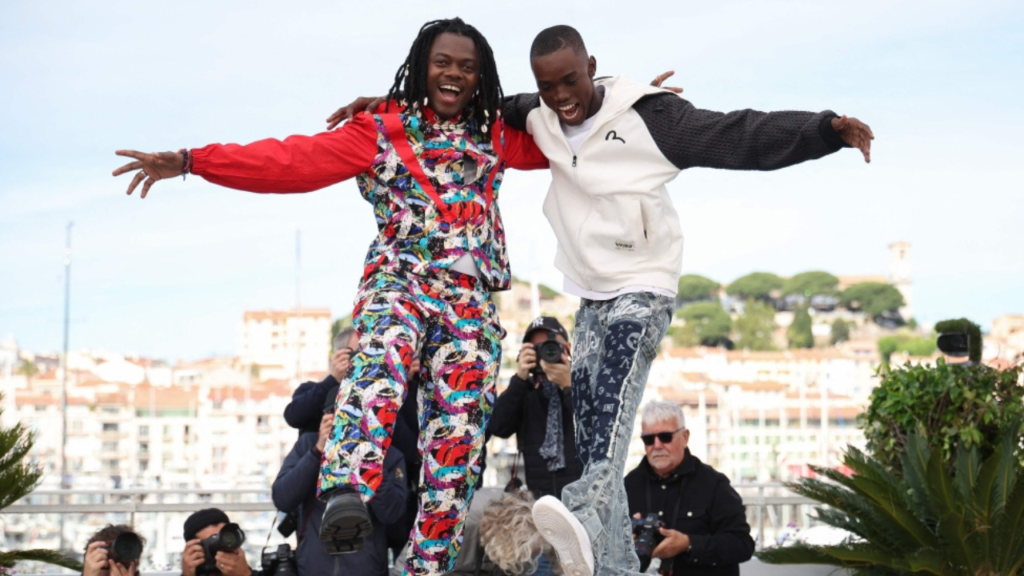
Rafiki Fariala’s Congo Boy has brought its deeply personal story of displacement, family and survival to the 79th Locarno Film Festival, where the acclaimed musical refugee drama screened on the festival’s Piazza Grande. The film’s Locarno appearance follows its world premiere in the Un Certain Regard section of the Cannes Film Festival earlier this year, where it became the first Central African film selected for the section and earned a Best Actor award for its lead, Bradley Fiomona Dembeasset.
The film follows Robert, a 17-year-old Congolese refugee living in Bangui, the capital of the Central African Republic. When his parents are imprisoned following a bureaucratic dispute involving their identity documents, Robert is left responsible for his four younger siblings. He must balance that responsibility with his education while pursuing his dream of becoming a musician, performing his own songs in Bangui nightclubs under the stage name Congo Boy.
Although the story is fictional, Robert’s circumstances are closely connected to Fariala’s own life. The filmmaker has spoken about his family’s experience of fleeing the Democratic Republic of Congo because of war and moving to the Central African Republic in search of safety, only to encounter another conflict after arriving there. His family later considered moving to Benin and eventually Europe in search of greater stability, but problems with their passports and refugee documentation led to his parents being arrested.
That personal history gives Congo Boy a perspective on displacement that Fariala wanted to bring to the screen. Rather than focusing on the familiar narrative of refugees travelling from Africa toward Europe, the film explores inter-African migration, following a Congolese family displaced to a neighbouring African country. The possibility of eventually reaching Europe remains part of Robert’s wider story, but the film begins by examining displacement within Africa itself.
The film’s journey through the festival circuit has already given it considerable international attention. At Cannes, Congo Boy received a standing ovation following its premiere, while Dembeasset won the Un Certain Regard Best Actor award for his portrayal of Robert. Its selection also marked a milestone for Central African cinema, making it the first film from the region to screen in Cannes’ Un Certain Regard section.
Fariala’s own filmmaking journey makes the film’s subject even more closely connected to his career. His earlier work, We, Students!, was banned in the Central African Republic, forcing him into exile in France. He continued developing his filmmaking career there before making Congo Boy as his fiction feature debut.
Music is central to the film’s identity as well as to Robert’s ambitions. His performances as Congo Boy become part of the character’s attempt to find a sense of possibility while dealing with responsibilities that would ordinarily be far beyond those expected of a teenager. The film therefore combines its refugee story with a coming-of-age narrative built around Robert’s relationship with music.
Fariala co-wrote the screenplay with Tommy Baron and Boris Lojkine, while the music was co-written by Fariala and Lillo Morealle. The film is produced by Vicky Nelson Wackoro, Dieudo Hamadi and Caroline Nataf, with Adrien Lallau serving as cinematographer and César Simonot handling the editing.
The cast alongside Dembeasset includes Christy Djomanda Louba, Pétruche Mbomba, Rosiana Kotozia and Gloria Ambacko. Congo Boy is a co-production between the Central African Republic, France, the Democratic Republic of Congo and Italy, runs for 95 minutes, and is spoken in Sango, French, Lingala and Swahili.
The Locarno screening gives the film another significant international platform following its breakthrough at Cannes. Its appearance on the Piazza Grande places Fariala’s debut before one of Europe’s major festival audiences, extending a festival run that has already established Congo Boy as an important new work from Central African cinema.
For Fariala, the film is also part of a continuing interest in stories shaped by displacement. He has described his own refugee experience as something that echoes the lives of many others around the world, suggesting that the personal circumstances behind Congo Boy are also part of a much broader human experience.
From its historic Cannes premiere and Best Actor win to its Piazza Grande screening at Locarno, Congo Boy has quickly established an international festival profile. More importantly, Fariala has used his own experience to tell a story that places African displacement within an African context, while giving its young protagonist a second language through which to imagine a future: music.
Read More: