Mother Mary reviews have arrived with a strikingly divided critical response, positioning David Lowery’s latest as one of the most polarizing films of the year. Across publications, the film is being described in dramatically different terms — some critics frame it as hypnotic, daring, and emotionally resonant, while others see it as confounding, distant, and indulgent. That tension defines the conversation around this A24-backed psychodrama, which enters the cultural space less as a conventional music film and more as an abstract meditation on fame, identity, and artistic creation.
Directed by Lowery, Mother Mary stars Anne Hathaway as a global pop icon and Michaela Coel as the fashion designer she once shared a deeply personal and creative bond with. Set largely within a confined space, the film unfolds as a two-hander, following the uneasy reunion of two collaborators separated by a decade of resentment and unresolved emotion. What begins as a seemingly grounded character drama gradually transforms into something far more surreal and symbolic, blending performance, memory, and psychological fragmentation into a narrative that resists easy interpretation.
Critics broadly agree that Mother Mary is not interested in functioning as a traditional music drama. Instead, it leans into abstraction, using the language of pop stardom to explore deeper questions of identity and artistic possession. IndieWire captures this tonal identity by describing the film as “a singular, hypnotic… psychodrama,” emphasizing its departure from conventional storytelling. That sensibility is echoed across outlets like Vulture and Rolling Stone, where the film is framed less as a narrative experience and more as a haunting, immersive exploration of celebrity mythology and emotional fragmentation.
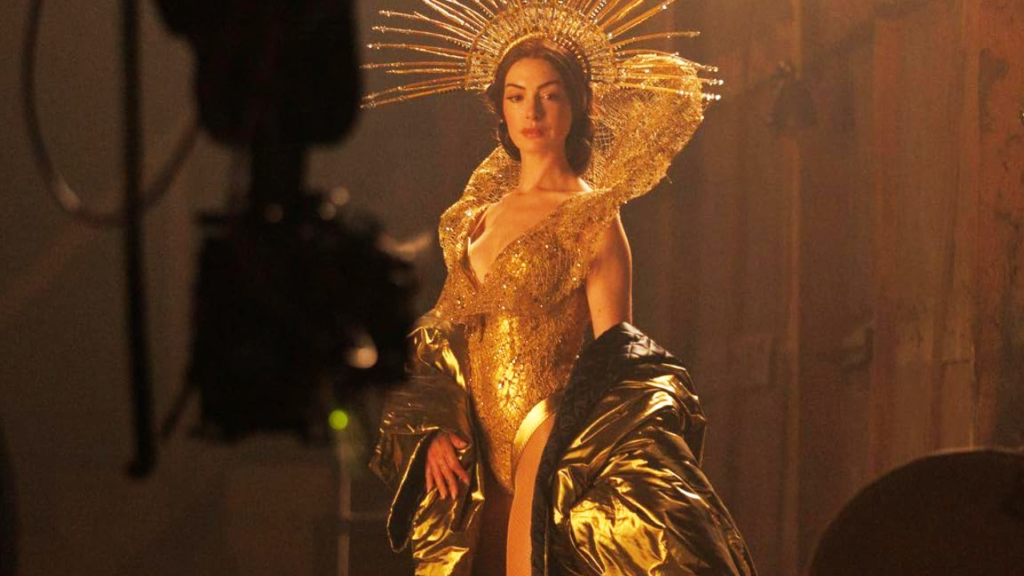
Where the film finds its strongest critical support is in its performances and craft. Hathaway’s portrayal of a pop star unraveling under the weight of her own persona has been widely praised, with The Hollywood Reporter describing her as “a commanding avatar for music superstars.” At the same time, Coel’s performance provides a grounded counterbalance, anchoring the film’s more abstract tendencies in emotional tension and confrontation. Together, the two create what IndieWire calls “a hypnotic two-hander,” a dynamic that sustains the film even as its narrative begins to drift. Supporting this is a strong aesthetic framework — from Bina Daigeler’s elaborate costumes to the music contributions of Jack Antonoff, Charli XCX, and FKA Twigs — all of which lend the film a sense of authenticity within its stylized world.
At its core, Mother Mary is driven by an idea that many critics have found compelling, even when they question its execution. As one review notes, the film is ultimately about “how art can take something terrible and turn it into something beautiful” . This thematic thread runs throughout the film, shaping its exploration of fame as both a creative force and a destructive one. The relationship between the two central characters becomes a metaphor for artistic collaboration itself — a space where intimacy, exploitation, admiration, and resentment coexist in uneasy balance.
However, it is precisely in its execution of these ideas that the film begins to divide critics. While some admire its ambition, others argue that it sacrifices coherence for atmosphere. The Hollywood Reporter is particularly direct in its critique, describing the film as “all style, no substance” , a sentiment that reflects a broader concern about its emotional accessibility. Similarly, Variety notes that the film “becomes almost completely incoherent” as it leans further into abstraction, suggesting that its narrative structure ultimately collapses under the weight of its own symbolism.
This shift toward the surreal is one of the film’s most debated elements. What begins as a dialogue-driven character study gradually evolves into something closer to a metaphysical experience, incorporating imagery and motifs that challenge conventional interpretation. The Wrap encapsulates this transformation with the observation that the film turns into “a ghost story about a great, big, red blob of something” — a line that has come to define much of the critical conversation around its abstract imagery. For some critics, this is where the film becomes most interesting; for others, it marks the point at which it loses its emotional grounding entirely.
Additional responses from publications like SlashFilm and IGN reinforce this divide, with critics noting that the film often prioritizes mood and visual identity over narrative clarity. Descriptions of the film as “ambitious but uneven” from Collider further highlight the tension between its artistic aspirations and its storytelling limitations. These reactions collectively point to a film that is deeply committed to its vision, but not always successful in translating that vision into a cohesive experience.
What ultimately emerges from these varied responses is a film that exists in a state of deliberate tension — between accessibility and abstraction, performance and identity, admiration and alienation. As one critic insightfully suggests, Mother Mary “lives on that edge… between brilliance and pretentiousness,” a characterization that feels central to understanding its reception. It is a film that invites interpretation but resists clarity, asking audiences to engage with it on an emotional and symbolic level rather than a purely narrative one.
In the end, Mother Mary stands as a bold, uncompromising piece of cinema that is unlikely to inspire unanimous agreement. It is a film that demands engagement, patience, and a willingness to embrace ambiguity — qualities that will resonate deeply with some viewers while leaving others disconnected. Whether seen as a hypnotic work of art or an indulgent misfire, it is undeniably a film that sparks conversation.
Cast: Anne Hathaway, Michaela Coel, Hunter Schafer, FKA Twigs
Director: David Lowery
Genre: Psychological drama, musical, surreal cinema
Release: April 2026
Read More Review Roundups on POF