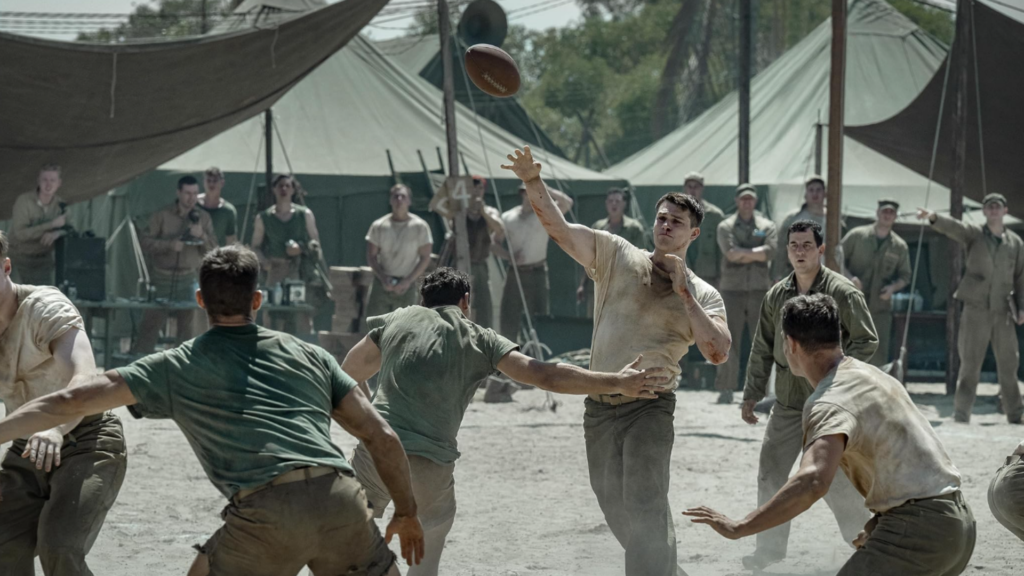
Peter Berg’s The Mosquito Bowl brings together college football and the brutal realities of World War II, following four promising players who abandon their sporting futures to enlist in the US Marines after the attack on Pearl Harbor. Starring Nicholas Galitzine, Bill Skarsgård, Ray Nicholson and Tom Francis, the drama is based on Buzz Bissinger’s nonfiction book about a real football game played by Marines on Guadalcanal on Christmas Eve 1944.
The film has drawn contrasting reactions from critics. While some praise Berg’s intense depiction of combat and the human cost of war, others argue that its graphic violence overshadows its characters and leaves its central football metaphor underdeveloped. The critical divide centres on whether the film’s visceral approach strengthens its anti-war message or prevents it from exploring the men’s experiences with sufficient depth.
The story follows four college football players whose lives change after they enlist in the Marines. Their sporting backgrounds and shared experiences establish the film’s central comparison between the discipline of football and the realities of military service. However, whether this connection gives the story sufficient emotional weight has become one of the main points of disagreement among critics.
Variety’s Guy Lodge delivers one of the film’s sharpest critiques, describing it as an “emptily macho” war epic. He argues that the four central characters lack distinct personalities, making it difficult for viewers to distinguish them or become invested in their individual journeys. Although the film repeatedly draws parallels between football and military service, Lodge finds that much of the dialogue feels simplistic rather than insightful. He also questions the significance assigned to the titular game, arguing that despite the buildup, it has less impact than the surrounding battle sequences.
The Hollywood Reporter’s Angie Han similarly finds that the film’s technical achievements cannot compensate for its storytelling weaknesses. She acknowledges the scale and authenticity of the combat sequences but argues that the emotional moments connecting them are insufficiently developed. IndieWire’s David Ehrlich also questions the film’s originality, contending that its familiar war-movie techniques and limited character development prevent it from offering a distinctive examination of the historical events behind the story.
Criticism also extends to the film’s treatment of violence and patriotism. Lodge questions its portrayal of Japanese soldiers and argues that the film does not adequately examine the attitudes expressed by its American protagonists. These concerns complicate its intended anti-war message, suggesting that depicting the horrors of combat is not necessarily enough to explore war’s moral consequences. The relentless violence, while central to the film’s intensity, also leaves limited room for quieter moments that might reveal more about the men beyond their roles as soldiers and athletes.
Deadline’s Pete Hammond offers a considerably more positive assessment, describing The Mosquito Bowl as a powerful and ultimately poignant portrait of four young football stars whose lives are transformed by war. He praises Berg for finding emotional weight in a story that moves from the glory of the football field to the devastation of the battlefield. In Hammond’s view, the violence serves a larger purpose by reminding audiences of the human price of conflict, while the football game provides a brief connection to the lives and ambitions the men left behind.
This interpretation contrasts with Lodge’s assessment of the titular match as an underwhelming centrepiece. Where Hammond sees a meaningful reminder of what the men stand to lose, Lodge believes the game struggles to carry the significance the film places on it. The difference reflects the broader critical divide over whether the connection between football and war successfully deepens the story or remains an idea that the film never fully develops.
The reviews ultimately present The Mosquito Bowl as a technically forceful but divisive World War II drama. Berg’s combat sequences are central to both sides of the response. Supporters view them as an effective expression of war’s devastating human cost, while detractors argue that the emphasis on spectacle comes at the expense of character development and deeper reflection.
Deadline’s Hammond finds a moving anti-war story, but Lodge, Han and Ehrlich are less convinced that the film’s ambition translates into emotional depth. Ultimately, The Mosquito Bowl appears strongest in its visceral depiction of combat, while its portrayal of the men behind the uniforms remains the principal point of contention. Whether viewers consider it a powerful anti-war drama or a familiar war epic may depend on how much weight they give its immersive battle scenes compared with the emotional development of its central characters.
Watch Trailer
Film Details: The Mosquito Bowl
- Director: Peter Berg
- Writers: Peter Berg, Mark L. Smith
- Based on: The Mosquito Bowl: A Game of Life and Death in World War II by Buzz Bissinger
- Cast: Nicholas Galitzine, Bill Skarsgård, Ray Nicholson, Tom Francis
- Genre: War, historical drama, sports
- Rating: R
- Runtime: Approximately 126 minutes
- Production Companies: Film 44, Imagine Entertainment
- Distributor: Netflix
- Release Dates: October 30, 2026, in theatres; November 25, 2026, on Netflix