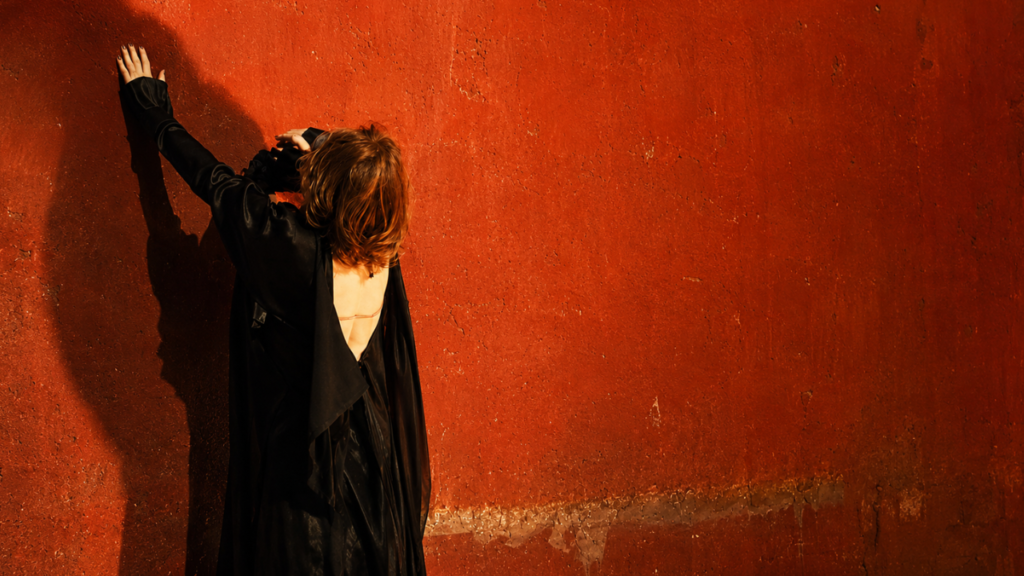
Albert Serra’s Sixteen Moments of My Life had its world premiere out of competition at the 79th Locarno Film Festival, bringing the Spanish filmmaker together with screen legend and singer Ingrid Caven for a film built around a single, unrepeatable live performance. Shot at the Théâtre des Bouffes du Nord in Paris, the film documents Caven performing alongside the Molforts, the Catalan musicians who regularly contribute to the soundtracks of Serra’s films.
Despite its subject, Serra has resisted describing Sixteen Moments of My Life as a conventional concert film. Rather than cutting between the stage and audience reactions, the filmmaker keeps his camera entirely focused on Caven and the musicians. There are no shots of spectators watching the performance, allowing the film to remain immersed in the act of performing itself.
Speaking about his approach, Serra explained that he would not want to film a concert unless he was directly involved with the music. His decision to avoid audience cutaways reflects that philosophy: the musicians and their performance are the film’s central subject, rather than the event surrounding them.
The film opens with Caven coughing before taking the stage, immediately establishing the physical and unpredictable nature of a live performance. For Serra, that moment captures something fundamental about what happens when an artist performs in front of an audience: every performance exists only once, and once it has passed, it cannot be recovered.
That idea also explains why Serra sees cinema as a natural medium for capturing live performance. Both, in his view, are built around moments that disappear as they occur. A frame can preserve what has happened, but the actual experience of that moment remains irretrievable. Sixteen Moments of My Life consequently becomes less a conventional record of a concert and more an attempt to preserve the fleeting nature of performance through cinema.
Caven, born Ingrid Schmidt in Saarbrücken, Germany, in 1938, has a long history in European cinema as both an actress and singer. She is particularly associated with German filmmaker Rainer Werner Fassbinder, her former husband, appearing in several of his films, including Love Is Colder Than Death and The American Soldier. Their professional collaboration continued after their divorce in 1972 until Fassbinder’s death in 1982.
Caven’s later screen appearances include Claire Denis’ 35 Shots of Rum and Luca Guadagnino’s 2018 remake of Suspiria. Her performance in Serra’s new film combines autobiography with a musical style that moves between opera and cabaret, while also drawing from the influence of French singer Edith Piaf.
The performance also brings Caven together with the Molforts, Catalan musicians who have regularly worked with Serra on the music for his projects. Serra has been a close friend of Caven for more than 15 years, adding another personal dimension to a film that is built around the immediacy of a single performance.
Sixteen Moments of My Life represents a notable departure within Serra’s filmography, which has largely been associated with austere, historically oriented dramas and unconventional approaches to narrative cinema. Born in Banyoles, Spain, in 1975, Serra holds a PhD in Literary Theory and Comparative Literature from the Universitat de Barcelona. He made his feature directing debut with Honour of the Knights in 2006, which premiered at Cannes Directors’ Fortnight.
His subsequent films have earned major recognition at international festivals. Story of My Death won the Golden Leopard at Locarno in 2013, while The Death of Louis XIV received the Prix Jean Vigo. Liberté won the Special Jury Prize in Cannes’ Un Certain Regard, and Pacifiction earned the Louis Delluc Prize as well as two César Awards.
Serra also revealed during the Locarno festival that his next project could move even further away from the style associated with much of his previous work. The filmmaker is developing what he described as a “Brigadoon-style musical comedy,” suggesting another significant change of register in his filmmaking.
With Sixteen Moments of My Life, Serra has taken a single live performance and built an entire film around its fleeting quality. By keeping the camera away from the audience and concentrating exclusively on Caven and the musicians, he treats the performance not simply as an event to be recorded but as something whose disappearance is part of its meaning.
Read More: