Uta Beria’s Tear Gas, a fiction film shot inside real anti-government protests in Georgia, is set to have its world premiere on August 12 in the Filmmakers of the Present competition at the 79th Locarno Film Festival. The film arrives at the festival amid a dispute between its production and the Georgian National Film Center (GNFC) over funding and permission to publicly screen the film.
Written and directed by Beria, whose feature debut Negative Numbers was released in 2019, Tear Gas follows 16-year-old Elene and her war-scarred family as they become caught up in a mass protest in Tbilisi. As the demonstration transforms the city’s streets into a battleground, the unrest also exposes tensions within Elene’s family. Alongside the political upheaval, the film follows Elene’s relationship with Andro, a young man she meets amid the thousands of protesters. Their relationship develops as the demonstrations become increasingly violent and are eventually dispersed with rubber bullets and tear gas.
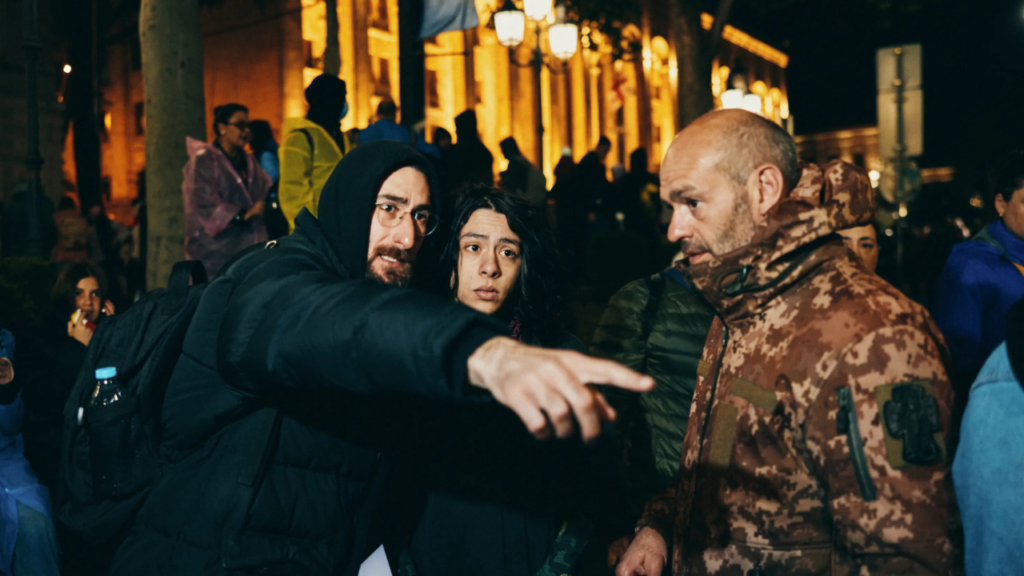
What distinguishes Tear Gas from a conventional political drama is the way it was made. Although the film is scripted fiction, much of it was shot inside genuine, ongoing protests in Tbilisi, combining staged dramatic scenes with footage captured during real demonstrations. Beria said the production spent 35 days filming inside real protests, while also incorporating footage he personally shot during demonstrations in Georgia in 2019.
For Beria, the experience of filming amid protests was closely connected to the film’s central idea. Speaking about the meaning of tear gas, the director said the weapon is intended to disperse protesters and restrict them, but that once the air clears, people instinctively return to what they consider most important. He has also described filmmaking as carrying a sense of responsibility, arguing that cinema can encourage new ways of thinking and potentially contribute to change.
The film’s path to Locarno has been complicated by a funding dispute with the Georgian National Film Center. Tear Gas received a production contract from the GNFC in December 2022. According to Beria, the production completed its first-stage accounting and audit on schedule, but the second stage of financing was not paid despite three requests made over an 18-month period. He says the production ultimately reduced its budget and raised additional funds independently in order to complete the film.
The dispute intensified after the GNFC learned that Tear Gas had been selected for Locarno. Beria says the production received a letter from the organisation refusing consent for a public screening and citing a financial sanction equivalent to 10% of the value of the contract. These claims are based on Beria’s account of the dispute.
Locarno has said the film’s premiere will proceed. Olly Osborne, the festival’s chief communications officer, said the festival’s agreement with filmmakers requires them to confirm that they hold the necessary rights to their films, and that Tear Gas‘s producers had signed that agreement. According to Locarno, any financial or contractual dispute between the production and its funders falls outside the festival’s involvement.
The controversy surrounding the film comes against the backdrop of sustained political unrest in Georgia. The demonstrations depicted in Tear Gas reflect a period in which mass protests against the ruling government and controversial legislation repeatedly brought large crowds onto the streets of Tbilisi. The protests have at times been met with tear gas, water cannons and other forms of forceful dispersal.
The subject also continues an interest in authority and human rights that has been present throughout Beria’s work. Born in Rustavi, Georgia, in 1987, the filmmaker studied film and television directing at Shota Rustaveli Theatre and Film Georgia State University. His 2019 debut feature, Negative Numbers, explored authority and rehabilitation inside a juvenile detention centre. The film won the EU’s Human Rights in Cinema award and later received Best Film and Best Director honours at Not Film Fest in 2021.
Tear Gas is produced by Nino Chichua and Anna Khazaradze through Tbilisi-based 1991 Productions, alongside France’s Tripode Productions and Germany’s 70 Steps. Indie Sales is handling international sales, while Tandem is distributing the film in France. During its development, the project won both the inaugural HBF Empowerment Award and the Outward Gaze Prize at the IFFR Pro Awards.
The film stars Taisia Eradze, Mzia Arabuli, Gaga Shishinashvili, Kato Kalatozishvili and Boris Andronikashvili and has a runtime of 96 minutes.
With its unusual production process, personal connection to the protests it depicts and ongoing dispute with a government-linked funding institution, Tear Gas arrives at Locarno with a story extending beyond the screen. Its August 12 premiere will place Beria’s film before an international audience while also bringing attention to the circumstances surrounding its production and the continuing debate over the relationship between cinema, political expression and institutional support.
Read More: