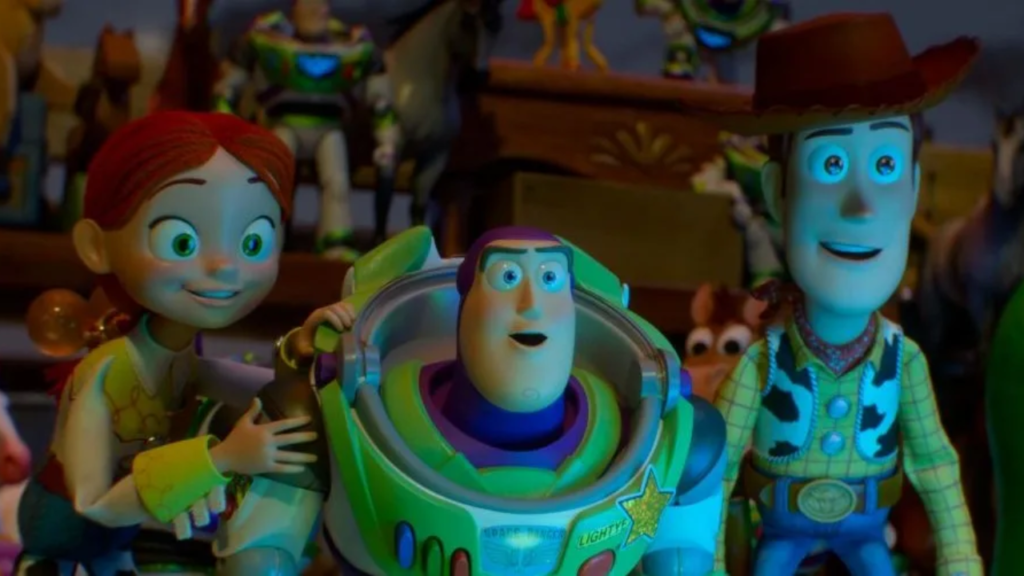
Toy Story 5 reviews are overwhelmingly positive, with the latest Pixar sequel earning a 93% score on Rotten Tomatoes from 114 reviews. More importantly, critics largely agree on something many fans considered impossible just a few years ago: Pixar has found a meaningful reason to continue a franchise that already seemed to have reached its perfect ending.
Ever since Toy Story 4 gave Woody an emotional farewell and appeared to close the book on one of animation’s most beloved sagas, the announcement of another sequel was met with skepticism. Did Pixar really have another story to tell? According to most critics, the answer is yes. While reviewers stop short of calling Toy Story 5 the best entry in the franchise, many describe it as a funny, emotionally resonant, and surprisingly relevant continuation that updates the series for a generation growing up in a digital world.
The film takes place in a world where Bonnie’s toys face a challenge unlike any they have encountered before. Instead of competing with school, hobbies, or simply growing older, they are competing with technology itself. Bonnie becomes increasingly attached to Lilypad, an AI-powered tablet designed to entertain, educate, and accompany children throughout their daily lives. As the toys struggle to understand their place in this new reality, Jessie emerges as the leader of Bonnie’s collection while Woody and Buzz return to help navigate the crisis. The conflict is no longer about being forgotten. It is about remaining relevant in a world where childhood itself is changing. Through that premise, the film explores questions about imagination, friendship, technology, and what children need most as they grow.
The biggest surprise for many critics is how effectively Pixar justifies the film’s existence. Rather than revisiting familiar territory, Toy Story 5 introduces a challenge previous installments never had to confront. Several reviewers argue that this is the first Toy Story film that feels truly rooted in the modern era. Earlier films dealt with abandonment, growing up, and finding purpose. This time, Pixar asks what happens when toys are no longer competing against time but against screens. Critics repeatedly praise the filmmakers for finding a contemporary issue that feels organic to the franchise rather than forced onto it.
That fresh perspective has led many reviewers to reconsider their initial skepticism. One critic compared the franchise to The Beatles’ legendary discography, arguing that if the original Toy Story is “Meet the Beatles” and Toy Story 3 is “Sgt. Pepper,” then Toy Story 5 feels like “Abbey Road”—not necessarily the defining masterpiece, but a mature and deeply rewarding chapter in a remarkable creative journey.
Much of the praise centers on Jessie, who finally steps into the spotlight after years as one of the franchise’s most beloved supporting characters. Critics repeatedly describe Toy Story 5 as Jessie’s film. With Woody no longer serving as the central protagonist, Jessie becomes the emotional anchor of the story, carrying much of the narrative’s weight as she confronts questions of leadership, purpose, and change. Joan Cusack’s performance has earned some of the strongest reviews of the entire cast, with several critics arguing that Jessie receives her most substantial storyline since Toy Story 2. Many reviewers even compare the emotional depth of her arc to the closure Woody received in Toy Story 4.
The film’s treatment of technology has become one of the most discussed aspects of the critical response. What reviewers seem to appreciate most is that Pixar avoids taking the easy route. Toy Story 5 does not present technology as the villain. Lilypad is not an evil machine determined to replace traditional toys. Instead, the film explores how technology can both help and hinder meaningful human interaction. Critics repeatedly note that the story acknowledges the benefits of digital tools while also questioning whether endless screen time can replace imagination, creativity, and real-world connection. Several reviewers describe the film as a thoughtful conversation starter rather than a lecture.
Many critics also believe the film resonates because it speaks to adults as much as children. One of the most insightful observations across reviews is that Toy Story 5 captures the anxiety of older generations looking at younger generations and wondering whether they are losing touch with the world around them. The toys’ fear of becoming obsolete mirrors concerns shared by parents, teachers, and adults trying to understand how childhood is evolving. In that sense, the film’s themes extend well beyond Bonnie and her toys.
Another recurring point in reviews is the increased importance of the human characters. Several critics argue that Toy Story 5 gives equal emotional weight to Bonnie’s journey and the toys’ struggles, something the franchise has rarely attempted before. By focusing more directly on how children interact with technology and imagination, the film expands the emotional scope of the series without abandoning the perspective that made audiences fall in love with it.
Despite tackling larger ideas, Pixar has not forgotten how to entertain. Critics consistently describe Toy Story 5 as one of the funniest entries in the franchise. Conan O’Brien’s new character, Smarty Pants, is emerging as the clear breakout favorite, with multiple reviews singling him out as a scene-stealer. The film reportedly leans more heavily into comedy than some previous installments, and several critics praised its willingness to embrace absurd humor while maintaining the emotional sincerity audiences expect from Pixar.
The emotional impact has also earned strong reactions. While many reviewers acknowledge that the film does not quite reach the devastating heights of Andy’s farewell in Toy Story 3 or Jessie’s iconic “When She Loved Me” sequence from Toy Story 2, several critics admitted that the final act left them in tears. Jessie’s personal journey, in particular, appears to be responsible for many of the film’s most powerful moments. Some reviewers even argue that a handful of scenes come surprisingly close to matching the emotional intensity of the franchise’s most celebrated sequences.
Visually, critics believe Pixar remains at the top of its game. Reviews praise the animation as stunning, but many also point to a subtle creative shift. Unlike the photorealistic approach that defined much of Toy Story 4, the new film reportedly embraces a more playful visual style, particularly during sequences inspired by children’s imagination. Several critics highlight how the film balances technical sophistication with a handmade, childlike quality that reinforces its central themes about creativity and play. The result, according to reviewers, is some of Pixar’s most expressive animation in years.
The film’s music has also drawn attention. Alongside Thomas Newman’s score, critics have highlighted Taylor Swift’s original song, “I Knew It, I Knew You,” which accompanies Jessie’s storyline and emotional resolution. Several reviewers describe the song as a fitting extension of Jessie’s history within the franchise and praise how it reinforces the film’s themes of memory, friendship, and recognition.
Not every critic was completely convinced. The most common criticism concerns the screenplay’s structure. While reviewers generally admire the film’s ideas, several argue that it occasionally struggles under the weight of multiple storylines. Some critics describe the first act as cluttered, while others feel the narrative becomes slightly scattershot as it juggles numerous character arcs. Even many positive reviews acknowledge that the storytelling is less focused than the franchise’s finest entries.
The question of franchise fatigue also remains part of the conversation. A handful of critics argue that the series is beginning to show signs of creative exhaustion and suggest that Toy Story 5 lacks the groundbreaking quality that made earlier installments cultural landmarks. Yet even among reviewers who question the need for another sequel, many still praise the film’s charm, humor, and emotional sincerity. The consensus is not that Toy Story 5 should not exist. Rather, it is that Pixar has worked much harder than expected to prove that it deserves to.
The most remarkable achievement of Toy Story 5 may be that it transforms its biggest weakness into its greatest strength. The film begins with a question many audiences have been asking since its announcement: why does this sequel exist? According to critics, Pixar answers that question by updating the franchise’s themes for a generation growing up with smartphones, tablets, and AI while finally giving Jessie the spotlight she has long deserved. It may not surpass the emotional heights of the series’ greatest installments, but most reviewers agree that it successfully reminds audiences why these toys still matter.
Film Details
Rotten Tomatoes Score: 93% (114 Reviews)
Rating: PG
Runtime: 1h 42m
Genre: Animation, Adventure, Comedy, Family
Director: Andrew Stanton
Writers: Andrew Stanton, Kenna Harris
Cast: Tom Hanks, Tim Allen, Joan Cusack, Tony Hale, Conan O’Brien, Greta Lee
Release Date: June 19, 2026
Production: Pixar Animation Studios, Walt Disney Pictures
Read More Review Roundups on POF